


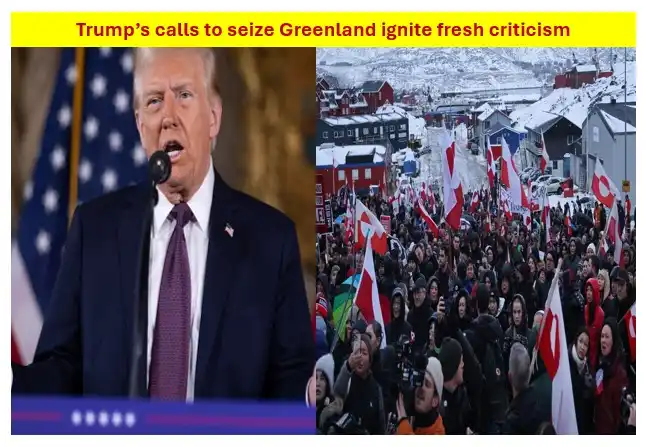
In a development that has roiled the corridors of Congress and reverberated across the Atlantic, President Donald Trump’s aggressive new campaign to buy Greenland has created its first major public split within the Republican Party. What started as a casual real-estate speculation experiment during his first term has become, at the outset of 2026, a high-stakes geopolitical showdown featuring overt military posturing, sanctions sold as tariffs and some serious questioning of the NATO alliance.
The current crisis boiled over this weekend after President Trump took to social media to declare that he will impose a 10 per cent tariff on goods from Denmark, along with seven other European countries including the UK, France and Germany commencing February 1.
A “Weapons-Grade” Disagreement
President Trump may still have high approval among his base, but the idea of strong-arming a NATO partner into capitulating territory seems to have been a bridge too far for numerous establishment Republicans. The reaction has been unusually frank, with even some of President Donald Trump’s most loyal allies saying they can’t believe the administration’s harsh tactics.
Senator John Kennedy, Republican of Louisiana and known for his colorful language, did not mince words in a recent interview. Invading or taking the sovereignty of a NATO ally by force was “weapons-grade stupid,” he said, and such an action would stand as one of history’s largest mistakes. Echoing this was Senator Thom Tillis (R-NC), who took to the Senate floor calling it “absurd” and “beyond stupid,” directly singling out White House officials driving a policy that disrupts decades of transatlantic trust.
He openly calls for invasion of an ally, that’s how we know he has no respect President Trump or America,” Mr. Duncan added in a second tweet.
The NATO Breaking Point
The GOP criticism is led by those worried about the existential threat this policy poses to NATO. In an unprecedented fact of alliance history, European members have staged a “token force” into Greenland, not to dissuade Russia or China but to be a human shield against possible American incursion.
Representative Michael McCaul, one of his party’s leading voices on foreign affairs, said any military foray into Greenland would “turn NATO on its very head.” He maintained that the U.S. already has full military access to the island whenever needed for national defense purposes, making a claim of total ownership unnecessary.
Economic Fallout and Bipartisan Resistance
The economic consequences of the recent tariff increases have also created distance from Republicans who have long valued free trade and fiscal responsibility. Senator Lisa Murkowski of Alaska, who had just returned from Copenhagen as part of a bipartisan delegation, said polling indicates that almost 75 percent of Americans are against the purchase. She called the tariffs “unnecessary, punitive and a mistake of profound proportion.”
In a rare display of bipartisanship, lawmakers from both parties are working on legislation that would prevent the use of Department of Defense funds for any occupation or attack within NATO territory. The point is to create a “legislative off-ramp” for the administration; that’s what Nebraska Congressman Don Bacon was telegraphing when he issued this stern warning: The GOP would not “tolerate” a military escalation over the Arctic island.
The Strategic “Golden Dome”
The White House defends it as stimuli for recession weary Denmark to sell it’s troubled Arctic territory: Greenland is critical to the “Golden Dome” anti-missile defense system and Denmark is ill-equipped to keep Russian or Chinese influence off the island. Former Speaker Newt Gingrich defended the President’s stance, framing it as a “negotiation” for mineral and national security rights.
But for many in the GOP, the price of that bargain —the possible destruction of Western security architecture — is simply too steep. With hundreds of protests erupting the streets in Nuuk and Copenhagen, the Republican party is being forced to make a choice: standing by a President dedicated to expanding America’s borders or preserving the sovereignty of the US’ oldest allies.
