


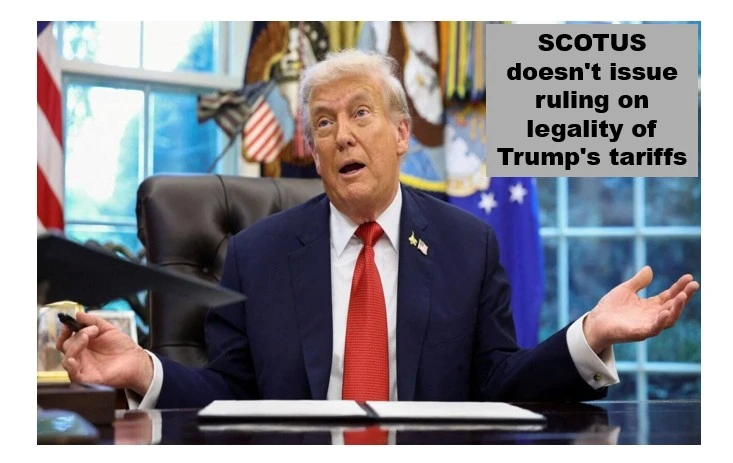
The U.S. Supreme Court heard not a peep on one of the most important economic questions in the decade this week. The justices had generated high expectations about a potential landmark decision, but instead issued four opinions on Wednesday and declined to rule on the legality of President Donald Trump’s broad, global tariff regime.
It’s the second time in a week that the nation’s high court has passed on considering whether President Donald Trump pushed beyond his constitutional powers. For Mumbaikars, global investors and thousands of businesses on Main Street America, the silence from Washington means that the “Great Trade Limbo” continues — leaving billions of dollars in overseas trade and diplomatic relations hanging.
The Legal Tightrope: Can a President Tax the World?
The International Emergency Economic Powers Act (IEEPA) In the case of Learning Resources, Inc. v. Trump (also V.O.S. Selections, Inc. v. Trump), all of these issues revolve around a single law: the 1977 International Emergency Economic Powers Act (IEEPA).
President Trump used this law in the year 2025, shortly after he was reinstated to the Oval Office, to announce that chronic trade deficits and the smuggling of illegal drugs like fentanyl constituted a “national emergency.” Under this declaration, his administration levied tariffs ranging from 10 percent to 50 percent on virtually all foreign trading partners, with China, India, Canada and Mexico all hit hard in terms of exports.
Lower courts have already sided with the administration, deciding that while the IEEPA permits the President to control commerce during emergencies, it does not give him a “blanket license” to levy worldwide tariffs — power the U.S. Constitution reserves for Congress. Now it’s up to the Supreme Court to determine whether the President’s definition of an “emergency” can stand as a matter of law, or whether it represents an alarming shift in executive power.
“WE’RE SCREWED”: The President’s Warning
President Trump has not been exactly circumspect about his feelings about the impending verdict. Addressing the issue earlier in the week on social media, he said a ruling against his administration would be a “National Security disaster,” and ventured: “WE’RE SCREWED!”
It’s not about the details of trade policy; it’s that we’re on the verge of a huge financial “complete mess.” If the court invalidates the tariffs, the U.S. Treasury could be forced to repay billions of dollars in duties that have already been collected. Trump says this money would end up in the pockets of foreign exporters, not American consumers, and be a windfall for foreigners who have competed against U.S. industries.
In terms of the overarching deficit, Treasury Secretary Scott Bessent has attempted to portray a more serene front on the issue by saying that while they have money in treasury to cover refunds, he doubts companies would actually return that savings to you at your corner store.
U.S. President warns of 25% tariff on countries doing business with Iran
Global Impact: From India’s Jewels to America’s Shrimp
Nowhere is the delay felt more acutely than in export-driven economies. The stakes could not be higher for India. Indian exports have been burdened by a 25% surcharge, reaching up to 50% in some sectors since last August.
- The Diamond Trade: Mumbai’s jewelry and diamond exporters struggle as demand has plummeted with the costs of doing business in the U.S. soaring.
- The Seafood Industry: The case of India’s and Vietnam’s shrimp exporters is an example in point. Should the court declare the tariffs illegal, more than half a billion dollars being held in U.S. Treasury coffers could be sent back to these non-U.S. companies.
For the American consumer, living in the “Tariff Limbo” means higher prices on imported goods are still baked into the economic pie. Retailers such as Costco and a slate of tech manufacturers are under “provisional” pricing, avoiding long-term supply chain shifts until the court shoots out the final word.
Trump expands travel ban, adding five more countries and imposing new limits on others
What Comes Next for the Supreme Court?
The court did not rule today, but the clock is ticking. The Supreme Court usually ends its current session by late June, and most legal experts predict a decision long before then.
The silence from the justices indicates a profoundly internal debate. At oral arguments in November, conservative and liberal justices raised doubts about the expansive use of emergency powers by the administration. But the court’s conservative majority has also been reluctant historically to undercut a President when it comes to national security matters.
Trump says US military considering ‘very strong options’ for Iran
