


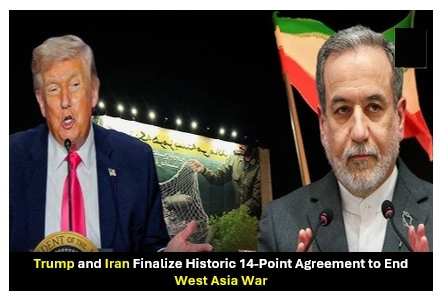
President Trump and Iranian President Masoud Pezeshkian have signed a historic 14-point interim peace accord, with immediate repercussions felt across the global commodity markets and changing the geopolitical course of the Middle East. The memorandum of understanding (MoU) agreed on Wednesday, June 17, 2026, provides an immediate mechanism to end the devastating conflict in West Asia, reopen the vital Strait of Hormuz and try to prevent the “worldwide economic depression” President Trump threatened.
The signing was done through a dual process signing remotely. The document, which was signed at the G7 meeting in Evian, was delivered in a physical form at the meeting of the two Presidents at the Palace of Versailles. At the same time, President Pezeshkian completed the Tehran accord, and Iranian state TV announced that the agreement had been completely implemented at the highest executive level without the need for a face-to-face meeting.
The deal is to end a multi-front war with a high stakes confrontation that started earlier this year on Feb. 28 when the U.S. and Israel entered into a direct conflict with Iran and its regional network of allies.
The Strategic Balance: Concessions and Frameworks
The 14-paragraph interim agreement imposes a tough 60-day negotiating deadline for a comprehensive, permanent peace treaty. This first step was made possible through significant tactical compromises by both sides, resulting in a lot of heated debate at home between Washington and Tehran.
President Trump has signed the document that halted a conflict that left 13 U.S. service members dead and greatly depleted the U.S. conventional ammunition inventory. But intense attention has been focused on the fact that the economic relief has been front-loaded and will allow Iran to immediately reopen key trade routes to ease its domestic economic problems, prompting questions from international observers.
Read also:
- Pakistan’s Spy Satellite Network Monitoring India Expands Rapidly
- Pakistan launches an attack on Afghanistan
Core Provisions of the 14-Point Deal
The leaked copy of the memorandum provides a quick de-escalation process to keep the international energy supply chain stable, and to temporarily freeze Iran’s nuclear program.
- Immediate Nuclear Down-Blending: Iran has explicitly confirmed that it “shall not procure or develop nuclear weapons,” known as immediate nuclear down-blending. To support this commitment Tehran has agreed to discuss the down-blending of its current 440-kilogram stockpile of highly enriched uranium (up to 60% purity), which could easily be rapidly turned into weapons grade. This will be done on-site, under the direct supervision of the International Atomic Energy Agency (IAEA).
- Sanctions Waivers and Blockade Lift: In return, the United States is seeking to lift its tough naval blockade of Iranian ports. Washington will grant broad waivers for Iranian oil, so commercial ships can travel without hindrance and for Iranian oil buyers to gain access to international banking and insurance systems.
- The Strait of Hormuz Reopens: The critical and important maritime strait, through which about one-fifth of the world’s petroleum exports pass, will reopen to commercial traffic. The agreement provides for safe and toll-free passage in the strait for the first 60-day negotiating period. But already, Iranian Parliament Speaker Mohammad Bagher Ghalibaf has indicated that Iran will impose transit fees after the 60-day interim period.
- International Reconstruction Fund: The plan provides for the establishment of a long-term, $300 billion reconstruction and development fund, to be financed by regional countries after the final pact is put in place. White House officials clarified that the U.S. doesn’t have to pay for this particular fund.
The paper examines the delicate geopolitics of Lebanon and Israel
The participation of the Lebanese front is one of the most complicated elements that makes up the MoU. Iran was able to manage the truce and ensure it extended to Lebanon, to ensure the safety of its key regional ally, Hezbollah. The group had joined the battle on March 2nd, launching voluminous salvoes of rockets at Israel in solidarity with Tehran. Soon after the signing Hezbollah’s leader Naim Qassem declared it a “great victory.
But this particular clause brings some ground-friction. The agreement is written to state the “territorial integrity” of Lebanon amid the current military actions.
Because Israeli Prime Minister Benjamin Netanyahu was not a direct signatory to this specific U.S.-Iran memorandum, enforcing a uniform ceasefire remains incredibly difficult. Even as the deal took “immediate effect,” Israel continued to carry out limited strikes in southern Lebanon. Tehran has warned that if Israel maintains troops or continues attacks inside Lebanese territory, it will be considered a direct violation of the Washington-Tehran agreement.
Market Reactions and Domestic Political Fallout
Global financial markets reacted immediately to the news of the Versailles signing. Brent crude futures fell 1.12% to $78.66 a barrel, while U.S. West Texas Intermediate (WTI) dropped 1.28% to $75.81, reflecting market relief that crude oil supplies would soon flow unhindered through the Persian Gulf. Conversely, spot gold prices jumped 1.4% to $4,316.42 per ounce as investors unwound short positions. In Asia, stock markets surged to historic highs, with Tokyo’s Nikkei 225 breaking past the 71,000 mark for the first time, gaining 1.88% to close at 71,219.45.
