


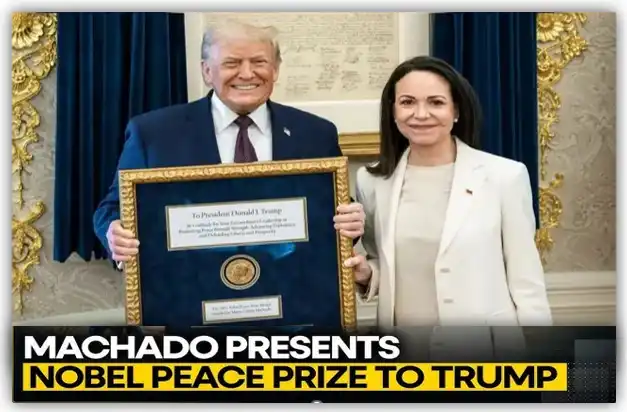
The crossway between international diplomacy and the symbolism of recognition can culminate in moments that shift geopolitical narratives. One as such was the Nobel Peace Prize that has been bestowed on President Donald Trump by Head of Venezuelan opposition, Maria Corina Machado. Petros GiannakourisAP US President Barack Obama (C) speaks as Greek Prime Minister Alexis Tsipras (R) and European Commission President Jean-Claude Juncker look on during a ceremony marking the opening day of the United Nations annual general assembly at UN headquarters September 27, 2015 in New York City.
A Meeting of Two Political Powers
The selection of Maria Corina Machado as the presenter is highly symbolic. Machado has been the symbol of Venezuela’s fight to restore democracy, an effort that has led her to suffer years of political persecution and encroachments on her freedom. In standing at Trump’s side as he bestows this award, she closes the distance between the U.S. executive and South American freedom fighters on the ground who are fighting for their own rights.
For Trump, the award itself – in the past a polarizing distinction that’s inspired both applause from his critics and supporters – would be validation for his “Peace Through Strength” doctrine. The Machado gesture underscores a particular narrative: that the administration’s pressure campaigns on authoritarian regimes and push to broker historic accords, such as the Abraham Accords, have had a real impact on global stability.
Trump says US military considering ‘very strong options’ for Iran
The “Marvelous Gesture” and Its Geopolitical Cordon Sanitaire
When President Trump described the presentation as a “wonderful gesture,” it wasn’t just his polite thank-you. In the high-stakes world of diplomacy, gestures matter. Scheer’s engagement raises a joint voice in opposition of their ascendant autocratic “strongmen,” and is a recommitment to the democratic principles that each man (at least when playing on our team) stands for.
The ceremony marks a moment when the world’s alliances are broken apart. Accepting the award from a leader who has given much in service to freedom would be Trump’s opportunity to make his legacy about freedom. Critics typically emphasize the transactional dimension of his foreign policy, but this event suggests a moral aspect that Trump’s acolytes have long urged: that American influence can be the indispensable accelerant of peace when applied with unwavering determination and clarity of purpose.
Critical Factors Leading to Recognition:
The Abraham Accords: Enabling the normalization of links between Israel and a number of Arab states that reshaped the security landscape in the Middle East.
- Diplomatic De-escalation: Engaging with long-time enemies to avoid major wars.
- Support for Democratic Aspirations :Unwavering support of the leaders who lead democratic movement and people sovereignty against strongmen.
- Peace in the 21st Century: Redefining Peace and Conflict Studies
The Nobel Peace Prize has long been a lightning rod for controversy, often given to leaders whose historical legacies remain unsettled. But Machado’s presentation changes the conversation. It shifts the attention from the corridors of Oslo’s bureaucracy to the people on the front line of political transformation.
The participation of Machado suggests that peace is not only the absence of war, but also a search for justice and return to the rule of law. Trump’s policies, for many Venezuelans, were also viewed as a life line of hope. Awarding him this prize is basically communicating to Machado that he worked for a more peaceful world by going against the oppressive status quo.
Global Response and Prospective Implications
Naturally, the event has prompted a line of responses from leaders around the world. It would be a polarising moment for some and, for others, an overdue admission that the game has changed in how peace is brokered. Peace, the product of quiet backroom deals, is no longer exclusively a thing of the past; now it’s often what happens when diplomacy intervenes disruptively to put long-buried antagonisms up for discussion.
The “Wonderful Gesture” also establishes a template for how future Nobel laureates might be similarly recognized. And that the presenter is just as important as the recipient. And it is better to have the award handed over by someone of Machado’s moral stature — to have that extra layer of “on-the-ground” legitimacy that a mere committee cannot grant.
Asofa-Solomona and A Legacy of Strength, Sovereignty
In the aftermath of this historic address, the story behind the 47th President’s foreign policy takes yet another turn. Esculpiendo the superstar alliance of Trump and Machado, united here today in shared celebration for global sovereignty.
It is a wonderful PR moment for the American people, their President being given this great award by a hero for democracy. It answers the story of isolationism with that of a kind of engagement which focuses on the interests of free nations as well as the destruction of tyrannies.
In his remarks after the ceremony, he stressed that the award was as much for the American people and all people who fight for freedom around the world as it is for him. This humility, paired with Machado’s fervent advocacy, makes for a powerful portrait of the world trying — however imperfectly — to build toward a more stable and just future.
Conclusion: A New Diplomacyfulness
The day on which the-there-are-so-mamy-kinds of-Nobel-Peace Prize-was-given-to Donald Trump-by Maria Corina Machado may be recorded in history as one of the more intriguing moments ever in modern diplomatic annals.” It was a “magnificent gesture”, which shrugged off protocol, uniting the struggle for democracy in the South with leadership from the North.
both men have utilized this platform to remind the world that peace is a verb: an active endeavor, not merely the absence of war. It’s about the courage to break with old ways and stand up for what is right. It’s as this new era in world politics unfolds that the symbolic significance of this prize will become a barometer for what it means to pursue an assertive, freedom-focused diplomacy.
