


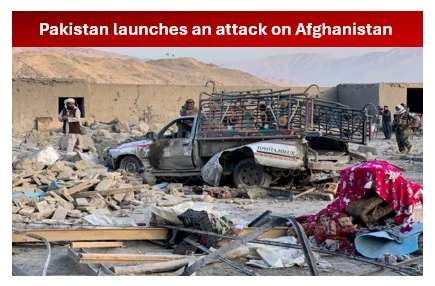
On June 10, 2026, new military tensions were reported to have broken out between Pakistani and Afghan military forces after Pakistan bombed multiple provinces in Afghanistan with fighter aircraft. The bombing took place in Khost, Kunar and Paktika provinces and is reported to have resulted in significant civilian casualties. Authorities in Afghanistan believe at least 13 people were killed, including 11 children; while 14 people were injured.
Pakistan Conducts Fresh Airstrikes Inside Afghanistan
This newest outbreak of military engagement represents continuing serious deterioration of an already strained military, political and social relationship between Pakistan and Afghanistan as they have experienced multiple incidents of cross border engagements over the last several months.
Rising Border Tensions
The relationship between Pakistan and Afghanistan has continued to decline rapidly due to disagreements regarding security and the fight against militancy. Pakistan has continually accused the Taliban government in Afghanistan of providing shelter to Tehrik-e-Taliban Pakistan (TTP) militants and allowing them to operate on Afghan territory and launch attacks inside Pakistan.
The Taliban government in Afghanistan has consistently denied these allegations and accuses Pakistan of violating Afghanistan’s sovereignty by conducting military operations and airstrikes inside Afghan borders. This dispute has resulted in several incidents of military confrontation resulting in a number of deaths and diplomatic tension between Islamabad and Kabul.
Also read: Pakistan’s Spy Satellite Network Monitoring India Expands Rapidly
Trigger for the Latest Attack
Reports indicate that the Indian Air Force airstrikes occurred one day after Pakistani Taliban attackers killed six Pakistani security personnel at a checkpoint in Pakistan’s Khyber Pakhtunkhwa province.
Militant safe havens on the other side of the Pakistan-Afghanistan border create a major concern for the Government of Pakistan and the Pakistani Government has pledged to further increase operations against those groups responsible for conducting attacks inside Pakistan. The Government of Afghanistan contends that the Government of Pakistan uses these claims of safe havens as justification for conducting military operations which have an often disproportionate impact on civilian populations.
Also read: Indonesian Foreign Minister Sugiono Arrives in New Delhi for Joint Commission Meeting
Increasing Numbers of Civilian Casualties has Generated Concern
Reported child fatalities have gained significant attention from public and government sources alike. Government of Afghanistan officials condemned the airstrikes and alleged that civilian areas were targeted rather than military targets.
Taliban officials condemned the action and stated the strikes violated both international law and the territorial integrity of Afghanistan. The Taliban called upon the international community to recognize the increasing instability along the Pakistan/Afghanistan border and the humanitarian impact of such military activity.
Human rights observers have consistently pointed out that cross-border military activity into populous areas pose a high risk to civilian casualty and displacement rates. The incident represents an additional factor heightening concerns about cross-border military activity into densely populated areas.
History of Recent Military Escalation
In 2026, there was an overall increase in army forces usage (escalation) worldwide lately, including recent military action taken by both Pakistan and Afghanistan attacking each other across borders this month. The government of Pakistan referred to the ongoing conflict between their two countries as an “open war,” which consists of airstrikes from Pakistani fighter jets onto cities within Afghanistan towards cities where research indicated that the Afghan Army may have attacked Pakistani Army positions.
Estimates suggest that both nations are inflicting heavy losses on one another
There have been several different attempts by various nations within the region to help mediate the conflict and reduce tensions, but no permanent resolution has been achieved to date. Continued instances of cross-border violence have also resulted in renewed claims from both sides regarding the presence of terrorists residing within their respective borders or having provided assistance to or supported those attempting to kill individuals within either country, which exacerbates the current situation.
In addition to being detrimental to long-standing political and commercial relationships between the Republics of Pakistan and Afghanistan, the continued build-up of military forces along their mutual boundary poses a threat to the security of the entire South Asian region, particularly at a time when South Asia is already facing significant geopolitical challenges. Continued military build-up and escalation on both sides could hinder or halt cross-border trade, increase population movements of individuals fleeing conflict, or undermine diplomatic initiatives to bring stability back to South Asia.
Prolonged hostilities between Pakistan and Afghanistan along the boundary area will likely impede peace and economic cohabitation to change South Asian geopolitics. If armed hostilities occur, the impact would have far-reaching ramifications throughout the international community.
Outlook
Currently, both countries are holding fast to their respective stances; Pakistan maintains that it is combating militant threats while Afghanistan views the air strikes as a violation of its sovereignty. Any civilian casualties are making tensions worse, and observers are concerned about the potential for escalation unless diplomatic channels are opened quickly.
The next few days will likely be critical in determining whether or not the two countries begin to engage in meaningful dialogue or continue along a military escalation path.
