


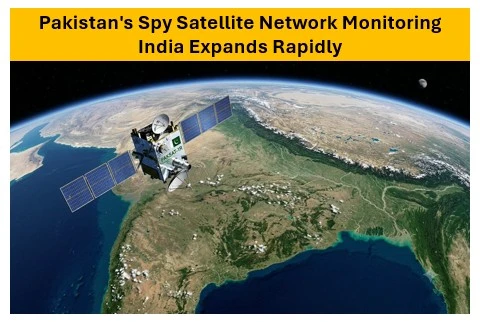
A subtle but significant shift in military intelligence is taking place, hundreds of kilometers overhead the Indian subcontinent. In an unprecedented span of just 16 months, the national space agency of Pakistan SUPARCO has successfully launched 6 advanced earth observation satellites to space.
The rapid expansion of Islamabad’s space architecture is a major leap from its historically slow-moving space program. The newly synchronized constellation of satellites, which was financed, built, and launched completely with the help of the Chinese State defense entities, has been carefully designed to enable India to monitor military operations, critical infrastructure, and deployments at all times at a high resolution.
Mechanics of a rapid space build up
Pakistan’s recent orbitals have amazed defense analysts in the region because of their rapid pace. SUPARCO successfully launched 5 most advanced platforms namely PRSC-EO1, PAUSAT-1, the Highly Advanced Hyperspectral Satellite (HS-1) and PRSS-2 into the accurate Sun-Synchronous Orbits (SSO) between January 2025 and June 2026. The precise positioning is particularly popular with the satellites because it means that they fly over the target area at the same local solar time each day, thereby offering the most favorable lighting conditions for highly accurate aerial analysis.
Advanced payloads and all-weather capabilities
This newly-formed network is capable of much more than just commercial photography. The new layer of intelligence gathering added in the region is the specialized platform such as Hyperspectral Satellite (HS-1). Hyperspectral imaging is not just a visual image but a spectral image, measuring hundreds of narrow, continuous spectral bands across the electromagnetic spectrum, as opposed to the limited number of visible bands that are measured with standard optical sensors.
This cutting-edge technology enables the exact content of items on the ground to be determined. In the military, this translates to camouflage netting, decoy rubber tanks and hidden underground command bunkers that can be easily identified and distinguished from natural vegetation or soil.
Moreover, the use of Synthetic Aperture Radar (SAR) payloads on the companion satellites makes the constellation totally insensitive to environmental effects. SAR technology produces very high resolution, radar-based images of the ground, regardless of the heavy monsoon cloud cover, heavy regional smog or total darkness at night.
Must read:
An Unmistakable Strategic Blueprint
Islamabad and Chinese military planners are equally at pains to demonstrate that the military application of the network is the prime intent, while both sides are courting a number of civilian uses, including monitoring crop yields, mapping urban sprawl, and tracking glacier-induced change along the China-Pakistan Economic Corridor (CPEC). The Indian navy flag officers and regional strategic analysts have noted that the rapid and simultaneous development of this series of satellites is not an evolution that could be called natural but a military structural change.
The sudden expansion is being seen as an attempt to feed data directly into Pakistan’s ever-expanding rocket forces and artillery units, thus establishing a real time “kill chain” capability. The ability to map movements of Indian naval ships in the northern Indian Ocean, the deployment of troops on forward border sectors and monitoring of security logistics across a vast swath of the country from Afghanistan and Iran to India’s eastern border, are also made possible due to the availability of high frequency and all-weather imagery.
A wake up call for New Delhi’s Space Architecture
The swift development of Pakistan’s satellite-based defence system under the Chinese flag is a highly sensitive issue in the context of India Defence Space System.The rapid development of Pakistan’s satellite-based defence system under the Chinese flag is a very sensitive issue in the context of India Defence Space System. In the last year, Indian Space Research Organisation (ISRO) has experienced some unanticipated failures, such as several major failures in the launch of satellites that directly affected India’s planned strategic surveillance satellites. This disparity in the capabilities of the orbits has caused some serious discussions along the lines of being vulnerable to its border monitoring systems within the national security circles of New Delhi.
As a direct reaction to these emerging threats of the hybrids, India defense had hurried to accelerate its next generation Space Defense system. This plan is dubbed the Space-Based Surveillance Phase III, and recently received government approval for construction and launch of a powerful military surveillance constellation with 52 satellites between 2025 and 2029. Important here is the fact that 31 of these platforms will be constructed and serviced by private Indian defence companies, according to the updated Space Policy of 2026.
As space becomes more and more a battleground for South Asia, the swift deployment of Pakistan’s orbital spying network has redefined the deterrence rules in the region. Today both countries are actively working to build large distributed LEO surveillance grids, and the strategic situation on the ground is now increasingly to be determined by the swiftness, precision and technological superiority of the eyes above the earth.
