


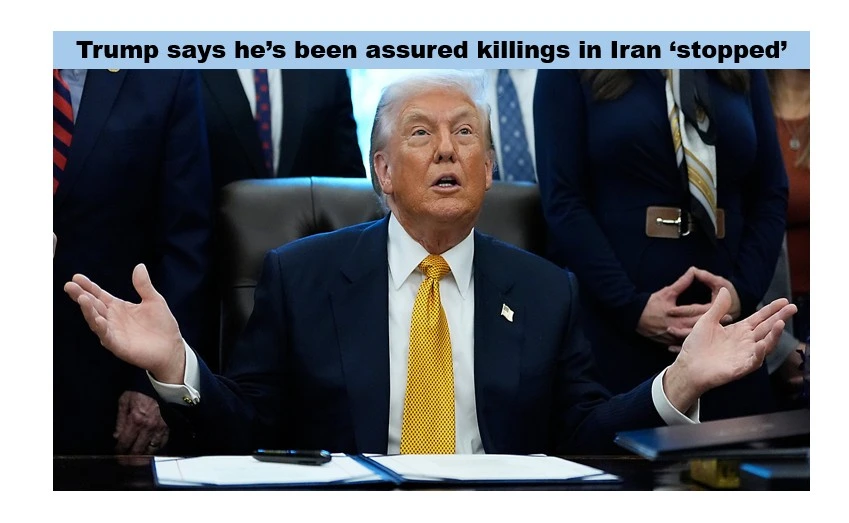
The volatile confrontation between Washington and Tehran took a sudden, unexpected turn on Wednesday. President Donald Trump claimed a senior official had informed him that the Iranian government had ceased its lethal crackdown on anti-government protesters. This change in rhetoric comes after days of increasing threats, in which the President warned of “very strong action” and great support for Iranian “patriots” as well as promising that “help is on the way.”
As of January 15, 2026, the world is still on tenterhooks. Though the President’s remarks hinted at de-escalation, Iran remains in the grip of uncertainty, with internet blackouts and conflicting signals from the Iranian judiciary.
In the Oval Office, a Sudden Reversal
President Trump, addressing reporters at the White House on January 14, struck a more conventional tone after days of relative calm in which he said little about Iran. That the administration was weighing military action had been clear only 24 hours before the protests began, after reports emerged that Iranian security forces had killed thousands of demonstrators since protests began last December.
“We have heard that it was going to be the end,” Trump said, and referred to the killing in Iran is stopping — it’s stopped — it’s stopping.” “And there is not a plan for executions, or an execution, or executions — and I have that on very good authority.”
The President did not identify the “important sources” behind these assurances, but the statement seems to have offered a brief off-ramp from a potential new Middle Eastern conflict. Analysts say that may be a strategic pivot — a “face saving” gesture to help the President from getting sucked into a full-blown military intervention he has always been hesitant about joining.
Conflicting Signals from Tehran
But while the President’s tone is hopeful, messages from inside the Islamic Republic are implausibly discordant. Iranian Foreign Minister Abbas Araghchi said something similar in an interview with Fox News, saying the government is “fully in control” and that “hanging does not solve things.”
But the Iranian judiciary has been a lot more gloomy. The judiciary’s chief, Gholamhossein Mohseni-Ejei, recently urged “rapid trials and executions” for some of the more than 18,000 people said to have been detained in the unrest. Groups such as Amnesty International and the Human Rights Activists News Agency (HRANA) continue to caution that the threat of mass executions has not passed.
One of the most prominent cases is that of Erfan Soltani, a 26-year-old. He is still in custody, although his family said his planned execution on Wednesday had been delayed. This thread of “deferment,” not “cancellation” has caused many activists to distrust the regime and believe that it is simply waiting for the world to turn its gaze elsewhere before turning on them again.
The Strategic Reality: A Nervous Region
The stakes for this de-escalation are higher than human rights. The geopolitical picture is presently a tinderbox:
- Military Movements: Hours before Trump’s announcement, the United States began a partial evacuation of personnel from Al Udeid Air Base in Qatar, saying it was for security reasons.
- Airspace Closures: Iran briefly closed its airspace to commercial flights on Thursday without explanation, a common precursor to military action.
- Economic Break: The protests were in part provoked by a tumble of the Iranian rial and rampant inflation, fueled by the United Nations’ reimposition of economic sanctions in 2025.
For Mumbaikars, and indeed the world, both oil prices, regional stability are on line. If the “stop” killings is indeed a real thing, itcould give diplomacy on Iran’s nuclear program just a sliver of an opening — something that was inconceivable only a few days ago.
What Happens Next?
The next few days will be a litmus test of the “assurances” readouts and direct discussions have provided to the White House. If the protests persist and the Iranian government keeps its pledge to show restraint, U.S. air strikes could be off the table. But if reports of “shadow executions” or other violence follow, the President has made clear that military options are still available on his desk.
“We’ll see what the process is,” Trump said. “I hope it’s true. Who knows?”
For the thousands of Iranians still in the streets, and for families of those detained, “who knows” is an uncertain place to be. The world is watching to see whether this is the onset of a genuine de-escalation or just the calm before a much larger storm.
