


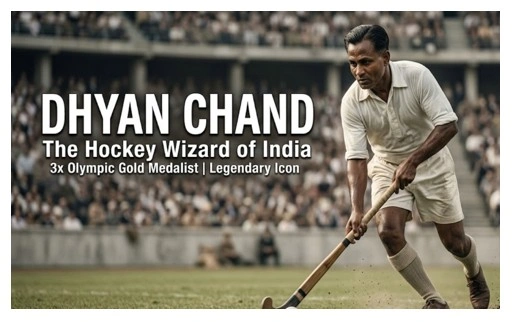
Major Dhyan Chand has achieved worldwide respect as one of the all-time greats in the history of sports. He is commonly referred to by the nickname “Wizard of Hockey” due to the global recognition he gained for Indian Field Hockey through his outstanding abilities to dribble, master control of the ball, and score goals. In the years 1928, 1932, and 1936, he played an instrumental role in winning India three Olympic gold medals.
Early Life
On August 29, 1905, Major Dhyan Chand was born in Prayagraj, India (formerly Allahabad). His father, Sameshwar Singh, was employed by the British Indian Army and was also a hockey player. Dhyan Chand’s family moved constantly due to all the transfers that his father received, and therefore, he received very little regular education.
A humble and relatively poor childhood influenced Dhyan Chand’s success to a great degree due to the discipline he learned as a soldier and from the other soldiers around him.
Personal challenges
As a member of an economically challenged family in India, he did not have the opportunity to train in modern facilities or have access to modern training techniques. Training for the Army and playing sport was not easy for Dhyan Chand because he trained in difficult conditions and had to travel long distances to play games.
you may also like:
- Vera Rubin her work helped prove the existence of dark matter
- Kaspar Hauser the Boy Who Arrived From Nowhere
- Amrita Sher-Gil influential modern artist
Career / Main Journey
- Beginning of the Journey
The beginning of Dhyan Chand’s hockey career began when he was serving in the Indian army. His immediate success as a player caught the eye of coaches and players alike. In 1926 Dhyan Chand was selected to be a part of the Indian Army hockey team’s tour to New Zealand, where he made a name for himself by scoring numerous goals.
- Major Breakthrough
Dhyan Chand’s most major breakthrough was during the Amsterdam Olympics held in 1928 where India won gold and Dhyan Chand was named top scorer of the tournament with his great performances attracting attention from around the world of sports.
On the road to fame, India defeated the USA 24-1 to win gold at the Los Angeles Olympics in 1932, and matched with Dhyan Chand’s brother Roop Singh, they created a lethal attacking combination.
The pinnacle of his career came in 1936 at the Berlin Olympics where India defeated Germany in the gold medal match 8-1 in front of Adolf Hitler. His performance left the audience in awe and solidified his legendary status.
- Major Contributions
Throughout the span of his playing career he scored over 400 goals internationally and beyond simply scoring goals he inspired countless generations of Indian athletes as well as making India the dominant power in Men’s Field Hockey internationally for decades.
Major Accomplishments
- Three time Olympic Gold Medalist in 1928, 1932, and 1936 Olympics
- Captained Indian National Field Hockey Team at 1936 Olympics
- Scored 400+ Goals in international field hockey
- Recipient of 1956 Padma Bhushan
- 29 August is National Sports Day and is celebrated in honor of the birth anniversary of Dhyan Chand
- Major Dhyan Chand National Stadium in New Delhi is named after him.
Personality & Character
His ability to remain composed during difficult situations has made him both respected by friends and opponents; however, he will always be remembered for his dedication towards training.
Through his leadership qualities, he inspired younger generations and instilled a strong sense of team cohesion.
Impact on Society
To this day, Dhyan Chand has created a legacy; his achievements have inspired athletes from every generation to pursue sports professionally and to pursue physical activity through hockey and have made hockey very popular at the every level of public school hockey programs and throughout sports academies throughout the country.
Lesser-Known Facts
- During his international matches in Europe, many officials were said to have checked his hockey sticks because they believed he had a magnet.
- Adolf Hitler said he was very impressed with the way Dhyan produced his performance at the 1936 Berlin Olympics.
- He often practised hockey at night under the moonlight. His friends named him “Chand” (moon).
- He would never celebrate after scoring goals.
Final Years / Death
In 1979 Dhyan Chand died from liver cancer in Delhi after having he had worked as a coach and accepted, because of a lack of funds for his contribution to hockey; he was forced to leave the sport completely. The entire nation paid tribute to him as one of India’s most celebrated sports heroes on the date of his passing.
Legacy
Major Dhyan Chand’s birthday is celebrated by the country each year as National Sports Day. Many written accounts, documentary films and sporting institutions are still recording Major Dhyan Chand’s achievements in order to maintain his legacy.
Conclusion
Major Dhyan Chand is remembered and will remain legendary for his contributions to Hockey as a player. He shall always be remembered even after his passing as a World Class player and the “Wizard of Hockey” by millions throughout the World today, and for years to come!
Timeline
- 1905 — Born in Prayagraj
- 1926 — New Zealand tour with Indian Army team
- 1928 — First Olympic gold medal
- 1932 — Second Olympic gold medal
- 1936 — Third Olympic gold medal and team captain
- 1956 — Awarded Padma Bhushan
- 1979 — Passed away in New Delhi
