


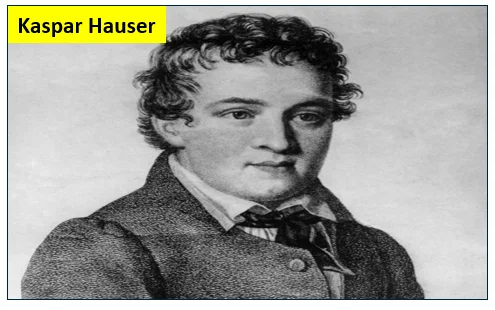
On the 26th of May 1828 the citizens of Nuremberg, Germany were faced with a strange and deeply unsettling sight. A teenage boy with a letter ambled into the city and behaved in a manner that immediately baffled everyone around him.
He could scarcely talk straight. He moved awkwardly and unnaturally, as if he had spent very little time walking outdoors. He was looked upon as being scared of his familiar surroundings and not knowing the simplest features of ordinary life.
When challenged the boy repeated some simple phrases and produced a letter for a cavalry captain. Eventually he said he was Kaspar Hauser. Nobody knew where he came from.
That moment was the start of one of the biggest mysteries in European history.
A Story That Shocked Europe
As officials attempted to speak with Kaspar Hauser, a remarkable story unfolded.
He says he spent most of his childhood shut in a small, dark room with little human contact. He said that he hardly ever saw a human being except for some unknown who brought him food and water.
Kaspar said he had never learned about ordinary life because he had lived in isolation. He appears to have known little about society, social customs or even the rudiments of daily life.
They were stunned by his condition.
The bright sunlight seemed to irritate him. He was frightened by loud noises and often behaved like a much younger child. Simultaneously showed surprising intelligence and emotional sensitivity.
He became the fascination of doctors, scholars, religious personalities and government officials. Some thought he was telling the truth. Others suspected exaggeration or fraud.
But whatever the different opinions, Kaspar Hauser was soon known all over Germany.
Latest published :
- Amrita Sher-Gil — Influential modern artist
- Tenzing Norgay – The Man Who Climbed Over Clouds
- Radia Perlman – The Woman Who Helped Build the Modern Internet
A Mystery That Captured Europe’s Attention
Word quickly spread across Europe about the mysterious boy. His story appeared in the newspapers and tourists came to Nuremberg, hoping to see him in the flesh.
His appearance at that time only added to the mystique. Psychology, human behaviour, and strange social cases were very interesting for nineteenth century Europe. Kaspar’s story seemed to have all these elements in one extraordinary mystery.
Questions flew in all directions
- Who was Kaspar Hauser
- Had he really been locked up as a child
- Why did he suddenly come out into public
- Someone was pretending to be someone else
Learning About the World for the First Time
Kaspar Hauser was placed in the hands of teachers and officials who tried to educate him and help him to fit into society on his arrival in Nuremberg.
What was surprising about him was how quickly he picked things up.
Kaspar had trouble with language and communication at first, but he gradually improved his reading and writing skills. He also started to develop social skills and to be curious about his surroundings.
Those who interacted with him were prone to describe him as polite, gentle and emotionally sensitive. He was very sensitive to kindness and often reacted strongly to emotional situations.
Strange Attacks and Growing Suspicion
Several violent episodes in later life further enveloped Kaspar Hauser in the mystery of his existence.
In 1829 he was discovered injured in an attack of unknown origin. It raised public suspicion that unknown persons might be trying to silence him.
Then, in December 1833, a further shocking event occurred in Ansbach, Bavaria.
Kaspar came home with a serious stab wound and claimed an unknown stranger attacked him in a garden after promising to tell him who he was.
His wounds proved fatal. Kaspar Hauser died on 17 December 1833, at the age of twenty one. Immediately his death added to the mystery of his life.
Some thought he was murdered for some royal connections that he might have had. Others thought he might have hurt himself, either by accident or on purpose. Historians have been debating the circumstances of his death for almost two centuries.
Theories That Refused to Disappear
Public fascination with Kaspar Hauser grew even after his death.
Writers, historians, psychologists and researchers have spun countless theories about his identity and his childhood. The most popular theory was that he was secretly connected to the Royal House of Baden.
Supporters of this idea suggest that Kaspar may have been born into a noble family and then removed from public life as a child, due to political intrigue surrounding the royal succession.
Other scientists disagreed completely.
Some thought Kaspar had made up much of his tale to get attention or protection. Others saw him as a psychologically unbalanced young man formed by trauma and emotional instability.
Influence on Literature and Psychology
The story of Kaspar Hauser has had a strong impact on European culture.
Questions raised through his life fascinated writers, philosophers and psychologists. His case ignited discussions around childhood development, isolation, identity and human behaviour.
Many scholars wondered about the impact of growing up without normal social interaction on language, emotions and intelligence.
Artists and filmmakers also found his story to be inspiring, because of the mystery, tragedy and emotional vulnerability it contained.
Books, plays, academic studies and films were made about him throughout Europe. One of the most well known portrayals was in the 1974 film The Enigma of Kaspar Hauser directed by Werner Herzog.
The mystery has never really disappeared and even today historians and researchers are still studying the case.
The Enduring Mystery of Kaspar Hauser
More than two hundred years after his abrupt arrival in Nuremberg, Kaspar Hauser is still one of Europe’s most enigmatic historical figures.
People come not only for the mystery, but also for the emotional questions about his life that still engage them.
Kaspar Hauser’s life is a story somewhere between history and legend, a reminder of how some mysteries live on long after the people at their heart have died.
