


Introduction
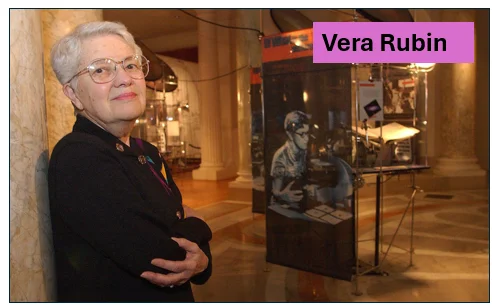
Vera Rubin was an American astronomer whose groundbreaking research helped prove the existence of dark matter. She became one of the most influential scientists in the world during the 20th century because of the way her discoveries have changed humanity’s understanding of the universe and where humans fit in it.
Early Life
Vera Rubin was born in Philadelphia, Pennsylvania on July 23, 1928 to a middle-class Jewish family. Her father was an electrical engineer and her mother instilled in her the value of curiosity and education. When Vera was young, her family moved to Washington, D.C.
As a child, Rubin enjoyed staring at the stars through her bedroom window, which piqued her interest in astronomy from an early age. As a result, she even built a homemade telescope with her father and would continue to nurture this interest throughout her life. Rubin’s formative years were marked by an intense curiosity about astronomy.
Rubin enrolled in Vassar College, with a major in astronomy, and graduated in 1948. At that point in time, it was uncommon to find women in the field of science. Later on, Rubin received her master’s degree from Cornell University and her PhD from Georgetown University.
Also read :
- Kaspar Hauser – The Boy Who Arrived From Nowhere
- Amrita Sher-Gil — Influential modern artist
- Tenzing Norgay – The Man Who Climbed Over Clouds
Personal challenges
Even after forming an impressive career as a scientist, Vera continued to struggle with the challenges of being a visible member of the scientific community. Most observatories (the buildings where astronomers conduct their research and analysis) had no women’s restrooms because very few women were engaged in the field of astronomy.
Career / Main Journey
Beginning of the Journey-Following her schooling, Rubin commenced examining the galaxy’s motion. Additionally, she developed an interest in the rotational behavior of stars about galaxies to see if they were consistent with established scientific theories.
Major Breakthrough-During the 1960s and 1970s, Rubin worked alongside another astronomer named Kent Ford using high-end instruments to observe spiral galaxies.
Under existing theory, the stars furthest away from the center of a spiral galaxy must travel at a slower speed than those closest to the center. However, Rubin found that the stars located at the periphery of the galaxies examined travelled at approximately the same rate as those located toward the centre of the galaxy. This was an odd characteristic that indicated that a substantial amount of invisible mass must exist within the spiral galaxies.
Discovery of Dark Matter-Rubin’s research has provided some of the best evidence for the existence of dark matter and how we now know that the amount of visible matter in galaxies does not account for the large amount of gravity needed to hold galaxies together.
Her findings revolutionized our understanding of modern astronomy and cosmology; scientists believe the majority of the universe’s mass is made of dark matter.
Rise to Stardom-Rubin gained tremendous popularity as a result of her research; she became one of the greatest astronomers of her time, and has motivated many women to enter scientific fields.
Major Achievements
Some of Vera Rubin’s major achievements include:
- Providing strong evidence for dark matter in the 1970s
- First woman allowed to make observations at the Palomar Observatory
- Awarded National Medal of Science in 1993
- Royal Astronomical Society Gold Medal Winner
- Published important papers on galaxy rotation
- Her work has transformed modern astrophysics forever.
Character & Personality
Vera Rubin is regarded as both humble and smart; she was an incredibly persistent scientist. Her view of science was that it should be open to all people, no matter their background or gender.
Influence on Society
Rubin’s research has changed how humanity views the universe. Dark Matter has become one of the most heavily studied areas in astronomy as a result of Rubin’s discovery, and dark matter’s definition is now in constant debate among astronomers and physicists.
Lesser-Known Facts
- Vera Rubin enjoyed looking at stars throughout her childhood.
- While she raised four kids, she maintained her professional scientific career.
- Her four children all became scientists or mathematicians.
- She frequently spoke publicly about how women in science need equal opportunities.
- Her commitment to balancing her family with her endeavors reflects her dedication to these goals.
Final Years / Death
In her final years of life, Vera pursued her studies and directed the studies of many students. For decades after she retired from research in astronomy, she remained active.
She died in Princeton, New Jersey on December 25, 2016 at the age of 88, and after her death scientists around the world honored her many accomplishments.
Legacy
Today, Vera Rubin is one of history’s greatest astronomers. In 2019, the Vera C. Rubin Observatory was dedicated in her memory.
Her accomplishments are the subjects of books, documentaries, and educational institutions and continue to support research of dark matter and the structure of our galaxies to this day.
Conclusion
Vera Rubin’s life gives us profound lessons on determination, inquisitive thought, and bravery. In the face of adversity and discrimination, she has been able to pursue her passion for science and to find answers that alter the way that we view the universe.
Timeline:
- 1928 – Born in Philadelphia, USA
- 1948 – Graduated from Vassar College
- 1954 – Earned PhD from Georgetown University
- 1970s – Published important dark matter research
- 1993 – Received National Medal of Science
- 2016 – Passed away at age 88
Famous Quote:
“Science progresses best when observations force us to alter our preconceptions.”
