


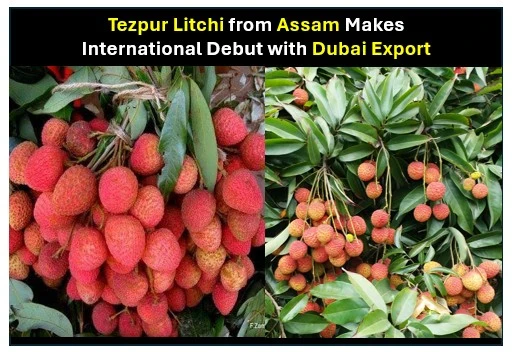
The special agricultural gifts of the Northeast are slowly becoming known and appreciated worldwide. In what is yet another milestone in the journey of regional farming, the Tezpur litchi of Assam has now officially invaded the international market, with its maiden export shipment successfully making its way out of Assam to Dubai on Tuesday, 9th June 2026, in a highly celebrated occasion.
The successful shipment is a milestone for the local orchards of Sonitpur district to turn into a premium product in the global market; from a highly localized seasonal delight to a premium product in the global market. The project will create a brand-new, high-value supply chain to the Middle East for fruit and vegetable growers, offering them the chance to enjoy the fruit of their many generations’ long agricultural tradition for the first time.
A National Export Framework Supported Milestone
The development of this first edition became possible thanks to specific support from institutions. The export flight missions were carried out under the close supervision and guidance of Agricultural and Processed Food Products Export Development Authority (APEDA) with the close coordination of the local farmer cooperatives and state export agencies.
Union Commerce and Industry Minister Piyush Goyal announced the achievement in his tweet and said he was very proud of the expansion of the Northeast’s agricultural portfolio in the world. The Minister said that this initial shipment to Dubai, where the market is very competitive, does more than just sell fruit as it is giving the special fruits of this region international recognition.
Local logistics and direct packaging infrastructure were for years very limited in the northeastern states, severely hampering the enormous agricultural potential. This first flight is a testament to the fact that these old walls are being broken down, and opening a good door for a variety of quality organic products to be shipped from here to hungry world markets.
Read more: Is China driving Japan’s growing investment in India?
Why Tezpur Litchi is so special?
The only way an understanding of the willingness of international buyers to pay a premium for this particular crop can be gained is to examine the unique environmental conditions of the region. The litchi orchards of Tezpur are well-suited for this highly specific microclimate and are found growing on the fertile alluvial soils, which are rich in nutrients and deposited along the banks of the Brahmaputra River.
This perfect growing environment results in the uniqueness of these fruits: the brilliantly red ripened outer skin, the extremely juicy and clear pulp, and the exceptionally high sugar content with a pleasingly light fragrance. It was officially recognized in 2015 and given a protected Geographical Indication (GI) tag, a legal designation that confirmed its exceptional taste and flavor and the fact that no other fruit in the world can be described as having the same taste and flavor.
But with litchis being highly perishable and having an incredibly short shelf life after harvest, it is imperative to have a flawless cold chain to enter into the international export market. APEDA and handlers collaborated closely with growers to ensure strict pre-cooling, thorough sorting and high-tech temperature-packed techniques. All these measures are taken to make sure that the fragile fruits maintain their flavor, colour and structural freshness during the Dubai flight.
Read more: Why did PM Modi ask Indian citizens to recycle gold?
Improving farmers’ incomes and strengthening local farming groups
This great achievement for exports goes to the smallholder farmers and the local orchard owners who manage these large green canopies in Sonitpur. In the past, litchi farmers had no control over the seasonal surpluses and deficits. During the short harvest season, when supplies surged into the local markets, the local wholesale prices would be driven down to a very low level.
The quality fruit was often bought by middlemen and local traders for very little money, leaving the actual producers with very small margins of profit on the top quality fruit, often not enough to cover their annual labour and fertilizer costs. The new trade route would cut out the many layers of local exploitation, bringing regional farms closer to the high-end supermarket chains in Dubai, and allowing farmers to obtain much higher, more stable prices.
Read more: Japan stops importing mangoes after 20 years
A fresh dawn for agri-exports of Northeast India
The first crates of Tezpur litchis are now appearing in retail shops in Dubai, and the potential impact of the crop is huge for the entire region. This successful operation is a big public demonstration of how Northeast India can now offer a high quality and fragile fresh produce to overseas buyers and logistics companies within a short span.
The petroleum ministry, commerce groups and the local state governments are already eyeing various other unique regional crops such as Assam’s renowned ghost pepper (Bhut Jolokia), sweet Kaji Nemu (Assam lemon), and other unique black rice crops of neighboring states to follow this blueprint. The export of Tezpur litchi, successfully done by the small and traditional family plots, is a new chapter of hope and hopefulness for Indian agriculture, and is proving that with a strong scientific support and determination of the masses, one can easily cross the oceans to reap the fruits of success.
