


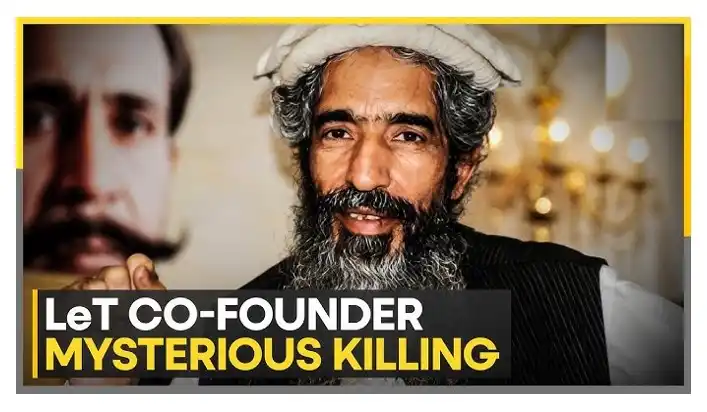
Hamza suffered gunshot wounds to his abdomen and was subsequently taken to a local healthcare facility. The shooting of Hamza is indicative of a growing trend of violence perpetrated against individuals identified as “militants” in Pakistan, including but not limited to individuals accused of involvement with the perpetration of militant-related violence.
Amir Hamza is an associated founder and senior ideologue of the terrorist organization Lashkar-e-Taiba (LeT) in Pakistan. He was shot on Thursday, April 16, 2026 in Lahore, Pakistan by an unknown assailant. According to reports, Hamza got shot from two men on a motorcycle when he left a television station.
Hamza has been subject to prior assassination attempts on two previous occasions within a 12-month time period. A prior attempt was made on or about January 25, 2025, prior to the current attempt.
The assailants rode up to Hamza on their motorcycle and shot him as he was leaving the TV station. Following his injuries sustained during the shooting, Hamza was transported to a local medical facility.
This was the second assassination of Hamza within a 12-month time period. The circumstances associated with the shooting of Hamza demonstrate a broader continuing trend in Pakistan of relentless targeted violence against militant-identified individuals. As such, Hamza falls into a category of individuals associated with the dissemination and provision of recruiting for more extreme or radical beliefs and those individuals who have previously committed acts of terrorism.
The rise of two assassination attempts so closely together raise serious concerns about Pakistan’s internal security situation and whether or not there is a power struggle among the various militant factions or possibly a dispute within one of the existing factions.
Who Is Amir Hamza?
Amir Hamza is one of the founders and leading ideologues of Lashkar-e-Taiba and has been designated as a terrorist organization by multiple member countries. The Lashkar-e-Taiba’s activities affiliate the organization with extremist literature, recruiting, and financing operations to support and carry out acts of terrorism.
Additionally to be considered is the individual’s alleged involvement in a wide variety of different terrorist acts, including the 2005 attack on the Indian Institute of Science (IISc) in Bangalore, during which several people were killed and/or injured.
The incident illustrates a trend in which unknown individuals have attacked multiple members of prohibited organisations under unknown circumstances, and no entity has claimed credit for the violent act.
The role of Hamza goes beyond operational planning; he has also been described as an influential writer and speaker who played an important role in developing an ideological narrative for the group.
There has been an increasing number of attacks on high-profile militants in Pakistan by “unknown gunmen” in recent years. Hamza’s death is one such example in this respect.
read also:
- China’s 4 point peace proposal to resolve Middle East war
- Satellite images revealing how Israel destroyed Lebanon
- What is Blue-Book protocol invoked by Pakistan?
Pattern of Targeted Killings
Reports have indicated a worrying trend of shooting deaths of individuals connected to Lashkar-e-Taiba, Jaish-e-Mohammed and Hizbul Mujahideen in suspicious circumstances. The vast majority of those shot were killed by unidentified shooters. Most reports do not mention who was responsible for the shooting.
This incident calls into question the security of individuals connected to extremist groups. The fact that Hamza was shot dead in a crowded city such as Lahore illustrates both the reckless nature of those who committed this crime and the extent of the intelligence/police presence at the time of the shooting.
The implications of incidents such as Hamza’s murder have the potential to create instability within Pakistan’s borders and raise internationally significant questions regarding the existence and protection of internationally-declared terrorists who could be hiding behind Pakistan’s borders.
Questions yet to be answered
No one has claimed the attack to this point nor has any been identified as a suspect. As of now, no one knows what prompted the killing of Amir Hamza.
Ongoing investigation will reveal if his death was the result of a rivalry between different groups, was the result of revenge, or was done as part of a larger orchestrated effort.
Conclusion
The murder of Amir Hamza marks a turning point in the path of Pakistan and continues the trend of violence directed against individuals associated with militant activity in that country. The violence directed toward such individuals cannot be easily explained; therefore, the authorities must thoroughly examine what occurred and also assist them in determining additional information in regard to their ongoing investigation into the organisational structure of militant groups and their threat assessments, and in relation to finding any additional unknown entities that operate in this area.
