


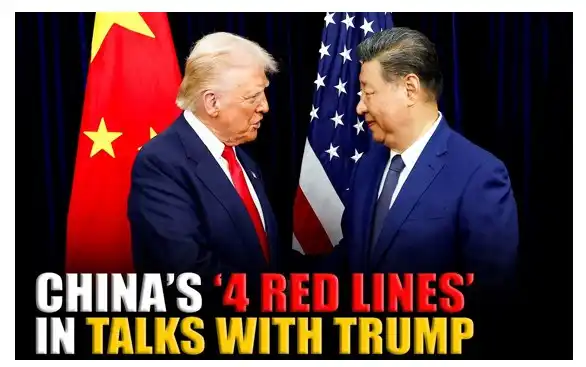
Ahead of US President Donald Trump’s visit to Beijing, Xi Jinping’s government has issued a strong diplomatic message, outlining four “red lines” that Washington must not cross during discussions with China. The warning, released through the Chinese Embassy in the United States, comes at a time of growing tensions over Taiwan, trade, technology, and geopolitical influence.
Trump’s visit is being closely watched across the world because it could shape the future direction of US-China relations, which remain one of the most important and complicated relationships in global politics.
What Are China’s Four Red Lines?
China’s embassy identified four sensitive areas that it believes should not be challenged by the United States. These include:
- The Taiwan question
- Democracy and human rights
- China’s political system and development path
- China’s right to development
Beijing claims that these issues involve its sovereignty and national interests so they cannot be negotiated. Chinese officials have stated that interference in these issues will lead to the deterioration of bilateral relations.
Beijings announcement has been viewed as an attempt to establish a framework of discussion before high-level discussions begin.
also read: Iran responds to US proposal for ending the war
Taiwan is the Most Sensitive Issue
Of the four issues, the most sensitive is Taiwan. China views it as an integral part of their territory and has expressed significant opposition towards any form of U.S military or political support for Taiwan. Additionally, China has repeatedly condemned the sales of arms to Taiwan and the visits of United States Members of Congress to Taiwan.
Currently, China’s Ministry of Foreign Affairs has warned that support for so-called “Taiwan Separatism” will create a serious decline in the United States and Chinese Super Power relationship. Furthermore, with the increasing levels of military activity occurring within the Taiwan Straits, the Taiwan issue has become much more important.
Analysts expect that Taiwan will dominate United States and Chinese discussions between President Trump and President Xi, as the United States continues to enhance relationships with Taiwan for both strategic and security reasons.
also read: Bangladesh seeks China’s support for Teesta River project
Human Rights and Political Systems
Another major “red flag” relates to any form of criticism of China’s political system and human rights record. China considers that democracy and human rights should not be used as tools to interfere in domestic affairs.
The Chinese government has been consistently dismissing the many criticisms leveled against it by the West for the actions it has taken in Xinjiang, Hong Kong, and its policymaking on censorship. In referring to “political systems and paths” within its warning, China seems determined to push back against any attempts by leaders in the United States to question whether its political system, led by the Communist Party, is legitimately developed.
Both parties’ administrations have critiqued Chinese behavior on civil and political rights for years. Nonetheless, Beijing continues to assert that each nation has the right to decide which political model is appropriate for itself.
Economic Competition and China’s “Right to Development”
The fourth red line refers to China’s “right to develop” as a reaction to increasing tension over trade limitations, sanctions, and technological restrictions. Beijing has claimed that restrictions by the U.S. on Chinese access to advanced semiconductors and the global marketplace have been directed at stunting the emergence of China as a dominant power.
In advance of this visit, previous President Trump has indicated that economic agreements and trading arrangements will play an important role during this visit. Sources have stated that President Trump may attempt to obtain greater access to Chinese markets for American businesses, and that there will be requests from President Trump for increased Chinese-to-American trade, such as the purchase of airplanes and agricultural items.
In addition to wanting increased court access to the United States for Chinese firms, China wants the United States to stop limiting the rights of China as it attempts to develop, and to respect developmental rights.
A High-Stakes Diplomatic Meeting
Although both of the countries have used some harsh language when discussing their relationship, both continue to show an openness to keep discussions going. Chinese officials have stated that a strong need for “mutual respect” and a commitment to living “peacefully with one another” exist between them. Similarly, Trump has stated at various times that he has a good working relationship with President Xi of China.
It is widely believed, however, that neither country has high expectations for any major movement or breakthrough in the relationship during the upcoming meeting. Instead, the expectation is that both countries will be working towards simply managing the overall tensions that exist between them, while preventing further deterioration of their overall relationship.
China has drawn a number of “red lines” regarding what they believe to be their core national interests. The manner or result of Trump’s imminent visit to China could end up impacting US-China relations, but also have more global implications on the balance of power in Asia and the rest of the world.
