


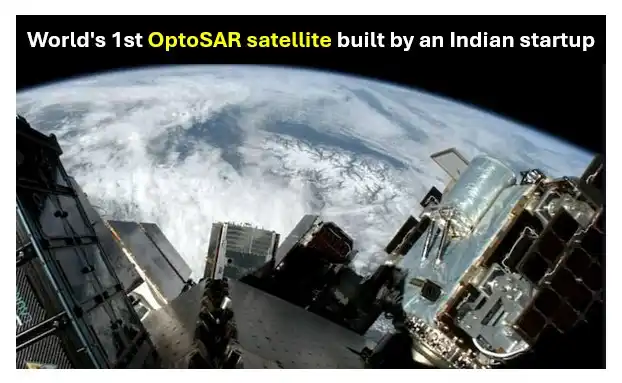
In a landmark event for India’s private space industry, an Indian-based startup launched the world’s first advanced Earth observation (EO) system that uses both optical and SAR (synthetic aperture radar) imaging: an OptoSAR satellite. This success places India at the leading edge of the next generations of satellite technology and indicates the growing impact of startups on the worldwide space economy.
What is an OptoSAR Satellite?
As the name implies, the OptoSAR satellite is a combination of optical sensors and SAR radars. The optical sensors provide still-imagery (photograph-like) that is appropriate for visual analysis, but only during daylight hours or when conditions are clear. The SAR radar systems, on the other hand, are capable of generating still images of the Earth regardless of the weather conditions or time of day.
By combining the two imaging functions into a single spacecraft, OptoSAR satellites can overcome the inherent limitations of operating with only one of the two technologies. For example, by combining SAR with optical imagers, an OptoSAR satellite can provide consistent, high-quality imaging data, regardless of time of day or weather conditions. This capability provides tremendous value to current customers that require constant monitoring, as this capability enables them to operate effectively.
also read: Gold factory discovered deep under the Pacific Ocean
A First of Its Kind
Optical and SAR satellites have each existed independently and have been used for decades, but this combination of optical and SAR in a single and compact satellite represents the first such application in the world. Traditionally, operation of both technology types required dual satellites working together in conjunction with each other, which added costs and complexity.
An Indian startup is responsible for this effort and has now miniaturized and integrated both systems. The launch will greatly reduce the cost of being launched as well as the operational costs. It will also improve the synchronization of the data because both optical images and radar images are being taken at the same time from one point in space.
also read: 10 year old writes to NASA to make Pluto a planet again
Private Sector Space Expansion in India
This launch indicates how quickly the private sector space industry in India has grown over the last few years. Policy changes by the government and other forms of support have provided an opportunity for start-up companies to create, build, and launch very complex space-based technologies.
This mission also shows that Indian start-up companies are not only able to build supporting roles, but can also take a leading role in technological innovation. Investors are now seeing space technologies as active participants in the digital/development space.
also read: How Oil and Gas Extraction Is Changing the Earth Forever
Potential for Broad Application
OptoSAR provides the opportunity to access innovative capabilities in many areas of commerce including:
- Managing Natural Disasters By routinely monitoring floods, landslides, and hurricanes (even if the visibility is low).
- Developing Food Products, Specifically: Determining crop health, soil moisture levels, and when the crops will yield.
- Supporting Defense and Security Operations: Providing enhanced surveillance and better border protection.
- Urban Planning by Mapping the Growth of Facilities and Identifying Areas of Unlawful Development.
- Environmental Change Research: Examples of measuring the environment for climate change includes agricultural land converted to forests, glacial shifts and coastal degradation.
- Time-sensitive and mission critical applications rely on continuous data that is reliable.
Cost Efficiency / Scalable
Of the many things about this project; one of its most compelling attributes is the cost savings. By combining two satellites into one satellite, we are able to decrease the number of launches as well as reduce maintenance costs by combining both systems into one spacecraft. This makes way for scalable satellite constellations. OptoSAR satellite “networks” would allow near real-time global coverage, which can then be used to perform missions using government and business’ need for high-frequency Earth observation data at a lower overall cost.
Global Competitiveness
India is now a part of a limited group of country that is advancing satellite imaging systems; therefore, developing their stature as a country that is capable of developing new space technologies. Additionally, the success of this company will lead to more opportunities for other indigenous companies to enter into new international collaborations and partnerships. As there is a greater demand for Earth observation data, these satellite technologies will provide high-quality, affordable data that will appeal to all types of people, may they be government, commercial or otherwise.
Challenges Ahead
Although significant progress has been made with the successful launch of the OptoSAR satellite, obstacles still exist. One ongoing challenge will be integrating the two intricate imaging systems which require critical calibration and advanced data processing ability plus ensuring their long term dependability while managing large amounts of data is crucial to long-term viability as well.
In addition, there is considerable competition globally from numerous companies who are developing next-generation imaging technologies so continuous development and collaboration with partners will be critical to maintaining a competitive advantage over these companies.
A Glimpse into the Future
OptoSAR’s success demonstrates how Space Missions will no longer simply be driven by national interests but increasingly by agile and innovative companies exploiting new technologies to realize their ambitions for the future of Earth-Based Observations and Space Exploration.
The OptoSAR program is expected to contribute to India’s efforts to help grow the Private Sector of India’s Space Program; thus creating opportunities for more ambitious missions, such as the development of next-generation Satellite Constellations or developing Human or Robotic Capabilities to conduct Exploration Missions to Other Worlds.
OptoSAR’s performance indicates that 21st century Space Technologies will be created not only by Governments but also by innovative and nimble organization(s) that are capable of taking bold ideas into reality!
