


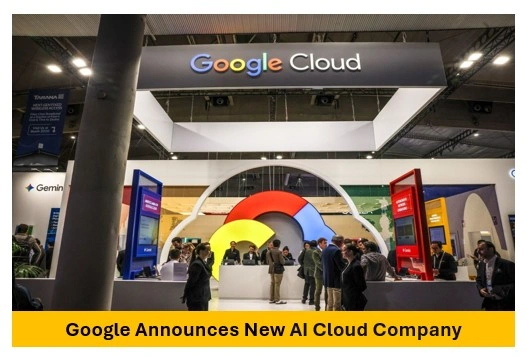
Google and Blackstone are partnering to create a brand-new artificial intelligence (AI) cloud service to help meet the increasing global demand for computing power to enable AI technologies worldwide. This collaboration will be initially funded with $5 billion in equity from Blackstone, and it is estimated to be one of the largest AI-related infrastructure partnerships in existence today.
$5 Billion Bet on the Future of AI Infrastructure
The new joint-venture company does not yet have a name but will provide large-scale cloud computing capabilities to support the specific requirements of AI usage. This company will leverage Google’s advanced AI hardware and cloud software along with Blackstone’s extensive infrastructure funding capacity. As part of their commitment to this venture, there is significant evidence that once debt financing and future expansions are included, Google and Blackstone will attract investment of up to $25 billion total into this new company.
Focusing on Google’s TPUs
One of the primary building blocks of this new venture will be the use of Google’s in-house designed tensor processing units (TPUs). These custom-built processors are purpose-built for high-speed processing using artificial intelligence to train and make inferences. Unlike most cloud providers for AI who are reliant on the widespread use of Nvidia graphics processing units (GPUs) to power their cloud services, the new Google/Blackstone venture will provide TPU-accelerated computing through their new joint venture company to clients.
TPUs (Tensor Processing Units) have been developed by Google for many years and many Google products (including Gemini AI, and other ML [Machine Learning] products) utilize TPUs. Google has partnered with other external companies and AI startups to provide access to TPUs in greater numbers than are currently available out there. Some analysts believe that this will create a competitive advantage for Google against cloud infrastructure providers like CoreWeave, and against established leaders in cloud technology such as Amazon Web Services (AWS) and Microsoft Azure.
Industry experts believe that if Google successfully implements this strategy it could help to broaden/ diversify the AI hardware market (currently dominated by Nvidia). This will allow Google to more aggressively commercialize their proprietary TPU ecosystem and gain increased share of the rapidly expanding AI cloud marketplace.
also read: How AI Chip Race Is Impacting Hardware Infrastructure
Plans for Expanding Data Centers
Google is planning on building and operating much larger AI data centers located throughout the USA, which have been reported to bring approximately 500 MW (megawatts) of Data Center power online by 2027.
This expansion comes at a time of significant growth in worldwide demand for AI infrastructure because of the rapid adoption of generative AI computing technologies. Large amount of computing power, electrical energy, and cooling capacity will all be needed for training the next generation of very complex AI systems. All major tech companies are rushing to secure, all their required chips, energy, and data center locations before they fall behind in this growing global marketplace.
Blackstone is one of the world’s largest investment firms, and it has recently ramped up its investments in both digital infrastructure as well as energy resources related to the development of Artificial Intelligence. Blackstone believes that the future of AI computing is a long-term growth industry that will create a tremendous demand for infrastructure over the next ten years.
Leadership and Strategic Vision
This new AI cloud business will reportedly be led by Benjamin Sloss, a long-time executive at Google with extensive experience in both investment strategy and infrastructure. According to Thomas Kurian, the CEO of Google Cloud, the intention of this partnership is to serve the rapidly growing demand for AI computing resources.
This partnership is consistent with Google’s overall AI expansion strategy, as seen in their recent developer conference, where multiple new AI solutions were launched throughout various Google products, including Search, Workspace, Android, and Gemini.
In addition to developing their AI capabilities across nearly every aspect of their business, Google has also been investing heavily into cloud services so that they can compete with Microsoft and Amazon. The partnership with Blackstone demonstrates that Google is now leveraging their strength in digital cloud services to provide enterprise-level AI infrastructure.
Intensifying Competition in the AI Race
This new company launch showcases the rise of AI infrastructure as a primary battle area between technical industries. The need for fast computers has increased dramatically as businesses use generative AI tools to build software, conduct research, automate processes and use in their business applications.
Emerging AI cloud vendors have been utilizing Nvidia’s resources; however, Google’s TPU approach is a competitor that may provide an alternate ecosystem focusing on its own model(s) and software service(s). Some experts think this model of both market categories (AI Chip and Cloud) all under one umbrella could give Google an advantage strategically.
This announcement reflects larger trends regarding increased private investment into funding AI Infrastructure projects (in several tech verticals now not only AI). Partnerships between leading technology companies (Google/Microsoft/Amazon, etc.) and banks/investors have continued to grow due to the billions of dollars in hardware and power (>10 billion) needed to make these systems operate properly.
What It Means for the AI Industry?
The Google and Blackstone partnership has the potential to dramatically alter the AI cloud marketplace. If successful, the companies involved in the venture would have considerable influence towards reducing reliance on Nvidia-based infrastructure and speeding up the creation of AI-oriented data centers globally by providing an increased number of specialized AI hardware options.
As more industries embrace the use of AI, the need for affordable and scalable computing power will remain one of the major impediments to progress in the technology sector. Being positioned at the front of this transformation will give Google and Blackstone an opportunity to create significant advantages over other technology providers.
