


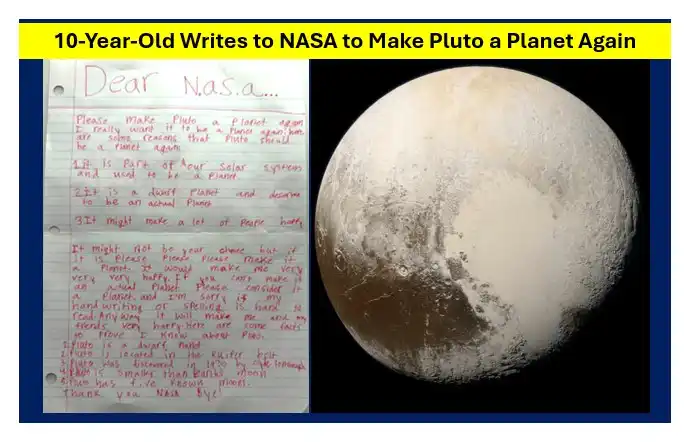
An attentive 10 year old has garnered a lot of publicity for her heartfelt letter to NASA where she asked the scientist to ” make Pluto a planet again “. The letter although simple in nature was very compelling, and
demonstrated an understanding of the planets by kids who were raised in the days of learning about Pluto as the ninth planet.
The child questioned how Pluto lost its status as being a planet and argued that it “looks and feels like a planet” now. This innocent notion has drawn attention worldwide because of the nature and sincerity of its message.
How Pluto Lost its Planetary Status?
The reclassification of Pluto occurred back in 2006 when the International Astronomical Union (IAU) announced new criteria on how they will classify celestial objects. To be classified as a planet, an object must orbit the sun, be spherical in shape, and have cleared its orbit of any debris.
Pluto meets the first two criteria but fails the final one because it shares its orbital zone with the objects in the Kuiper Belt. Subsequently Pluto was reclassified a “dwarf planet” and was met with worldwide debate and disappointment.
also read: NASA Shares Photo of Earth Taken by Artemis II
NASA’s Response
While NASA does not have authority over the classification of planets (that is the responsibility of the IAU), they often interact with the public on an informal basis to satisfy curiosity, especially among young learners. NASA has also responded positively to questions from children in the past and used this opportunity to foster an interest in space science by providing some background information regarding their reasoning for making scientific decisions.
NASA has continued to support the notion that Pluto is still a very intriguing object in space and one that has become even more interesting due to the discovery of Pluto’s geology, including its icy mountains, during the New Horizons mission in 2015. Thus, the New Horizons findings give additional value to the argument that Pluto should regain its planet status.
also read: NASA Report Reveals Critical Failures
Public Reaction: Science Meets Sentiment
There has been an outpouring of support from social media users and educators for the child who wrote the letter regarding the emotional connection that has existed between people and Pluto. For many years, Pluto was considered to be the ninth planet of our solar system and therefore, many felt that the demotion of Pluto was personal.
Many social media users are supporting the young letter writer and feel that the definition of planet should evolve as we learn more about the Universe, while there are others who support the IAU’s decision to maintain a consistent definition of a planet for the sake of clarity in astronomy.
also read: NASA Approves iPhones for Spaceflight
The Ongoing Scientific Debate
The scientific community is still considering different definitions of a planet. Several planetary scientists have suggested definitions of planets that would allow Pluto to be classified as a planet again. These definitions consider the physical attributes of planets rather than just their positions within the solar system. Scientists who were part of the New Horizons mission have stressed that Pluto possesses many unique, vibrant features, which makes it qualify as a planet.
Awakening the Next Generation
The question that sparked the debate has instilled a sense of wonder about how we define worlds in the universe. Many educators and scientists view this as an excellent opportunity to teach children about astronomy, critical thinking, and how science is constantly changing. Regardless of whether or not Pluto ever receives classification back as a planet, the conversations about Pluto impact our understanding of the universe.
One Little Voice, One BIG Effect
Although there is very little chance that one letter will change a decision made by scientists across the world, there is a positive effect from this outcome: Pluto is once again in the public eye. You don’t have to be able to use many words or be large to make an impact on the world. Simply showing patience with those around you can have a lasting impact on them over time.
