


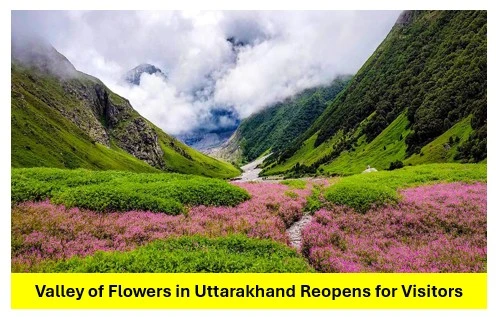
The waiting season is over for nature lovers, trekkers and adventure lovers from around the world to Chamoli. The Valley of Flowers National Park, a UNESCO World Heritage site, is officially open for the 2026 tourist season, located deep in the high altitude alpine meadows of Chamoli district in Uttarakhand.
It’s immediately felt when the forest is opened on Monday, as the first day of the season saw over 108 trekkers pass through the forest checkpoints. The valley, with its thick blanket of heavy snow, is fast becoming legendary – a large, colourful canvas of colours set against the rugged snow-clad peaks of the Western Himalayas.
An Ecological Masterpiece in Full Bloom
This is quite an impressive area of 87 square kilometers, not only is it a wonderful trekking site, it is a very sensitive and internationally recognized ecological wonder. It is an integral part of the UNESCO recognized Nanda Devi Biosphere Reserve, in addition to the adjoining Nanda Devi National Park.
Local forest department officials attributed this year’s increased beauty of the valley to the wonderful weather conditions in late spring. Already, in this early stage of the season different rare alpine plants have started to cover the meadows.
Forest Range Officer Chetna Kandpal said that over 300 to 500 species of wildflowers have been recorded in the valley including some rare medicinal plants and endemic plants of the Himalayas. In the following weeks, trekking the trails, visitors may encounter beautiful specimens of exotic orchids, wild poppies, primulas, marigolds, daisies and anemones.
The flora is but half the ecosystem, though. Its isolated and highly protected location makes it an important refuge for rare and threatened species. It is not uncommon to see the tracks or even a faint figure of the elusive “Snow Leopard”, the “Himalayan black bear”, the “red fox”, “flying squirrel” and the majestic “musk deer” during the early morning hours.
read more: Weekly Horoscope for June 1 to 7, 2026
The legacy of Frank Smythe
It’s said that the world owes its knowledge of this botanical wonderland to a stroke of luck almost 100 years ago. In 1931, a team of three British mountaineers, headed by the famed botanist and mountaineer Frank S. Smythe, got lost as they were returning from a successful ascent of Mount Kamet.
This flowery valley was discovered by chance. Spellbound by its unspoiled and airy beauty, Smythe dubbed it the “Valley of Flowers,” and later immortalized its rich floral bounty in his classic book of the same name.
read more: US couple spent Rs 10 lakh in exploring India in 30 days
Navigating the Sacred Trail
It takes a combination of driving and stamina to get to this high-altitude paradise. The route usually starts from the base town of Joshimath and goes through Badrinath National Highway to Govindghat. Govindghat is a short 4 km drive from where it is followed by Pulna, the last motorable village.
The real adventure starts from Pulna. The trekers have to climb 11 km to reach the tranquil hamlet of Ghangharia, which is the base camp and the last overnight stopping point of the Valley of Flowers trek and the sacred Sikh pilgrimage site of Hemkund Sahib. The national park actually begins about 3.5 km from Ghangharia. Due to its steep terrain and nearly 12,000 foot elevation, this hike is of moderate to difficult level and will require a bit of fitness to complete.
read more: Why do you feel sick sleeping in the AC?
The following are some notes on points of interest for visitors
The Uttarakhand Forest Department has strict rules which are not negotiable and are put in place to protect the sensitive environment of the valley, as well as the safety of the tourists. When travelling this season, remember these main points:
- Operating Window: The valley is officially open on June 1, 2026, and will stay open to the public until October 31, 2026.
- Peak blooming season in the valley is in June when the valley is lush and green, but the absolute peak blooming season is during the monsoon rains between July and September when millions of flowers are released simultaneously.
- Strict Timings: Park gates open every day at 7:00 AM and the last entry for the day is allowed until 2:00 PM. All visitors MUST start their return trip by 1:00 PM to comply with the law and be out of the park by 5:00 PM.
- No Camping Policy: Camping or overnight stays are not permitted within the National Park (No Camping Policy). Ghangharia is the last place to stay in before it gets dark.
- Mandatory Permits: Trekkers are required to get Mandatory Permits within the forest department gate outside Ghangharia with a valid government ID or online through the official website of the valley of flowers.
- Environmental Responsibility: All plastic objects and water bottles should be declared at entry point. Heavy fines and legal action are awarded for littering or plucking flowers.
