


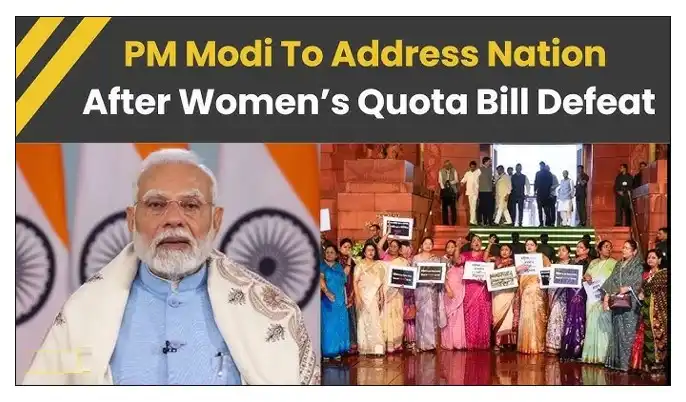
PM Narendra Modi addressed the country on April 18, 2026, after the Women’s Reservation Amendment Bill failed to secure the two-thirds support required for approval in the Lok Sabha. If passed, the proposed amendment to the Constitution (131st Amendment) would have represented the first legislative step toward providing women with 33% of the seats in both the Parliament of India and the State Assemblies of India. While a majority of Lok Sabha Members supported the Bill, with only 230 opposing it (298 in favour), this is considered a rare defeat for a legislative proposal during this government.
Dreams of Women Crushed: Modi’s Apology
Prime Minister Modi addressed the nation and apologized for the bill’s failure and said the dreams of millions of women have been crushed by the failed bill. He went on to say that the failure of the bill has “crushed the dreams” of the millions of women who seek a greater role in the governance of this country.
While most had anticipated that the Immigration (131st Amendment) Bill would garner at least 352 votes, it ultimately received only 298. This outcome has ignited a passionate political discussion around the issue of increasing female representation in the political arena.
Several Members of opposition parties believe that the linkage between delimitation and the expansion of parliamentary seats resulted in the bill’s failure to pass. Additionally, many of these same members of opposition parties state that the linkage with delimitation created confusion regarding the bill and directly resulted in its failure.
also read: PM Modi and Kharge pose at Ambedkar Jayanti event
Strong Attack on Opposition
The Prime Minister stated that he was confident that the government is committed to the empowerment of women, despite the fact that legislation was not passed. Modi emphasized the need for adequate political representation for women and stated that the government will continue to work toward this goal, ensuring that women are provided a sufficient voice in politics.
Additionally, the Prime Minister criticized several opposing parties for standing in the way of the bill’s passage and preventing this historic initiative from developing. He stated that the opposition parties such as the DMK and the Congress were using “selfish politics” to obstruct this important legislation. He also made the comparison of the opposition’s actions to “foeticide,” or killing a fetus before it was born and labeled their actions as foeticide. He said the opposition will have to face the consequences of their actions when addressing the women of the country.
However, Modi maintained that the government would continue to pursue their efforts by committing to “removal of administrative and legislative barriers” and to re-introducing this bill when possible. The Prime Minister stated that this legislation is one component of a broader vision for the development of women and that it is vital to empower them politically.
He indicated further that the government was looking for other ways to achieve women’s representation. He said that this was also an important policy objective for the government.
also read: Pakistan threatens to hit Kolkata during future conflicts
Delimitation was the Main Point of Contention
The issue of the bill was tied closely to the issue of delimiting parliamentary constituencies; opposition parties were concerned that this would cause the balance of power among states to change, especially with respect to southern states.
The prime minister said the opposition was using the delimitation issue as a dividing tactic to defeat the bill and divide people between regions.
Delimitation as an issue created more significant political divides and was critical in determining how people voted on the bill.
Opposition Leaders Hit Back
Quick to point out that the prime minister’s speech was politically motivated, opposition leaders told the press that it was more of a “distress message” than a true appeal to the Nation.
Opposition leaders contended that the government’s poor design and timing of the bill (tying it to delimitation) were the main reasons for the bill’s failure.
Critics also contend that the ruling party was using women’s reservation as a political weapon rather than addressing women’s reservations as an issue of structural reform.
Political and Social Implications
Some consider the Women’s Reservation Bill to have been an important moment politically – this is one of the few times that a major constitutional amendment was not possible to be passed by the ruling coalition.
In addition to having political implications, this event has re-energized the debate about how women are represented in society. The number of women participating in politics has increased over time, but still significantly less than other countries.
This failure also demonstrates that there are great difficulties in gaining broad support for structural changes to the way we do things. Structural changes that include elements related to electoral processes and to the relationship between states and the central government.
What lies ahead?
Notwithstanding the setback, it is clear that the issue of women having reserved seats is going to continue. The Government has indicated that they will review the proposal, and the Opposition parties continue to call for an alternative level of reservation.
As stated by the Prime Minister in his concluding speech above, he will continue to press for the empowerment of women and that the Government remains committed to fulfilling what they believe to be a long overdue national commitment.
The coming months should see renewed negotiations regarding representation and how it interacts with federalism, and changes to the electoral process, as these three things will continue to influence India’s legislative agenda.
