


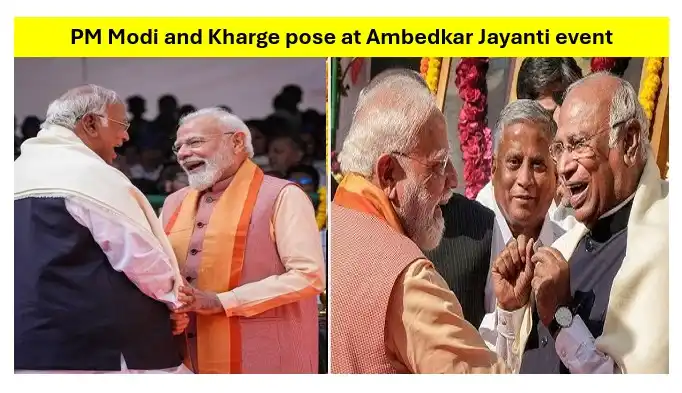
During Ambedkar Jayanti celebrations, Prime Minister Narendra Modi and Congress Party President Mallikarjun Kharge showcased an example of political decorum by sharing a stage together. By honoring the legacy of Dr. B. R. Ambedkar, who famously helped to create the Indian Constitution, this event brought together numerous leaders from all sides of Indian politics, creating a momentary truce in an otherwise heated rivalry.
A Rare Moment of Unity
Both leaders paid their respects to the late Dr. Ambedkar through the traditional act of placing flowers at his statue. Prime Minister Modi spoke about Ambedkar’s vision for an inclusive India, while also emphasizing his government’s commitment to improving the situation for disenfranchised citizens. Congressman Kharge discussed the long-standing connection between the Congress Party and the values espoused by Dr. Ambedkar, warning against any threats that exist to constitutional values.
The ceremony saw dignitaries, leaders of social movements and citizens come together to celebrate the lasting legacy of the works of Dr. Ambedkar. The ceremonial atmosphere showed great reverence for both Dr. Ambedkar and the occasion itself.
read also: Raghav Chadha shares a cryptic post amid the rift with AAP
Symbolism Beyond Politics
The combined appearance of Modi and Kharge had an essential meaning behind it to show solidarity to the public at large, particularly in this era of increasing political polarization within India and the urgent need to unite on national issues. Observers have stated that Ambedkar Jayanti allows for party unity due to its emphasis of equality and justice.
The few moments of just the two leaders standing together were highly viewed throughout a variety of media outlets, with many people seeing it as an illustration of the possibility to unite politically on shared values such as equality and diversity in regard to foundational figures like Ambedkar.
read also: Do parties have the authority to remove their Rajya Sabha MPs?
Two Different Messages, One Mutual Respect
Though they used the Ambedkar Jayanti celebration to illustrate significant points in their respective political narratives, both leaders took the opportunity to highlight the important government programs aimed at the social empowerment and economic development for those who have been traditionally disenfranchised. Modi emphasized that these initiatives build upon the vision that Ambedkar had for these groups.
While Kharge was speaking about protecting the Democratic institutions and the Constitution, he cautioned against the threats to what Ambedkar represented and encouraged citizens to protect their rights and freedoms. This contrast in message illustrates the conflicting ideologies of the ruling party versus the opposition, but the tone was also respectful and moderate, which demonstrates mutual respect for Ambedkar’s legacy.
Public reaction and Political reaction
The image of Modi and Kharge together generated a variety of responses. Some supporters of both political parties viewed the gesture as an exhibition of political maturity, while other analysts viewed it as a political strategy for both leaders to connect with voters through Ambedkar. Conversely, some critics were quick to point out that all symbolic actions require a basis in substantive action. They believed true homage to Ambedkar is through the establishment of policies to combat social inequities and to uphold constitutional protections.
The Enduring Relevance of Ambedkar
One of India’s biggest national memorial days is still celebrated by multiple groups that have looked to Ambedkar as a model for their efforts. Ambedkar Jayanti provides an annual focal point for continuing the struggle towards social justice in India. Politicians from all parties also use this time to re-confirm their dedication to Ambedkar’s principles and ideals. The presence of Prime Minister Modi and Leader of the Opposition Mallikarjun Kharge together indicates how much respect Ambedkar has across political parties in India. Even though the two leaders represent completely opposing political ideologies, they can agree upon the vision of B. R. Ambedkar.
In a time when the country is extremely polarized, politicking is nearly the same as war; these sorts of joint gestures of support/acknowledgment of ambedkar offer evidence that there still is a foundation of values which unite Indians, regardless of political affiliation.
