


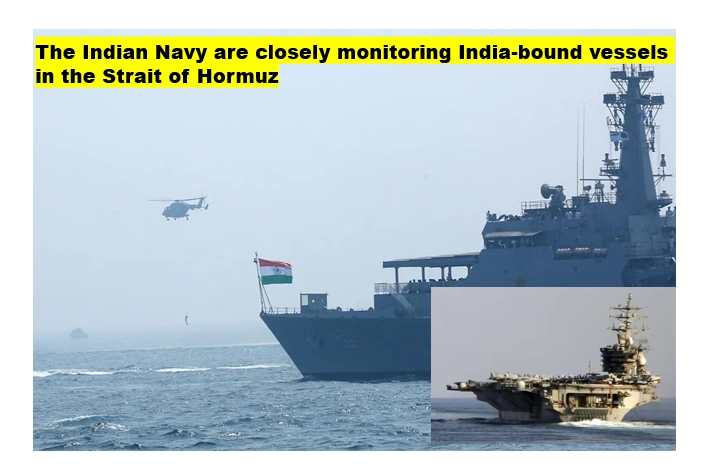
The silence of the sea, which has been so close and assailed with so much fierceness, in the narrow thin, watery ribbon called the Strait of Hormuz, is now interrupted by the low hum of gas turbines of Indian Navy destroyers. By March 15, 2026, the area has long since ceased to be a trade thoroughfare and has turned into a chessboard of high stakes on the sea. With the looming tension between the regional powers, the Indian Navy has stepped up its operations making the Operation Sankalp more than an ordinary patrol it is now a literal life-saving operation to thousands of Indian seafarers.
To the men and women on the India-bound ships the appearance of a gray hull whose tricolor is waving at the salty breeze is more than a strategic measure–it is the distinction between a safe homecoming and the loss of their lives in a war to which they were notborneen.
Iron Escort: Protection of the Energy Lifeline
Strait of Hormuz is a geopolitical noose that is strangling when geopolitical tensions are up. Saturday, March 14, the Shivalik and the Nanda Devi sailed through the strait successfully without any mishaps. They are not ships but huge floating tanks with a capacity of around 92,700 metric tons of Liquefied Petroleum Gas (LPG). The safe passage of these tankers is a national security issue in a country where millions of households rely on these cylinders to their daily meals.
It was an art of naval coordination in the modern day. The existence of a so-called dark mode operation in which parties moving along the most hazardous routes could be tracked with the closest attention on the part of Indian warships was demonstrated by satellite surveillance and related data on maritime tracking.
You are not in those waters and looking at the radar but you are feeling the tension in the air, says a veteran merchant mariner who is presently located in the Gulf of Oman. That a Navy destroyer is in sight alters the whole mentality of the bridge. You are, however, not a sitting duck any longer.
Read also: Iran war impact on India: LPG shortage concerns rise
The Human Cost: Waiting Families on the Shore
The 24 Indian flagged vessels that are already in operation in the Persian Gulf are the story behind the headlines talking of tonnage and strategic interests. There is about 668 Indian seafarers at the centre of the storm.
Things got to be very grim in early March when the projectile hit the tanker Skylight killing two Indian sailors. These were not fighters, they were breadwinners in small towns in Kerala and Punjab, who were on the wrong side of a regional proxy war. Ever since the war started on February 28, the Indian government control room of 24 hours has received more than 2,400 calls of panicked relatives.
The watch that is in the possession of the Navy is a ray of hope to these families. According to the Ministry of Shipping, whereas most foreign-flagged ships are being abandoned by their owners who do not want to pay war-risk insurance, Indian-flagged vessels are being escorted with the feeling of duty.
Read also: UAE Bitumen Ship Finally Reaches Karwar Port Despite Strait of Hormuz Crisis
The High Seas: Diplomacy- The Silent Shield
It is half the battle to have the Navy there. It is working behind the scenes by a so-called Silent Shield of diplomacy. External Affairs Minister S. Jaishankar has been in constant touch with his Iranian counterparts so that it is not India-bound but India-targeted.
The recent remarks made by the Iranian Ambassador to India, Mohammad Fathali, reiterated this special relationship saying that due to the long-term friendship between the two countries, Indian ships were going to be given the safe passage. The truth in the water, however, is something unpredictable. The IRGC (Islamic Revolutionary Guard Corps) has been more demanding and a ship passing through waters must seek express permission or face the danger of being shot by the drone boats or sea mines.
The Indian Navy warships serve as a deterrent and a spectator in this kind of environment. They use an advanced system of:
- P-8I Neptune planes- long-range sea surveillance planes.
- Drones carried on the ships to survey suicidal boats or mines.
- AIS (Automatic Identification System) monitoring all the time to avoid ships being spoofed or being diverted.
