


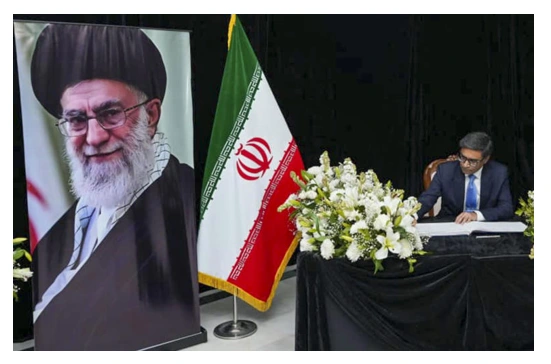
India officially stated its sympathies over the death of Iran’s Supreme Leader after days of quiet. This was a major political move during a time of sensitive events in the region. The move was made when India’s Foreign Secretary, Vikram Misri, went to the Iranian Embassy in New Delhi to show his condolences over the death of Ayatollah Ali Khamenei.
Condolences in a formal way at the Iranian Embassy
Foreign Secretary Vikram Misri visited the Iranian Embassy in New Delhi and signed the book of condolences on behalf of the Indian government. It is common for diplomats to show respect and sorrow for the family and friends of a foreign head of state or top leader who has died.
India’s first official public show of grief over Khamenei’s death was the visit. For several days before the event, New Delhi hadn’t made a public comment about it, even though people from many countries were reacting.
India showed it would officially recognize the loss and follow diplomatic procedures by sending its top minister to the Iranian embassy.
Delay in the Government’s Answer
India’s condolences came days after Khamenei’s death, which drew attention to the fact that public messages were sent so late. At that time, the Indian government hadn’t said anything directly about what happened, even though emotions in the area were still rising.
Before the death of the Iranian leader, officials had talked about how important it was for West Asia to have peace and security. Foreign Secretary’s ultimate visit is seen as a good move that strikes a balance between diplomatic politeness and India’s larger strategic goals.
This action shows that India is very careful in handling important international events, especially those involving major global players.
Read also: Israel-Iran conflict : Iraq closes airspace after Israel
Diplomatic Reach Out Continues
India and Iran continued to communicate diplomatically through official channels while the ambassador visited the office. During this time, India’s Ministry of External Affairs maintained contact with its Iranian counterparts.
The effort underscores how important it is for India to maintain ties between the two countries. The visit was a show of sympathy, but it also showed that India is determined to keep foreign ties strong, despite the area’s generally unstable conditions.
India and Iran have had cultural and political links for a long time. The formal sympathy message and the embassy visit are signs of how close the two countries remain, at a time when the world is focused on what’s happening in the area.
How sensitive the event is to geopolitics
Khamenei’s death has had significant effects in the region and around the world. For many years, he was Iran’s Supreme Leader and wielded significant political and religious power in Iran and throughout West Asia.
Because global ties are complex and India has many strategic agreements, New Delhi had to be very careful in its response. India has friendly ties with many countries in the region and with major world powers.
Read also: Iran and US to renew nuclear negotiations in Geneva
Communication in difficult places to maintain peace
India’s tragic last message underlines its commitment to international law and cooperation. As the world changes, the government seems to be striving to maintain equilibrium.
This visit by India’s Foreign Secretary Vikram Misri to the embassy shows that the country is aware of what is going on in Iran and wants to keep talking to the government. At first, the silence got people’s attention but India’s public apologies have now made its position clear.
As tensions rise in the area, India’s carefully timed diplomacy moves show that it wants safety, discussion and strategic balance. The apologies were just a show of support, but they show how important it is for New Delhi to keep good relationships with other countries, even when things are tough.
