


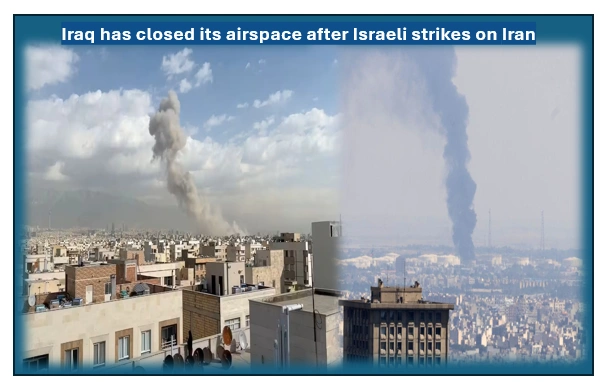
The sky above the Middle East turned into a quiet, holey darkness, on the afternoon of the last day of the month of February 2026. The standard buzz of commercial airliners, the metal birds that were transporting Europe and Asia together, was gone in minutes. In its stead a wave of terror fell upon Baghdad, Tehran, and Tel Aviv interrupted only by the shrill screech of supersonic planes and the terrible, nauseating bang of explosions.
This is no longer a shadow war. After a series of giant Israeli, so-called, pre-emptive attacks on the Iranian capital and some other large cities, the drastic measure of the closure of the national airspace of the country was adopted by the Iraqi Ministry of Transport. It was a policy measure, and a panicky measure at that.
The Moment the Music Stopped: Airspace in Lockdown
Before the Iraqi airspace became closed, a panicked clearing of the skies had been undertaken. In a more of a rehearsed emergency evacuation than a normal air traffic control effort, Mitham al-Safi, a spokesman of the Iraqi Ministry of Transport, confirmed that all civilian planes were immediately ordered to land or reroute.
To the occupants of Air India flight AI139 that was flying between Delhi and Tel Aviv, the war came into reality mid-way through their flight. The pilot was a thousand feet in the air when he told a shocked cabin that the plane was returning to Mumbai. They were the lucky ones. Hundreds of passengers across the region were stuck in foreign airports, waiting with their eyes on news tickers as they desperately refreshed with the latest explosions in Isfahan, Qom, and Karaj.
The ministry has declared closing of Iraqi airspace, al-Safi informed Iraqi News Agency. This was followed by all air traffic evacuation to facilitate the safety of civilians in case of anything happening to them.
Read also: How Modi ‘broke down walls’ between India, Israel – at Palestine’s
Major Combat Operations: The Trump-Netanyahu Offensive
The strikes, which commenced in the early hours of Saturday were as characterized by Israel defence minister Israel Katz as a proactive mission to eliminate imminent threats. Yet, this size of the operation indicates something much bigger than a simple surgical strike.
To make the matter even more global, U.S. President Donald Trump confirmed that American troops are already engaged in what he termed as mass and continuing combat operations, back in Washington. During a typical video speech, Trump informed the audience in Iran that it was the time of your freedom, and it was time to assume the government, a message that has shocked the diplomacy at the UN.
The human cost is starting to be felt in Tehran. The new skyline now is smoke plumes and one of the biggest explosions has been reported to have taken place near the offices of Supreme Leader Ayatollah Ali Khamenei. As Khamenei supposedly has been transported to a secure location, the people of Tehran have been left to scramble in the vicinity. Mobile phone services are reduced and the internet which is the only opening that most people have to the outside world has flickered to blackness.
The Human Price: Fear in the City of Pearls and Beyond
Though missiles and requirements are the bases of the headlines, human stories are in the cellars of Tehran and the dungeons of Tel Aviv. In Israel, hospitals have gone underground, transferring patients to underground levels of surgery and critical care as sirens scream all over the nation.
A reminder of the invasion in 2003, the airlift shutdown in Baghdad which is geographically caught between the two warring sides is a haunting event. The airplane jet heard over Iraq is not merely a news piece to Iraqis, but a pure physical stimulus of the traumas of the past.
Read also: Iran warns attack on Khamenei would be declaration of war
A World in Wait
This is already being felt at the world gas pump and the boarding gate. As the Strait of Hormuz effectively becomes a live-fire zone and the air routes of the main Middle Eastern region are closed, the world economy is preparing to have a shock. Airlines such as Lufthansa, Emirates and IndiGo have cancelled all flights to the region, which are causing logistical bottleneck that might not be untangled in weeks.
However, when the UN diplomats request the urgent de-escalation, the situation on the ground is that of ingrained positions. The Iranian states have threatened any U.S. staff or installations within the region, as legitimate targets of retaliation.
When night falls over the desert, the flight monitors, normally full of thousands of yellow icons, there now appear to be a dark blank area on the screen in the center of the Middle East. It is a silence which speaks louder than an explosion.
