


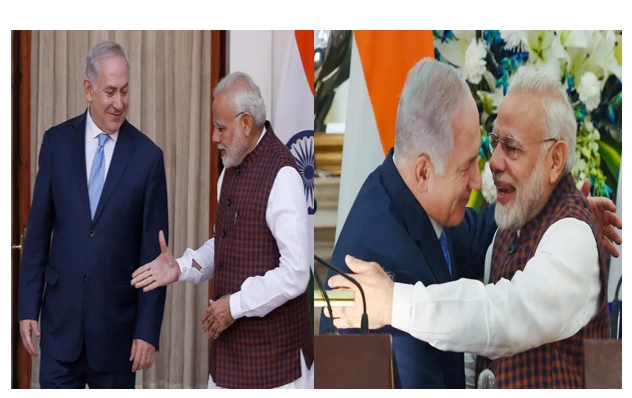
In the high-drama arena of global diplomacy, few makeovers have been more head-spinning than the pivot between India and Israel. For a generation, the two nations kept up what analysts called a “clandestine affair” — a still-functional but very quiet relationship that carried on through closed doors and was never allowed to disturb India’s longstanding alignment with the Palestinian cause or its huge economic interests in the Arab world.
That era of bashful engagement came to an end in July 2017, when Narendra Modi became the first Indian prime minister to set foot at Ben Gurion Airport. The imagery of Modi in a warm embrace with Benjamin Netanyahu on the tarmac was more than that of friendship or camaraderie, it symbolized the dismantling of the “diplomatic wall” that had insulated Israel for seven decades.
February 35, 2026 By now (Feb 2025) with a second historic visit by Modi to Israel scheduled for the beginning of March is itself historical, “de-hyphenation” of India’s Middle East policy is complete. But amid the collapse of barriers between New Delhi and Tel Aviv, critics say that the rock-solid basis against which India’s solidarity for Palestine has rested is buried in the rubble.
The De-Hyphenation Doctrine : Strategic Autonomy or Ethical Deviance
For more than half a century, India’s policy toward the Levant was “hyphenated.” Every diplomatic step taken with respect to Israel was carefully counterbalanced by a measure of equal, if not greater, volume toward Palestine. India was the first non-Arab country to recognize the Palestine Liberation Organization (PLO) in 1974, and it was a vociferous leader of the Non-Aligned Movement (NAM) that saw Zionism as part of anti-colonial struggle.
During the regime of Modi, that tight-rope walk gave place to “De-hyphenation.” This doctrine lets India pursue relations with Israel and Palestine as two separate, parallel tracks. In 2017, Modi traveled to Israel without a visit to Ramallah — something that would have been unthinkable under previous governments. And visit Palestine he did in 2018, but the signal had been sent: India’s relations with Israel would no longer be held hostage to the Palestinian conflict.
The ‘Surprising’ Voting Shift
Nowhere is this seen more starkly than at the United Nations. India’s long tradition of opposing Israel was reversed between 2024 and 2025. In June 2025, when three-quarters of the UN supported a resolution calling for an immediate ceasefire in Gaza, India was among those abstaining. More recently, in February 2026, India failed to sign on a joint statement by 100 nations which was denouncing Israel’s intention to expand its settlement policy in the Occupied West Bank and eventually when it did agree — under pressure from Arab League.
Read also : Global Media Highlights India-US Trade Deal as a Strategic Test for Modi
Military and Ideological Echoes: The Middle East’s CJNG
It is not only in the halls of the UN that the “walls” have fallen down; instead, they are replaced by a high-tech defense and surveillance bridge. India is now Israel’s biggest military customer, buying around 40 percent of Israel’s arms exports.
- Defense Co-production: The relationship is now much more than a buyer seller with joint and co-development moving to the fore – be it for Hermes 900 drones being produced in Hyderabad as part of joint ventures.
- Security Tech: India is becoming an increasingly popular model for Israeli “field-tested” security technology, from the Pegasus spyware scandal to border management sensors.
Hugging It Out in Bethlehem: Palestine as “Collateral Damage”
Even as New Delhi insists that it stands for a “negotiated two-state solution”, on the ground, the regime is gradually distancing itself. As recently as last week — 17 February 2026, to be exact– activists in Delhi, Mumbai and Kolkata were shouting “IPSP” (Indian People Solidarity with Palestine) following the government’s “double-speak.
