


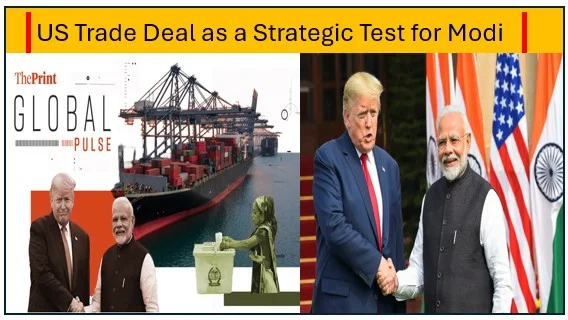
The recent trade deal between India and the US has been described by major international news outlets as both a diplomatic success and a political challenge for Prime Minister Narendra Modi. Analysts have pointed out that concessions made in the agreement could have effects at home even as potential economic gains happen.
Many well known newspapers and financial magazines around the world have written about the trade deal. They say that it could lead to more market access and stronger strategic ties, but the terms of the deal have also caused a lot of attention and mixed political responses around the world.
The deal is seen by the New York Times as a political headache
India and the US reached a temporary trade deal after months of talks, according to the New York Times. However, as more information came out, the Modi government was called a “headache” because of the political difficulties it faced.
At first, officials in New Delhi were excited about the idea of lower tariffs on important exports. But when they saw how the final structure of mutual market-opening conditions worked, they weren’t as excited. Analysts cited in the New York Times said that headlines about lower American taxes were not always seen as a clear win. This made what the newspaper called a “nuanced political challenge” for Modi’s government.
Bengaluru’s By 2 Coffee Tradition Wins Hearts of Global Food Students
An economist looks at the agreement’s give and take
The Economist magazine looked at the deal’s mix of cuts and possible benefits and found that both sides made big changes.
This article says that India agreed to lower tariffs on a number of American goods, and the US agreed to lower long-standing tariffs on Indian exports to the US market. Economists writing for the magazine said that the real effect on the economy will rest on how quickly businesses change their supply lines and on how well Indian makers are able to turn lower tariffs into more exports.
The study found that some industries in India, like textiles, gems and jewelry, and manufacturing goods, will benefit. However, the way the concessions were set up could be criticized by producers who think that important protections were loosened without any immediate benefits.
Bloomberg focuses on the effects on regional industries
Bloomberg’s analysis of the trade deal put it in a bigger economic context, pointing out how new American market access could affect regional supply lines like shipbuilding in Tamil Nadu.
Economic reporters said that the deal could help Indian makers, but it also puts them at risk of tough competition from US companies with more money and better technology. The study that was used in news stories around the world looked at how this change could speed up India’s economic modernization while putting more pressure on local businesses to grow faster.
More talk about trade, politics, and what to do at home
A study of global media shows that the trade deal is being talked about not only for its economic benefits but also for the political meanings it holds.
The deal comes at a time when geopolitics and supply chain diversity are attracting significant attention. As part of its plan to become less reliant on a single supply source, the US has been building stronger economic ties with key partners.
The deal is an attempt by India to become more involved in key global markets while also safeguarding its own interests. Reporters from around the world have said that Prime Minister Modi’s government will have to work hard to manage public perceptions and expectations across different sectors. This is especially true in sectors like agriculture and manufacturing that depend on labor and are vulnerable to competition from imports.
Analysts who cover the whole world say that how India implements the deal will likely affect how investors feel and future trade talks with other major partners.
Indian Rupee Gains Momentum Opens Higher Against US Dollar Amid Trade
Possible Gains in Translation and Unresolved Issues
There are different opinions on the trade deal between India and the US, but most agree that it could be good for both countries in the long run if the lower tariffs and new market access lead to steady export growth.
Economists from outside India watching the deal say that stable tariffs and open trade between the two countries can boost investment, make both countries more competitive, and improve economic cooperation.
Still, there are concerns about the effects on the trade balance, sector shifts, and how local players view the balance of benefits and compromises.
27th edition of Intersec concluded at Dubai World Trade Centre
