


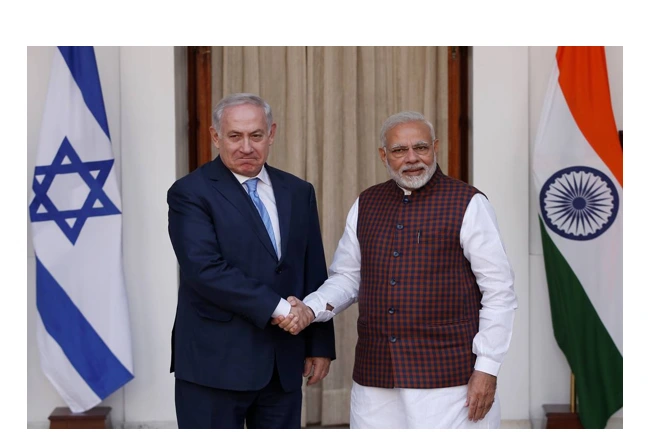
Breaking new ground in the growing New Delhi-Tel Aviv strategic relationship, India will embark on a multi-billion dollar project for joint development of a medium range surface-to-air missile (MR-SAM) with defence-sharing ally Israel+. This strategic shift, that comes just days ahead of Prime Minister Narendra Modi’s mega visit to Israel on 25th Feb 2016, is not one of seller-buyer but more of co-development.
Central to this collaboration is “Mission Sudershan”, India’s ambitious plan to build a concentric, impenetrable bubble over its key cities and economic centers. And by merging battle-tested Israeli technology with India’s homegrown top secret defense projects, the two countries hope to revolutionize the Indo-Pacific security order.
Iron Shield of the East : Collaboration and Mission Sudarshan
The development of new anti-ballistic missile systems is due to dominate the talks. World renowned for its multi-layered defence that includes the long-range Arrow, medium-range David’s Sling and short-range Iron Dome, Israel is now going to give share its most tightly held technological secrets.
Contrary to the preceding decades when technology transfer was restrictive, “full access” is stressed in India’s updated Defense Acquisition Procedure (DAP) 2026. This will entail Indian scientists from the DRDO collaborating with Israeli engineers to develop systems specifically suited to counter the unique perils that India faces along its northern and western boundaries.
The partnership is reportedly likely to have a particular emphasis on:
Exo-atmospheric Interception: This promotes India’s missile destruction capability in space that would match the Arrow-3.
- Laser Defense: The evolution from kinetic interceptors to high-energy laser systems which can rapidly knock down drones and missiles at the “speed of light” with much cheaper costs per shot.
- Networked Sensors: Plugging Israel’s ultra-sophisticated EL/M-2084 AESA radars (the “brain”) of the Iron Dome into the Indian grid to turn what many see as 360 degrees of dumb surveillance loop in to a seamless affair.
From Procurement to Co-Production: A Roadmap for $10 Billion
This partnership’s financial magnitude is mind-boggling. Defence pipeline Unlike in India where we expect the sum of defence wins to be much larger than the first two order-wins, in UAE currently I think if you see from a pipeline perspective how the numbers look, there is probably one and half-and-half kind of similar level discussion that we have won more like $10-odd billion over five years. It is not just writing checks, but building factories.
A new Memorandum of Understanding (MoU) was signed between Israel’s SIBAT (International Defence Cooperation Directorate) and the Society of Indian Defence Manufacturers (SIDM), only last week. This deal consolidates 30 companies of Indian and 26 from Israel, which include giants such as the Israel Aerospace Industries (IAI) compared to India’s Hindustan Aeronautics Limited (HAL).
The most humanising facet of this package is the emphasis on MSMEs (Micro, Small and Medium Enterprises). The “Make in India” initiative is decentralizing production, generating thousands of jobs at high-tech posts like Hyderabad and Bengaluru, where pieces for the global shields are now being made.
“We’re not just buying a shield — we’re learning how it’s made, how to weld the rivets, working with fire and iron,” says a senior defense official who is part of the negotiations.
Read more : India Successfully Test-Fires Agni-3 Ballistic Missile
The Regional Catalyst: Why Now?
The necessity of such cooperation is fueled by an unstable regional environment. The success of Israeli systems to intercept high-volume missile salvos during the recent conflicts in West Asia have acted as a compelling proof-of-concept for New Delhi.
In addition, the shadow of “Operation Sindoor”—a recent tactical flare up in the region has underscored the need for precision and protection. India has already been able to successfully procure Israeli-origin Rampage air-to-surface missiles and Air Lora Ballistic Missile to meet the threat. Now, the focus is moving from “sword” to “shield.”
The timing coincides with India’s imminent launch of the INS Aridhaman, its third nuclear submarine, expected this spring. Since India finishes off its nuclear triad, the immunity system of a reliable ABM guarantees that the “second-strike” capability of the country is shielded by an advanced defensive umbrella.
Key Defense Stocks to Watch
As the collaboration gels, market watchers are eyeing a number of Indian outfits that stand to gain from the tech infusions:
- Hindustan Aeronautics Limited (HAL): Collaboration for conversion of civil-registered to military-registered aircraft and missile integration.
- Bharat Electronics Limited (BEL): it is leading the development of radar and electronic warfare.
- Data Patterns & Astra Microwave: These are small cap players, who specialise in the crucial high frequency components of the ABM shield.
