


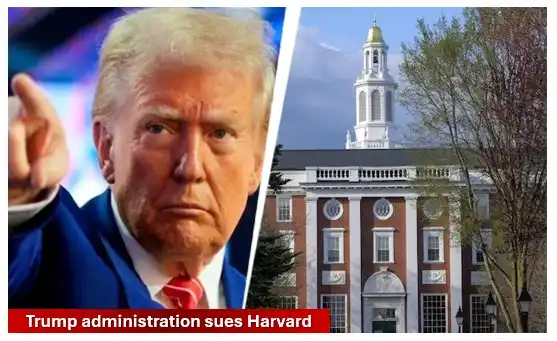
The showdown between the Trump administration and Harvard University is coming to a head. The Department of Justice officially filed a suit against the Ivy League powerhouse on Friday, accusing it of “thwarting” a federal investigation into its admissions activities.
More than mere regulatory skirmishing, the move is a high-stakes battle over the future of higher education in America. The administration accuses Harvard of thwarting an investigation intended to establish whether the school has indeed left race-conscious admissions behind, while Harvard insists that it is unfairly targeted and the victim of an ideologically motivated crusade.
The Crux of the Dispute: Why DOJ Is Suing
The lawsuit, which was brought in a Boston federal court, concerns an “compliance review” that commenced in April 2025. The Justice Department is seeking five years’ worth of granular data, including applicant-level grades, test scores, essays and internal correspondence.
The administration’s argument is straightforward:
- Compliance with the Law: In the wake of a 2023 Supreme Court decision that gutted affirmative action, DOJ wants to know if Harvard is using “workarounds” to maintain racial balancing.
- Transparency: Assistant Attorney General Harmeet Dhillon, who heads the Civil Rights Division, presented the lawsuit as a simple question of accountability. “If Harvard has ceased discriminating,” Dhillon said, “it should gladly share the statistical proof of that reality.”
- Failure to Comply: The DOJ claims that Harvard has spent over ten months “slow-walking” its response to the government’s document requests, effectively stonewalling the government’s ability to conduct its inquiry.
The lawsuit does not accuse Harvard of present discrimination, it should be noted. Instead, it aims to force the university to produce the requested records by invoking the receipt of federal funding by the school as a legal lever behind its demand.
Harvard’s Defense: A Struggle for Academic Independence
Harvard isn’t backing down. In a scathing response, a university spokesman denounced the lawsuit as a “retaliatory action” and an “unlawful government overreach.”
The university’s defense is based on a few crucial underpinnings:
- Good Faith Cooperation: Harvard says that it has been cooperating in good faith and has already given the government a lot of information, but adds that its requests are too wide-ranging and implicate academic freedom.
- Constitutional Rights: The school argues that the administration is trying to “cavalierly surrender its independence,” and that the pressure campaign infringes on its rights as a private institution.
- Political motivation: Harvard’s lawyers have suggested in the past that those investigations are less about civil rights and more of an ideological attack on “woke” culture at elite institutions.
This isn’t an isolated incident. Over the last year or so, Harvard has already sued the administration multiple times — testing everything from the sudden freezing of $2.2 billion in research grants to efforts to keep international students from enrolling.
The $1 Billion ‘Price of Peace’
Further complicating the legal matters is a fresh financial demand from the White House. Reports emerged just weeks before the lawsuit was filed that the administration had been seeking a settlement payment of $1 billion from Harvard to resolve other federal probes.
These investigations aren’t confined to admissions. They also comprise inquiries into the university’s approach to campus protests and allegations that it has failed to protect Jewish students from antisemitism. Other institutions, like Columbia University, have reportedly agreed to multimillion-dollar settlements of similar suits but Harvard has not backed down.
The lack of a settlement most likely set the stage for Friday’s legal escalation. The lawsuit, for the administration, is a lever to extract obedience from colleges and universities; Harvard’s endowment is nothing else than a “ransom” for its autonomy.
The Road Ahead
The next step is up to a federal judge in Massachusetts, who must decide whether Harvard has a legal obligation under federal law to turn over the five years of records. If the judge directs the disclosure, we could find ourselves with a huge trove of admissions data unsealed and made public, in one fell swoop rekindling the national conversation over how “merit” is defined in our increasingly complicated 21st century.
No matter the legal outcome, the culture war is profound. The administration fancies itself the protector of fairness and the “colorblind” Constitution; Harvard sees itself as the bulwark of academic freedom against a meddling state.
