


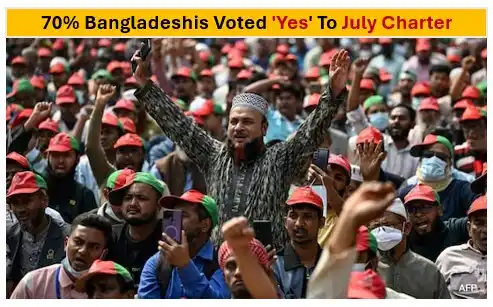
Bangladesh’s political demography has received a jolt and let the recent referendum on the ‘July Charter’ be evidence. With 70% of the vote caucused in, the nation has spoken to party politicians: out with the old and in with a reform-heavy new constitution.
But how bad is this, really, for the common man, the economy and the future of geopolitics in South Asia? This is no mere change of law; it’s a complete reimagining of what the Bangladeshi state ought to be.
The July Charter: A New Paradigm for Bangladesh
To make sense of the 70% pledge, in other words, we need to first unpack what exactly the July Charter is. A product of a youth-led revolution and its interim aftermath, the Charter is intended to be a “People’s Constitution.” The goal is to unravel the hyper-concentration of power that many believe led to the decade’s political stagnation.
The End of “Winner-Takes-All” Politics
For decades, Bangladesh ran on a system of winner-take-all. The New Charter of July introduces PR.. Under this system, seats in Parliament are awarded based on the overall percentage of votes a party wins, rather than by winning individual constituencies.
This near 70% “Yes” vote tells us that the public is hungry for a more inclusive government where smaller parties of diverse voices have a seat at the table and one entity cannot emerge as a “democratic autocrat.”
Radical Decentralization
The Charter vows to decentralize power away from Dhaka. Through empowering local government institutions with financial independence, the “Yes” victory proves that Bangladeshis are tired of waiting for the capital to take care of local problems. From agriculture in the north to ports facing the south, regions will now have more control over their development.
Why 70%? Decoding the Mandate
A 70% victory in a national referendum is a huge democratic sign. This is a country so frequently divided, half against half and red states versus blue ones — you want something to engender 90-odd percent consensus?
The Youth Factor
The July Charter has its roots in the hopes of Gen Z and millennials. These voters represented the core of the “Yes” campaign. For them, the Charter represents:
- Meritocracy Not Nepotism: More stringent rules for political appointments in the civil service.
- Digital Rights: Constitutional guarantees for access to the internet and protection of data.
- Environmental safeguard: Include “Ecological security” as fundamental right.
The Stability Argument
Oddly enough, the 70% “Yes” hadn’t only issued from radicals or reformers. Much of the business world and the middle class chose “Yes” for predictability. With term limits (2 terms max for PM) and an independent (!) Judiciary, the Charter offers long-term investors a rule-based framework.
# The Economics of the “Yes” Vote
Political stability is the coin of economic expansion. In ratifying the July Charter, Bangladesh has called out to the World Bank and the IMF, as well as to foreign investors: there is a new sheriff in town.
Labour Rights and RMG
The Charter contains provisions on fair wages and the right to unionise. Although a lot of factory owners were initially afraid of these measures, the 70% directive reflects that public opinion now understands that there is no alternative to having a more equal workforce if we are to sustain the (Ready-Made Garment) RMG industry.
The Charter in Practice: What Future Challenges Can the Charter Address?
The reformers win with a “Yes” vote, but the road is hard. A constitution is only as good or bad as its practice.
The Old Guard’s Resistance
The remaining 30% who voted “No” or did not vote are a mixture of traditionalists and those simply afraid the Charter is too idealistic. The transition from patronage to one based on merit will naturally meet resistance from the bureaucracy and local power brokers who lose their purchase.
The Verdict: A Nation Reborn
The July Charter 70% ‘Yes’ vote is not just a figure, it’s our unified exhale and hope for the future. It represents not only that Bangladesh is no longer willing to settle for being a “developing nation” by economy alone, but also chooses to be a “developed nation” in its institution, its justice system and even in its democratic soul.
The Charter isn’t a magic wand, but it is a sturdy new compass. Once in a generation, the people of Bangladesh have articulated where they want to go. The hard work of walking that path starts now.
