


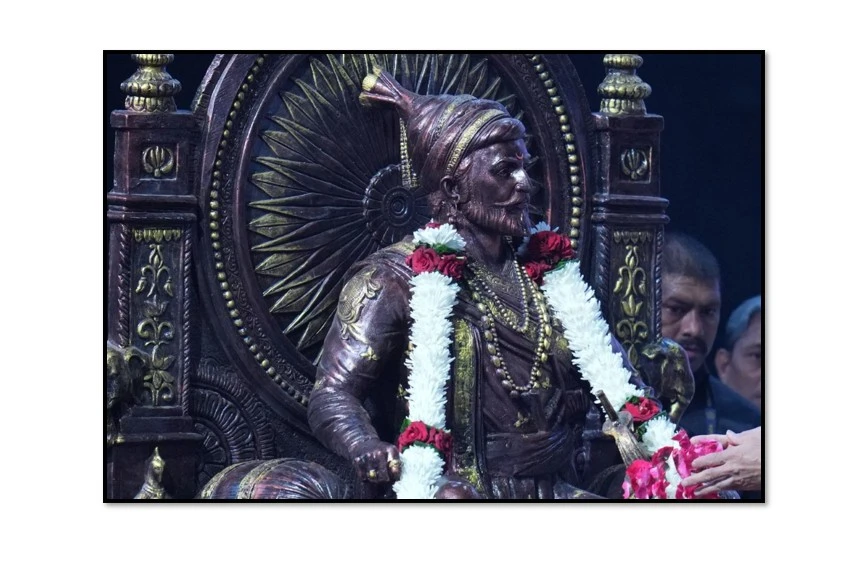
In what is being hailed as a landmark moment for Indian historiography and descendent of the Maratha empire, Oxford University Press (OUP) has now finally tendered an apology in public for incendiary material in a book it had published over two decades ago. The apology, carried in newspapers on January 6, 2026 was offered based on “long standing grievances” about baseless and defamatory statements against the legendary Chhatrapati Shivaji Maharaj.
The development comes in response to an order by the Bombay High Court, and closes one of the most acrimonious academic and social struggles in contemporary Maharashtra. In this way, the scholar at one of the world’s most-respected academic presses has attempted to heal an almost generation-long schism over the 2003 book.
The Shivaji Controversy, The Roots of the Dispute: James Laine’s “Shivaji”
Background The dispute began in February 2003 when American historian James Laine published his book Shivaji: Hindu King in Islamic India. Although the book was meant to offer a scholarly examination of the “legend” of the Maratha king, it included several other passages — specifically on pages 31, 33, 34 and 93 — that had crossed the line for millions of his followers.
The most offensive parts consisted of abusive comments against the parentage of Shivaji Maharaj along with defamatory derogatory remarks towards his mother Rajmata Jijabai. For some, these were not only historical inaccuracies but also deliberate provocations to the “Chhatrapati,” as a symbol of self-rule (Swaraj) and identity culminated in India.
The Aftermath of Publication
The 2004 fallout was quick and brutal:
- The BORI Attack: A British curse, a ‘Maratha’ fury”: Protests peaked with the Sambhaji-B brigade vandalizing the Pune based Bhandarkar Oriental Research Institute (BORI) accusing local researchers of giving Laine some controversial details.
- Legal Battles: The Maharashtra government first prohibited the book, leading to years of litigation in India’s High Court and the Supreme Court.
- Academic Chill: The fallout saw some local scholars destroying years of their own research, paranoid that they would be misrepresented or beset.
22 Years Later: The Apology, the Terms
The regret expressed by OUP India’s former Managing Director, Sayeed Manzar Khan, is unmidded. The notice stated that the material had been published “with insufficient verification” and it accepted the huge distress caused to the general public as well as to direct descendants of the royal family.
The apology was targeted only at the 13th direct descendant of Shivaji Maharaj, Chhatrapati Udayanraje Bhosale (MP). The criminal defamation proceedings were filed by Bhosale in 2005, a case which has been long winding the judicial corridors for more than two decades.
Implications for Contemporary Historiography
The apology by Oxford is a critical precedent under academic accountability. In the era of “post-truth” and unverified claims ricocheting across social media, a prestigious institution admitting it fell short on conducting its own peer-reviewed standard is at least one win for historical accuracy.
Historians in Maharashtra have welcomed the step, but some have also questioned why it took more than 20 years for the publisher to admit that the content was “perverse”, as Indrajit Sawant did. And an apology is just a start, they say; the work that really needs to be done now is too ensure scholars produce more nuanced and respectful history tracts in future—that truly represent figures as large as Shivaji Maharaj.
A bronze statue honoring a Korean queen with Indian roots is unveiled in Ayodhya.
A New Page in Cheeky Political Correctness
But beyond the legal victory, this apology ushers in a new era of how international publishers should navigate cultural sensitivities in the Global South. OUP has undertaken to conduct more thorough community consultations and “sensitivity reviews” to be sure that historical narratives do not accidentally trample the living heritage of a nation.
For the followers of the Maratha warrior king, it is also a time of vindication. It is a reminder that while history may be subject to interpretation, it cannot serve as a vehicle for smearing the memory of legends who molded and breathed life into the soul of such a rich culture.
