


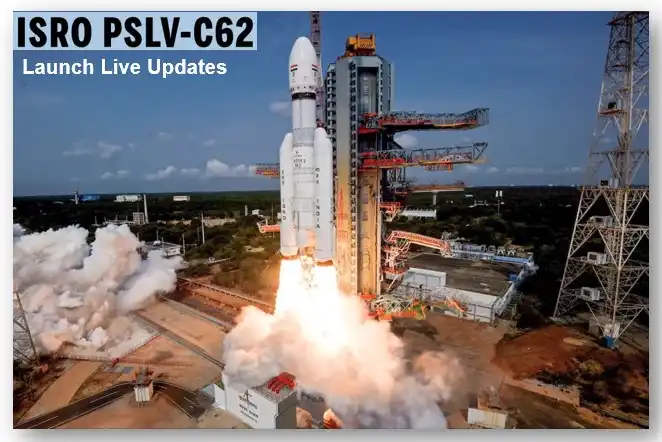
India’s space fraternity, which is used to the clockwork precision of its “workhorse” Polar Satellite Launch Vehicle (PSLV), breathed easy on Monday morning when it finally pulled off what had initially appeared impossible; in this ordeal was a rare touch of anxiety. A technical malfunction on the PSLV-C62 mission, launched on January 12, 2026 carrying the primary EOS-N1 (Anvesha) and 15 other co-passenger spacecrafts has put the final mission status under doubt.
The roar of the vehicle as it blasted off from the Satish Dhawan Space Centre in Sriharikota at 10:18 am IST was perfectly normal and so was its liftoff, but during its crucial third stage, it encountered a major glitch.
Anomaly: Variance from the Flight Path
The first two stages of PSLV-C62 have performed as expected and placed the vehicle into space, based on real-time status reports from ISRO Mission Control. However, as the third stage (PS3) was approaching shutdown, data showed a “disturbance in roll rates.”
Yielding from terse protocols on telemetry loss, ISRO Chairman V. Narayanan also said:
“Everything was going perfect until the (end of) SS3. Afterward, there were some performance anomalies and an off-nominal flight path was recognized. “at the moment we are reviewing the data and will return with a full status asap.”
In satellite launches, the “roll rate” refers to the rocket’s degree of rotation about its central axis. If this rotation becomes unstable, the vehicle will tend to deviate from its pre-estimated trajectory. Preliminary reports indicate that it is this deviation, which stopped the fourth stage from placing the satellites in their designated 505 km Sun-Synchronous Orbit (SSO).
India’s ‘Baahubali’ Rocket to Launch Massive US Commercial Satellite
The Payloads: What’s at Stake?
The PSLV-C62 was not an ordinary flight; it was a “priority mission” for the national security and commercial space sector. Total 16 satellites are carried onboard which were developed within the last few months together with ISRO, DRDO and private startups.
EOS-N1 (Anvesha): The main payload, weighing 407 kg designed for DRDO is a hyperspectral imaging satellite. This “eye in the sky” was a high-flying spy plane built for cutting-edge maritime surveillance and strategic observation, able to scan across hundreds of wavelengths to look down on Earth and recognize what it saw.
KID Re-entry Capsule: A technology demonstration from a Spanish start-up, intended to test atmospheric re-entry and splash down in the South Pacific.
AayulSAT: Bengaluru-based OrbitAID Aerospace had developed this as India’s first on-orbit satellite refueling demonstrator.
Student and University Satellites: This rideshare mission featured multiple CubeSats from Indian universities and its international partners.
A Rare Stumble for the Workhorse
Space analysts are already comparing with the PSLV-C61 mission of May 2025, which had also experienced anomalies in its third stage. A third-stage repeat will certainly trigger a rigorous FAC review to ascertain whether there is some systemic issue with the solid-fuel motors or nozzle control systems employed during this particular phase of flight.
What Happens Next?
Unfortunately for the US, there is no “Mission Accomplished”. Scientists at ISRO are processing the final set of telemetry pings received prior to the deviation, working all through the night at MCC (Mission Control Centre).
The analysis will address the following main questions:
- Orbit Injection: Did any of the satelites make it to orbit even if was not where they were intending to go?
- Telemetry Recovery: Is PS4 trackable to garner enough data for a suitably controlled-deboost?
- Root Cause: A problem with the motor, or a bug in the navigation software?
Blue Origin Makes History with First Wheelchair User in Space
The Resilience of ISRO
For every setback that ISRO has faced – from the early days of the SLV to its first trials with the Cryogenic engine, it has always come back with a stronger and more efficient vehicle.
The PSLV-C62 may have fallen short, but it is a bitter pill that will lead to innovations and data points in the future which should guarantee the safety of essential missions such as Gaganyaan test flights or the expansion of NavIC.
