


India is about to reach a major milestone in its space journey. Its strongest rocket, the LVM3, also known as the Baahubali rocket, is getting ready to launch a big US commercial satellite. India’s growing power and authority in the global space market are shown by the fact that this mission will be the first time a big American commercial satellite is launched using the country’s own launch vehicle.
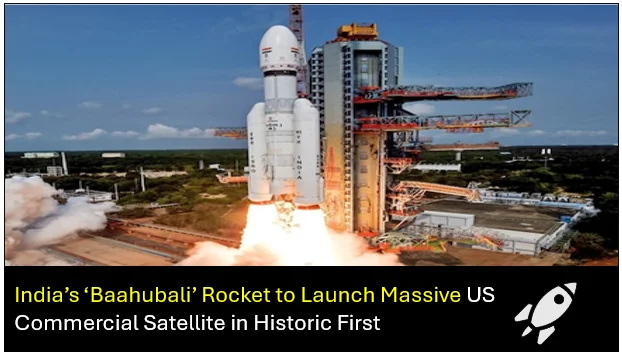
New Space India Limited, the business part of the Indian Space Research Organization, will carry out the launch from the Satish Dhawan Space Centre in Sriharikota. People see it as a turning point for India’s plans to do business in space, as it opens up new opportunities for relationships with other countries and high-value flights.
A historic mission for business in space
BlueBird 6 is a next-generation communication satellite being sent on the future flight. It was made by a US-based business that focuses on space-enabled mobile connection. The project is both technically difficult and politically important because this is the largest commercial satellite that has ever been put into space on an Indian rocket.
India’s LVM3 rocket has mostly been used for national tasks like exploring the moon and getting ready for human travel until now. Launching a big business satellite from another country shows that people around the world trust India’s launch systems and mission trustworthiness.
Why the LVM3 “Baahubali” rocket is important
The LVM3 is India’s most powerful rocket. It can send big objects into low Earth orbit and geosynchronous transfer orbit. The rocket is over 40 meters tall and weighs more than 600 tonnes. It has been on several successful flights, which shows how strong it is.
The LVM3, which is known as Baahubali because of how powerful it is, has been an important part of major projects like Chandrayaan-2 and Chandrayaan-3. India is one of only a few countries that can launch heavy objects, and its pick for this US business mission shows that it can handle big, complex satellites.
The BlueBird 6 and the Future of Mobile Connectivity
BlueBird 6 is going to change how people around the world link to their phones. Unlike other satellites, which need special tools on the ground to work, this one is meant to connect regular smartphones directly.
When BlueBird 6 is put into orbit, it will open a huge antenna system that will let it provide voice, text, and high-speed data services from space. The goal is to bring cell service to areas that are hard to reach, rural, or prone to tragedy, and where it would be hard or expensive to build infrastructure on the ground.
The satellite should support next-generation mobile services, such as improved internet connection, which could change how millions of people around the world communicate.
India’s space economy gets a strategic boost.
This launch isn’t just about technology; it’s also a big step forward for India’s space economy. India is becoming a more dependable and cost-effective launch partner by getting such high-profile foreign business missions.
India is also trying to open up its space industry to private companies and clients from around the world. This project is part of that effort. As the need for satellite launches grows around the world, India’s space industry may get more business contracts and grow over the long term if this mission goes well.
A Look Ahead
As preparations for the countdown continue at Sriharikota, hopes are high. A successful launch will strengthen India’s reputation as a reliable spacefaring country and give the world a look at what its homemade launch vehicles can do.
The historic flight of the Baahubali rocket could be the start of a new era in which India plays a bigger part in supporting global communication and business space activities.
