


A bold test of China’s new reusable rocket came to a fiery end on Dec. 3, 2025, when the first stage of LandSpace’s Zhuque-3 exploded during descent and rammed into the ground below. The explosion, recorded in a video taken near the landing zone in the Gobi Desert, highlights one of the dangers that comes with working to build fully reusable launch systems.
Mission: Success — but the Landing Is a Fireball The booster successfully brings itself in for a landing on Port Canaveral.
The first flight of Zhuque-3 was carried out from the launch site at Jiuquan Satellite Launch Centre. The rocket successfully placed a dummy payload in low Earth orbit — an important milestone for LandSpace and China’s burgeoning commercial space industry as a whole.
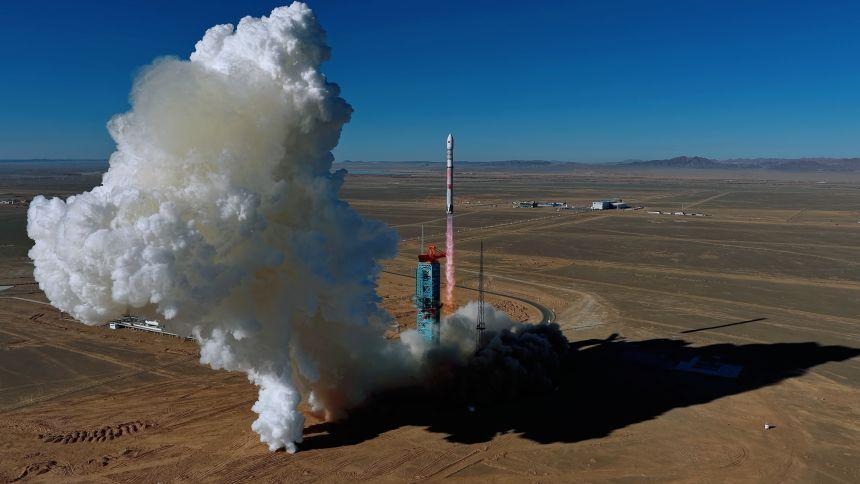
But it was a half victory: As the first stage tried to return and land, so that it could be used again, the mission went wrong. In midair over the Gobi Desert, the booster’s engine caught fire, then lost control, then exploded — and came crashing down short of a safe landing.
The explosion dashed the prospects of an Earth‑landing — a major selling point that many global space companies are offering in order to cut launch costs and turn around hardware quickly.
read also: Today Free Fire MAX is releasing new redemption codes
Why Reusable Rockets Are So Important? — and This Failure Stings
Rockets like Zhuque‑3 aim to achieve something akin to what SpaceX and Blue Origin were able to accomplish with their trailblazing vehicles — reusing boosters that land straight up but had previously expendable, which reducing costs and boost the pace of launches. For China, if it had been successful, it would have marked a historic first: the nation’s private industry joining the ranks of global companies that can do reusable rocketry.
But it illustrates how landing — particularly coming down vertically — is still the most punishing challenge. Rocket boosters move at tremendous speeds, experience intense temperatures and have the guiding capability to land safely. A single errant push, timing hiccup or mechanical failure can transform a promising mission into a flaming fall.
What LandSpace and Observers Say?
LandSpace has a history of setting ambitious aims: Zhuque-3 had been designed to put 20–25 tonnes into low Earth orbit. Analysts had even speculated that the rocket might match up to those killer heavy‑duty reusable rocketry giants of mastodonic space enterprises.
Although the landing did not work out, the company is still calling the flight a partial victory. Getting the payload into orbit demonstrates that the core launch technology functions. The landing crash, although a setback, provides valuable information about what went wrong that can help engineers refine the design and control systems as well as the landing mechanism of future missions.
Broader Implications: For China, the Private Space Sector — and Global Space Race
China’s upstart private rocket companies are seen as integral to Beijing’s broader ambitions: rapidly deploying ever more satellites, establishing communication networks and lessening dependence on state‑run space agencies. A successful reusable rocket would sharply reduce the cost of launches and allow them to be undertaken far more frequently, turbo‑charging China’s space capabilities.
To international observers, the attempted landing — unsuccessful as it was — demonstrates a willingness to compete on the most rarefied playing field. But the explosion also serves as a reminder of just how daunting technological and engineering challenges persist.
What’s Next for LandSpace — And for Reusable Rockets
LandSpace is also expected to take a second look at its telemetry data, landing software, thrust‑control systems and hardware survivability before making another attempt. Here is a guide to how the lessons of today’s failure will inform design tweaks and mission planning.
In the meantime, China is not alone on this course. All of which isn’t to say that several companies aren’t still pushing the scope of reusability, refining technology and process, achieving greater reliability in landing and extracting more lessons for a standard framework for safe, cost-effective travel to space. Each failure —and it is painful to watch — brings the industry slightly closer to routine, relatively reliable reuse.
And for those who “look up” as observers and enthusiasts, the crash is also a reminder: Rocket science isn’t just about rocket launches; it’s in the return, the recovery, the reuse.
