


The final frontier got a little more attainable this weekend, when the space company founded by Jeff Bezos completed its NS-37 mission. But while all launches are remarkable technical achievements, this one will go down in history as a turning point for inclusivity. And no passenger’s experience was more singularly extraordinary than that of Michaela “Michi” Benthaus, a 33–year–old German engineer who has now officially become the first wheelchair user to make the trip — and so perhaps one of space tourism’s most memorable pioneers.
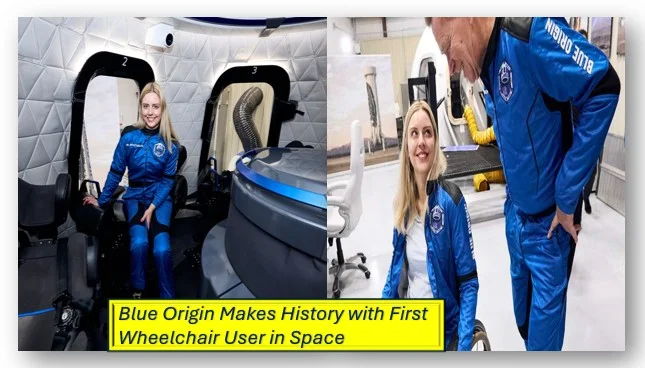
The 10-minute suborbital flight peaked at around 107 kilometers, beyond the internationally recognized Kármán line. For Benthaus and her crewmates, a short but life-changing experience showed physical disability was no longer a block to touching the stars.
A DREAM COME TRUE: THE MICHI BENTHAUS STORY
As an aerospace and mechatronics engineer for the European Space Agency (ESA), Michi Benthaus has dedicated her life to mastering physical performance through parkour and mountain biking. But in 2018, a serious mountain biking accident caused a spinal cord injury that left her paralyzed from the waist down.
“When I was in my accident, I thought that would be the end of my dream to go to space for good,” Benthaus said in an interview ahead of the launch. Her perspective changed after she attended AstroAccess, a project focused on inclusion of people with disabilities in space exploration. Once she demonstrated an ability to handle microgravity in parabolic “Zero-G” flights, the road to the New Shepard capsule was paved.
She was on the flight with a well-known personality in the space industry: Hans Koenigsmann, an old hand at rocket science and a former executive at SpaceX. Koenigsmann’s involvement in helping make the trip a reality was crucial, and on an organizational side of things he worked with Blue Origin to make sure it would be easy for them to modify their capsule minimally so that Benthaus would be able to fit inside.
read also: China’s Private Rocket Attempt Ends in Flames
Redefining Access in the New Space Age
The NS-37 success wasn’t just about the launch; it was what led up to that. Blue Origin’s New Shepard vehicle was designed with accessibility in mind, but this mission needed some logistical fine-tuning:
The Transfer Board: A specialized patient transfer board was used to help Benthaus slide from the capsule hatch into her seat.
The “Carpet of the Desert”: When she landed, a crew spreaded out a carpet on the uneven desert floor so that she’d have smooth terrain for her wheel chair as soon as possible.
Launch Pad Integration: The seven-story tower already has an elevator and it was simple for Benthaus to ascend to the capsule.
Benthaus was able to float around the cabin and experience weightlessness that she had been preparing for years. Images from the mission showed her floating freely alongside her crewmates, a potent image that fundamentally challenges the stereotype of what an “astronaut” can look like.
Meet the NS-37 Crew
Benthaus was the superstar, but she had an interesting ensemble cast of passengers that added their own distinct tales to the mission:
Hans Koenigsmann The now-retired SpaceX executive who helped lead the charge for this mission.
Joey Hyde: An astrophysicist and former hedge fund investor with a PhD in astrophysics.
Neal Milch: A business executive and chair of the board for the Jackson Laboratory.
Adonis Pouroulis: business person working in the natural resources and energy industry.
Jason Stansell: A “space nerd” who flew in honor of his brother, Kevin, who died.
AZ’s NS-37 mission patch incorporated personal symbols for each member including a hippopotamus—Benthaus’s favorite animal. She flew with a plush hippo toy — which accompanied her in the cabin as the mission’s “zero-g indicator,” according to The Times, when she required comfort after undergoing surgery at a hospital seven years ago.
A Small Leap Toward Inclusion in Space
The NS-37 flight is Blue Origin’s 37th New Shepard mission and the 16th with humans on board. So far, the company has flown 86 people to space — including octogenarian and nonagenarian passengers on one end of the age spectrum and those with a range of physical disabilities they had learned to manage.
As private space flight evolves, the question then becomes less about “can we go?” to “who can we take?” By dispatching a wheelchair user to space, Blue Origin has just sent to the world an unmistakable message: The view from 100 kilometers up is for everyone.
