


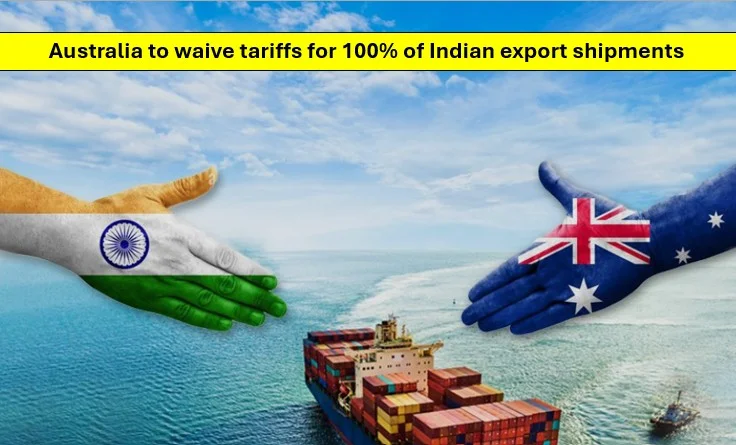
Australia to abolish tariffs on All Indian Exports with Effect from January 1, 2026, Making It a Watershed Moment for Bilateral Trade Relations. In a move that is set to promote further trade between the two nations, Australia will waive tariffs for all tariff lines for exports to India, starting January 1, 2026, when the India-Australia Economic Cooperation and Trade Agreement (Ind-Aus ECTA), which came into force in late 2022, celebrates three years in force this December. The decision was announced by the Minister of Commerce and Industry, Piyush Goyal, of India, on December 29, 2025.
It means that all the goods flowing from India to the Australian market are now duty-free, and this is the first time this has happened in the history of trade agreements between India and developed countries. As per the ECTA agreement, signed in April 2022 and effective from December 29, 2022, the elimination of tariffs was expected to take place gradually. But now, with the final phase effective in the next year, Indian exporters, especially the labor-intensive industries, can have access to all sectors without paying tariffs.
Increasing Exports and Competitiveness
Minister Goyal emphasized that this marked the beginning of newer opportunities opening up for the Indian export community, MSME units, farmers, and workers in the export sectors of textiles, chemicals, plastics, pharmaceuticals, petroleum products, and gems & jewellery. This also happens when the trade tariff reforms have started showing positive results in the trade trend, which helped increase the Indian export shipments to Australia by 8% in the financial year 2024-25 and improve the trade balance in the bilateral trade relation, he added.
Trade experts and industry observers believe that the removal of tariffs will increase the price competitiveness of Indian goods within the Australian market and will be attractive relative to goods exported from other countries. This provides hope to Indian firms that may wish to broaden the focus of their exports to regions outside of the U.S. and EU. This may have particular implications within the labor-intensive sectors of textiles, and handicrafts, which have potential within the international market but are generally hindered by tariffs.
Background: The India-Australia ECT
The India-Australia Economic Cooperation and Trade Agreement (ECTA) aims to reduce tariffs, make market access easier, and improve supply chains for both economies. The new trade pact is the first trade agreement signed by India in the last decade and is part of its strategy of deeper integration in the Indo-Pacific markets.
It has been agreed that the customs duties on the export of Indian goods would be reduced in various phases. After the end of 2025, the final phase would be over, leading to zero customs duties on all goods from January 1, 2026. It is a major breakthrough in market access for various sectors of the Indian economy compared to the initial enforcement date of the agreement.
As regards Australia, ECTA is already bringing significant gains to its export Community. Preliminary data reported by the Australian government revealed that a significant number of products, including Australian wine, agri-products, and mineral shipments, have secured preference access into India, with these tariffs either eliminated or reduced in stages since 2022.
Economical & Strategic Implications
The waiver on tariffs on Indian exports is also likely to increase economic collaboration between the democracies. This announcement comes at a time when the two nations are also attempting to expand trade and investment partnerships amidst economic uncertainty around the world. It has been pointed out by economists that the absence of duties on certain products may induce increased foreign direct investment flows, as the firm may restructure its supply chain organization to benefit from tariff incentives.
It has been pointed out by economists that the absence of duties on certain products may induce increased foreign direct investment flows, as the firm may restructure its supply chain organization to benefit from the tariff incentives. This achievement is in line with the overall strategy for enhancing the export presence of India across the globe, and more specifically with the “Make in India” program and the future “Viksit Bharat 2047” vision, which aims at making the nation a developed economy when it celebrates the centennial year of being an independent nation.
Looking Ahead:
CECA and Beyond Though the ECTA has currently reached an important juncture with the achievement of complete tariff reduction, both the nations are currently negotiating a more comprehensive agreement, known as Comprehensive Economic Cooperation Agreement or CECA, for further relaxation in services trade, investment, and professional mobility. Further advancement in the talks regarding CECA might take bilateral economic engagement to an even higher level in the years to come. It is a significant milestone in India and Australia’s trade relationship, with the scrapping of tariffs on all Indian exports, starting from January 1, 2026, giving a huge boost to market accessibility, export growth, and economic integration for India.
