


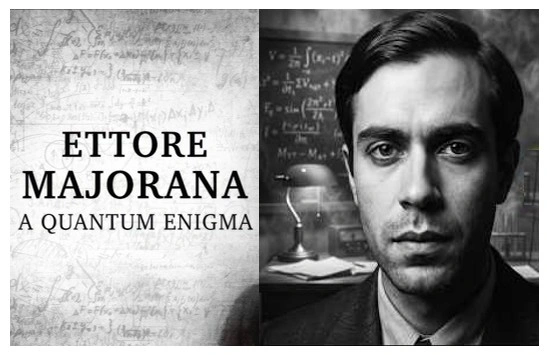
Ettore Majorana was an Italian theoretical physicist with one of the most brilliant minds and remarkably troubled in the 20th century. He was an actMajor Dhyan Chand — Legendary field hockey icon with almost mythical stories.ive member of the golden age of quantum mechanics, and is widely recognized for his pioneering work in particle physics. He is most famous for his pioneering research into neutrino masses, and for the theoretical prediction of “Majorana fermions”—particles which are their own antiparticles. Majorana’s theories have been revolutionary, and are now being used as the basis for some of the most advanced fields of today, such as quantum computing.
Early Life
Majorana was born in Catania, Sicily, on August 5, 1906, into a prestigious and wealthy family of scientists, engineers and politicians. He showed an incredible mathematical genius, which is why he used to be able to solve complicated arithmetic problems while hiding under the tables as a kid. He first went to Rome to study engineering. In 1928, however, he was persuaded by a friend, Emilio Segrè, to switch to physics. He enrolled at the University of Rome at the Institute of Physics, among the famous “Via Panisperna boys” of the university under the guidance of Nobel laureate Enrico Fermi.
Personal Challenges
Yet there were issues deep within Majorana’s mind, that plagued him, even though he was a genius. He had a very high level of social isolation, depression and perfectionism. He was extremely critical of himself, often thinking that his world changing discoveries were insignificant. Besides, he had to deal with various physical ailments such as severe gastritis that added to his reclusiveness. He was reluctant to publish, so much of his brilliant work was missed during his lifetime.
also read:
- Major Dhyan Chand legendary field hockey icon
- Vera Rubin her work helped prove the existence of dark matter
- Kaspar Hauser the Boy Who Arrived From Nowhere
Career and Main Journey
Majorana’s career was short but very effective.
After joining Fermi’s group, Majorana soon made a name for himself. His mind was capable of solving complex quantum phenomena without the need for paper and pencil before his colleagues could even write out their problems.
The Leipzig Visit: Fermi persuaded him to go to Germany in 1933, where he worked with Werner Heisenberg. Heisenberg became one of the few scientists to whom Majorana was much indebted, and he eventually persuaded the young Italian to publish his studies of nuclear forces.
In 1933, after his return to Rome Majorana experienced a breakdown, both physically and mentally. He was rarely seen outside his home for the next four years, when he was completely cut off from the scientific world.
In 1937, he was again in the public eye when he was appointed to the full professorship of theoretical physics at the University of Naples. The university did not have to go through the exam procedure, because there was no doubt that he was a genius.
Major Achievements
• Majorana Equation: He formulated a relativistic wave equation which was analogous to the Dirac equation but valid for particles of arbitrary spin.
• Majorana Fermions: In 1937 he postulated the existence of Majorana Fermions, particles that are also their own anti-particles.
Personality & Character
Greatly introverted, too humble to be seen, and very pessimistic. He was never interested in fame or academic accolades. Enrico Fermi was a famous Italian physicist that divided scientists into three categories: second/third-rate, first-rate (who will make an essential discovery) and geniuses like Galileo and Newton. Fermi put Majorana in the last category because he “just did not have the common sense to appreciate himself.”
Impact on Society
Majorana’s work was regarded as brilliant and obscure for many years. His ideas are today at the very cutting edge of physics. Majorana fermions have attracted a great deal of interest in condensed matter physics because the particles could be the stable blocks (qubits) to build functional, error-resistant quantum computers.
Lesser-Known Facts
Majorana would often work out difficult physical problems, or record revolutionary equations on cigarette packs, napkins or tram tickets in cafes, and that sort of thing is a peculiar and frustrating thing for him to do. He would show his co-workers to prove a point, and then throw them in the trash, and disparage his own genius.
The last years and disappearance
In March 1938, Majorana cashed in all his money and bought a ship ticket from Naples to Palermo. He wrote an ambiguous, apologetic letter to Antonio Carrelli, director of the Physics Institute at Naples, suggesting he may wish to commit suicide. Shortly thereafter, he sent a telegram to cancel the previous letter and apparently purchased a return ticket to Naples. He was never seen again. He either took his own life, escaped to South America or entered a monastery, it is one of the still-unanswered science questions.
Legacy
Nowadays, Majorana is regarded as a giant of physics who was lost. His name lives on in modern science through the “Majorana Equation,” “Majorana mass,” and “Majorana fermion. The Majorana Prize was established in 2006 to honor the best contributions made to the theoretical physics.
Timeline
- 1906 — Born in Catania, Sicily.
- In 1928, he joined Enrico Fermi’s Physics group in Rome.
- 1933 — visited Leipzig to work with Heisenberg, soon after began his four year isolation.
- 1937 — Published his famous paper on Majorana fermions, and was appointed professor in Naples.
- 1938 — Disappeared in March at age 31.
Conclusion
Ettore Majorana’s life is a moving story of an extraordinary genius, accompanied by great personal sadness. Within a few years of activity, he developed theories which did not get full recognition by the rest of the scientific community for almost 100 years. This tale is as reminder of a grave burden that rests on the shoulders of exceptional genius.
