


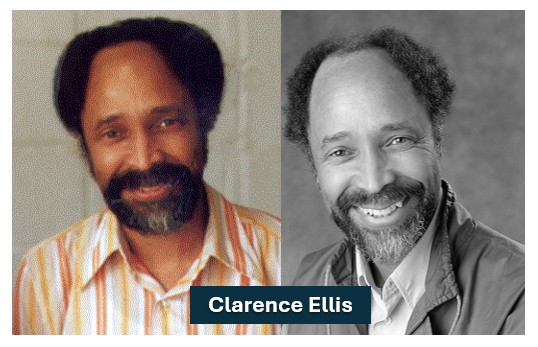
Clarence Arthur Ellis was born on May 11, 1943, in Chicago, Illinois, United States. He was raised in a time when computers were not yet prevalent and not widely understood by most people. In the 1940s and 1950s, technology had not yet invaded the ordinary home and the idea of people communicating or working together through computers was almost unimaginable.
Education
Ellis was interested in mathematics, logic and problem solving from a very early age. He enjoyed understanding how things worked and was naturally drawn to scientific thinking. It was not easy, however, for African Americans to pursue careers in advanced technology at the time. Racial inequality in the United States continued to severely limit educational and professional opportunities in the scientific fields.
Still, Ellis kept his head in the books. He attended Beloit College in Wisconsin, studying mathematics and physics. His intelligence and dedication allowed him to continue to pursue higher education as very few black students entered computer science.
In 1969 Clarence Ellis became the first African American to get a PhD in computer science. And this alone made him a major figure in the history of technology and education.
His greatest contributions were yet to come.
Entering the World of Computing
Computer science was a growing discipline in the late 1960s and early 1970s. Computers were big, expensive machines that were used by governments, universities and large corporations. Most of them had never used one before.
Then the computers were designed mainly to do calculations and to process data. But Ellis started to think differently. He thought computers might one day help people talk to each other, share ideas and work together.
For the time, this was a radical thought.
The online collaboration is now part of our daily lives. Students collaborate online, employees edit in real time and teams instantly communicate across countries. But decades ago, those possibilities were almost non existent.
also read:
- Dashrath Manjhi Carved a road through a mountain alone
- Tenzing Norgay the Man Who Climbed Over Clouds
Work at Xerox PARC
Ellis’s arrival at Xerox PARC, one of the world’s most influential technology research centers, began one of the most important phases of his career.
Xerox PARC is well known for inventing things that would eventually change personal computing. There, long before they became commercially popular, many ideas we associate with modern computers were investigated.
Ellis developed computer systems at Xerox PARC that supported communication and collaboration. One of his major contributions was OfficeTalk, an early office collaboration system aimed at helping groups share information and coordinate tasks electronically.
The idea later formed the basis for collaborative workplace software.
Ellis believed technology should not alienate people. Instead, he felt computers should improve teamwork and boost communication between human beings.
Pioneer of Groupware Technology
His research looked at how multiple users could work together on digital systems without getting in each other’s way. As computers developed, the problem became more and more important.
One of his most important contributions was operational transformation, a concept that allowed multiple people to edit shared digital documents at the same time, while preserving consistency in the document.
Today similar ideas are used in collaborative editing platforms all over the world.
Long before things like Google Docs existed, Ellis was already exploring the principles that would make such systems possible. His work provided the technical underpinnings of modern collaborative computing.
A Respected Teacher and Mentor
Besides his research, Ellis had a strong commitment to education. During his career he taught at various universities and built a reputation as scholar and mentor.
Students liked his ability to explain difficult concepts clearly and thoughtfully. Colleagues described him as calm, smart and generous with his knowledge.
He also believed in the importance of representation in science and technology. Ellis was the first African American to earn a PhD in computer science and he inspired many young students entering technical fields.
Recognition and Influence
And as the computer and the internet became more and more central to the life of modern man, the importance of Clarence Ellis’s contributions became ever more apparent.
Many of the technologies people use daily now reflect ideas Ellis explored decades earlier. His research is related to ideas that are fundamental for shared workspaces, collaborative editing systems, online teamwork environments and digital coordination tools.
Ellis was eventually recognised in the academic and technology worlds for his pioneering work in collaborative computing.
He never achieved the public fame of certain tech entrepreneurs, but his influence rippled through the digital world.
Today, many people are using systems designed by ideas he helped develop, without realising it.
Final Years and Legacy
Clarence Ellis died May 17, 2014 at the age of seventy one.
By then, the world had become the digital world he had dreamed of. The internet had become a common place for schools, businesses and people to communicate with each other. Across the globe, connected digital systems were humming, people working together, the very future Ellis had spent decades studying and building toward.
His contributions are not only important for the technical value but also for the vision. He saw the potential of collaborative technology long before the rest of society understood.
Today Clarence Ellis is remembered as
- 1st black person to receive a PhD in computer science
- One of the fathers of groupware and collaborative computing
- An innovator whose ideas helped define online collaboration as we know it today
His story continues to inspire students, researchers and technology professionals everywhere.
More importantly, his work reminds us that some of the greatest innovators are not always the most famous in the public eye. Sometimes they are the quiet thinkers building the future before the rest of us can even see it.
