


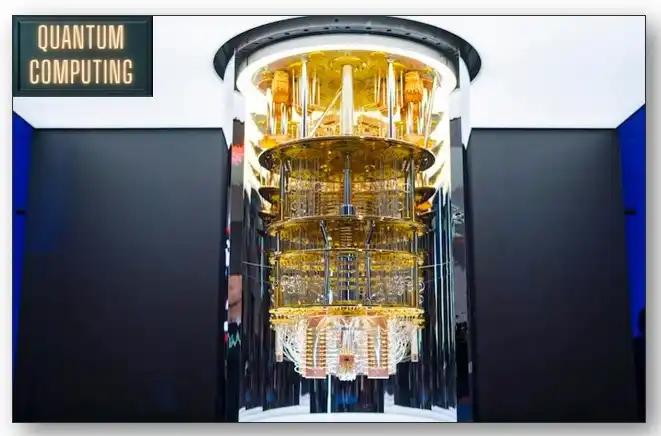
Quantum computers use qubits, quantum bits, which leverage superposition and entanglement-properties that enable them to represent many possible outcomes and process them simultaneously.
Unlike classical bits-0 or 1, qubits can be both at once, in principle-enabling quantum computers to study many solutions simultaneously. This potential makes them promising for particular problems where the solution may take indefinable time to reach through traditional computers.
Currently, we find ourselves in the NISQ era: machines of tens to a few hundred qubits that cannot perform error-free computation yet. But the roadmaps and expert predictions indicate that practical use cases – if narrow – could arrive within the next 3-5 years.
Technological Advancement Over the Next 5 Years
Hardware Improvement in Steps
Quantum hardware will continue to scale up in both the number of qubits and the quality of performance: Companies like IBM, Google, IonQ, and D-Wave are pushing hardware improvements and new architectures. Recent moves include D-Wave’s pivot to universal gate-model quantum systems that signal broader application ambitions.
According to the quantum roadmap of IBM, systems with increased qubits and computing power will be delivered in the coming years.
New hardware methods, like quantum fault-tolerance research, constantly improve the process of quantum error correction that is central to making quantum computing reliable.
Quantum providers are also making these machines more accessible via cloud-based services, allowing developers and researchers to execute quantum jobs remotely without owning expensive hardware.
Over the following five years, quantum computers will not displace classical ones, but they will begin to provide value in specific applications wherein quantum advantage -where they have outperformed classical machines – is achievable.
1. Quantum Systems Simulation
This is one of the most realistic use cases and among the earliest: simulating molecules and materials at the quantum level. This turns out to be very difficult for a classical computer when the number of interacting particles increases. Quantum systems could transform areas like:
- Drug discovery and molecular design
- Material sciences, including advanced batteries and catalysts
- Chemical reaction modeling
Already, businesses are experimenting with quantum approaches to such jobs, and for certain specific algorithms, this could start to happen within two or three years.
2. Optimization Problems
Quantum computers promise a potential speed-up in the solution of complex optimization problems occurring in:
- Supply chain logistics
- Supply chain
- Traffic Routing
- Energy grid balancing
- Financial Portfolio Design
Such issues typically include huge combination and trade-offs that can be explored more efficiently by the quantum systems over classical algorithms, particularly when the systems are combined using quantum-classical models.
3. Cryptography & Security
Within the next 3-7 years, quantum computing has the potential to start endangering existing methods of encryption. Powerful quantum algorithms, so as Shor’s algorithms, are able to break several widespread methods of public-key cryptography.
This is not an indication that the internet security system is headed for a breakdown anytime soon; nonetheless, the need to make the transition to new cryptography in the wake of increased quantum power cannot be overlooked.
4. Quantum-Driven AI and Data Processing
Even if it remains the realm of speculation at this point, some researchers are predicting that quantum computing may be able to accelerate the development of artificial intelligence in the following areas:
- Sampling high-dimensional data
- Machine learning subroutines based on quantum
- Quantum Optimization for Training Artificial Neural Networks
- Industry and National Initiatives that Drive Adoption
Governments and key technology players are pouring investments in the development of quantum technology. Governments and large technology companies such as:
- The U.S. National Quantum Initiative is being revamped to enhance quantum research and leadership.
- The global regions are enhancing quantum ecosystems by means of financial support, infrastructure, and educational initiatives.
These are investments in the hardware as well as the overall talent pool and environment that will be needed in the next decade with the coming of Quantum computing.
Key Challenges Over the Next Five Years
Although there is optimism about the future of quantum technology, these are the challenges incurred:
1. Error Rates and Stability
In the Qubits are very fragile and are likely to lose their quantum properties through noise. Although methods to decrease errors are in advancement, fault-tolerant quantum computing, in which quantum computation needs to be reliable for long enough periods to carry out complex calculations, is still considered challenging.
2. Scalability
Many useful quantum applications require thousands of logical qubits, which could turn out to be many orders of magnitude more physical qubits when error correction is involved. Scaling to that within the next five years can be considered optimistic, though incremental progress might come along the way.
3. Development of Algorithm
Quantum software, including new algorithms tailored to real business problems, is still a field in development. More breakthroughs are needed before broad commercial adoption can occur.
What to Expect by 2030?
Quantum computing will likely shift by the late 2020s from a laboratory curiosity to industry-specific tools for high-impact research problems. Niche solutions in pharmaceuticals, materials, finance, and logistics would increasingly be tested, while broader, fault-tolerant quantum computing would take shape beyond 2030. In a nutshell: Over the next five years, quantum computing won’t yet change consumer’s everyday computing, but it will start solving real scientific and optimization problems that classical computers can’t practically do — setting on a path to greater impact in the decade ahead.
