


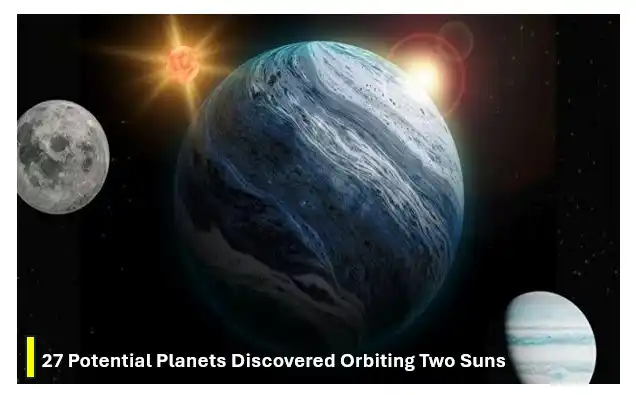
Using NASA’s Transiting Exoplanet Survey Satellite (TESS), astronomers have discovered 27 potential new planets orbiting two stars, in the second discovery of circumbinary (surrounding two stars) planets in the universe. This is a breakthrough discovery that projects against the backdrop of Tatooine from Star Wars. Astronomers believe that these discoveries will allow scientists to expand their understanding of how planets form and survive within complex stellar systems.
What Are Circumbinary Planets?
A circumbinary planet is defined as a planet that encircles a binary star system – two stars in orbit around one another. Unlike Earth, which defines a single solar orbit, circumbinaries would be subject to two sunsets and have environmental features and systems unique to circumbinary events. The scientific community once considered this idea to be a fictional property, but there are now several confirmed examples of circumbinary planets.
Prior to this new discovery, there were approximately 18 circumbinary planets. Consequently, the expanded quantity of circumbinary systems (27 total candidates, confirmed in time) will expand the total circumbinary systems, thus having several times more circumbinary planets than currently known, depending upon the observation of their validity and confirmation.
These planets were discovered using TESS data collected by NASA between 2015 and 2018 since TESS brought to life a potential universe beyond our own solar system.
A team of researchers at University of New South Wales led a study of 1,590 binary star systems, using a new technique along with the classic transit method they have used to find other planets. The newly developed technique takes advantage of changes in the timing of binary star eclipses due to an external gravitational influence causing ‘apsidal precession’, which is a delayed and then accelerated change in orbital period due to the force of gravity exerted by another body.
Margo Thornton, the lead author, described how having two stars eclipse one another at slightly different times can suggest some external object could have a gravitational influence on them, like a planet, etc.
you may also like:
- Super-Earth discovered
- 10 year old writes to NASA to make Pluto a planet again
- How Oil and Gas Extraction Is Changing the Earth Forever
- Gold factory discovered deep under the Pacific Ocean
The New Technique Allows For A Broader Range Of Opportunities
Traditionally, astronomers detect a planet by the dip of light that occurs when it passes between the star and the observer (i.e., on Earth). A potential drawback to this approach is that it will only be successful if the planet has its orbital plane perfectly aligned with that of the observer.
In contrast, the new technique can help identify hidden planets even if they will never eclipse their stars in this way. Experts believe this could allow for the discovery of many more planets than would otherwise be detectable.
Senior co-PI Ben Montet suggested many systems have likely escaped detection by astronomers due to the limitations of prior methods.
How Big Are These New Worlds?
Astronomers estimate that the size of the newly assessed celestial objects varies from Neptune-like to nearly ten times heavier than Jupiter; however, researchers caution that additional observations are required to identify them as genuine planets.
Some of these objects may even be brown dwarves (larger than a planet but smaller than a star). To help determine the precise characteristics of these objects, the light spectra from the objects will be examined.
Experts assert that a circumbinary planet may have extreme temperatures due to the growing influence of two stars; however, scientists believe that many circumbinary planets fall within the “habitable zone” where temperatures would allow for the presence of liquid water.
Astrophysicists note that approximately 50 percent of the stars in the universe are members of binary and multi-star systems. This suggests that planets around two stars may be very common relative to planets around one star.
Recent results indicate that binary stars may be very effective for planet formation. According to researchers, the outer regions of binary systems may provide more suitable environments for the development of giant planets than do the outer regions of single-star systems like our solar system.
A Step Closer to Real-Life Tatooine
Researchers recently discovered the red dwarf where Earth-like planets may reside, focusing their attention on 4 nearby star systems. The timing of this announcement came on a day known as “Star Wars Day,” or May 4, which is celebrated by many. With the results of their study, scientists are claiming that they will help to expand our knowledge of real-world planets and how diffferent they can be from how we imagine them in films and literature.
This discovery and accompanying documentation have appeared in the Royal Astronomical Society’s monthly publication, Monthly Notices.
