


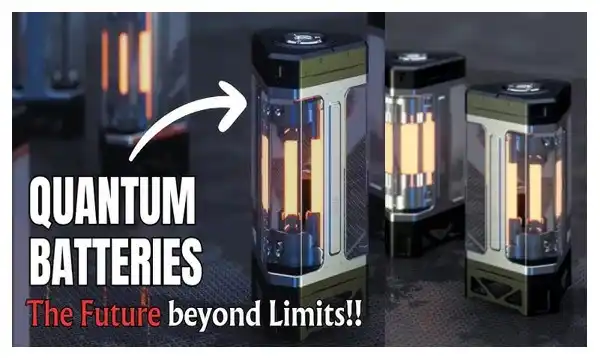
Researchers around the world have just unveiled a new generation of batteries that operates under the laws of quantum mechanics. Unlike conventional batteries that produce power through chemical reactions, these revolutionary new batteries use the principles of quantum mechanics to transfer, store and discharge electrical energy. Innovative designs could enable faster-charging, more efficient electric cars and devices.
A quantum battery uses the principles of quantum mechanics, in particular the ways we can create coherence between atoms and entangle them together. While conventional batteries use electrochemical means to store energy, quantum batteries store energy at the atomic and/or subatomic level. A quantum battery would allow multiple energy states to be used at once when removed from their charging source, and thus theoretically allowing for faster rates of charge compared to lithium-ion.
For many years, scientists have theorized about developing systems that harness quantum mechanics for improved energy production. However, these technologies have yet to be realized—a long sought after breakthrough. The first full prototype demonstrates how scientists can use quantum-mechanical states to store energy and draw it down. This opens up an entirely new realm of opportunities for adoption and improvement across all sectors of the economy, including consumer electronics, electric vehicles and renewable energy systems.
How the Technology Works?
A quantum battery consists of a group of quantum mechanical components (known as qubits) that can work together to produce charge within the same period due to quantum entanglement. Thus when more components are added, the speed of generating charge increases, which is a well-known concept referred to as “Quantum Advantage.” The design also provides for less energy loss than standard battery constructions, with most energy loss resulting from inefficient energy storage in non-coherent quantum states. By utilizing coherent quantum states, the system has enhanced storage time, resulting in reduced waste and improved sustainability.
Industries that can leverage quantum battery technology are abundant. For instance, electronic devices can be charged in seconds rather than hours, and electric vehicles will have considerable reductions in charging time, enabling their large scale of use.
Renewable energy systems can also take advantage of this technology. Due to their intermittent nature, solar and wind energy generation will benefit from improved methods of storing excess generated energy until needed; thereby providing more effectively for stabilization of power to grid systems and improved energy security.
read more:
- what it can actually do in the next 5 years?
- Google Chrome on Android gets desktop-style bookmarks bar
Challenges and Limitations
The current quantum battery technology is developing at a slow and steady pace, thanks to the inability to maintain stable quantum states because of how easily lost they can become due to coherence from their environment. Further development and engineering advancements will be necessary before larger-scale commercial batteries are developed.
The costs associated with quantum battery system design and manufacture remain very high and many hurdles must be overcome before quantum-based batteries become available in large quantities to the public.
Worldwide Race Towards Quantum Developments
This announcement serves to demonstrate how many nations and industries all over the world are now fully engaged with and developing typically quantum technology. Over the last several years, many countries and companies around the world have invested heavily in research efforts in order to take advantage of the transformational abilities of quantum-based technologies and services. Advances in the area of quantum-based batteries, as well as in quantum computing and quantum communications all serve to demonstrate that advances in technologies are designed to create vast amounts of energy storage, provide new ways to power electronics easily, and store energy very effectively.
Conclusion
The creation of the world’s first practical quantum battery signifies a very significant advance in the technological revolution taking place in today’s technological environment. Although there are likely some project development cycles before practical applications can emerge, the theories associated with quantum batteries have moved into a new reality. As research continues, it will likely provide new developments in how we store and utilize energy that will provide faster, cleaner, and more efficient methods of providing power in the future.
