


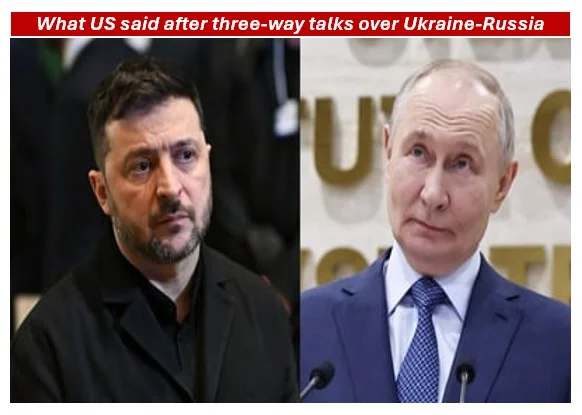
In the glittering, high-security halls of Abu Dhabi, a glimmer of diplomatic light has suddenly appeared in the shadows of almost four years of war. Jan. 24, 2026 The first direct three-way talks between the United States, Ukraine and Russia ended on Monday, with American officials calling them a “big step” in resolving the conflict’s cause.
Under the guidance of U.S. Special Envoy Steve Witkoff and Senior Adviser Jared Kushner, the two-day summit was a historic turning point in president’s Trump administration’s aggressive approach to securing a peace settlement.“The goal here is really clear: we want this transaction, we are working on this more complex contemporary deal where economic revitalization could be a key to unlocking that potential for sustained peace,” said senior adviser Jared Kushner, speaking through an Arabic interpreter in opening remarks. No formal treaty emerged, but the mere fact that Ukrainian and Russian military, intelligence experts lived under one roof for as long as they did – a first since the Istanbul exchanges of 2024– has been hailed in Washington as a significant step forward in “logic of peace.”
The ‘Constructive’ Paradox: Fire in the Midst of Progress
The U.S. delegation called the conversations “upbeat, positive and productive.” But this upbeat view runs in stark contrast to the situation on the front lines. Despite negotiations to discuss cease-fires, a vast barrage of Russian drones and missiles struck Kyiv and Kharkiv, leaving millions in sub-zero temperatures without power.
But even amid the violence, President Volodymyr Zelenskyy echoed the U.S. assessment that talks were “constructive.” He added that for the first time in years, all sides are drilling down into the nuts and bolts of a possible framework.
“There is a realization that it’s necessary to have American supervision and control of the procedures for ending the war, so as to ensure real security,” said Zelenskyy, in an apparent indication of increasing acceptance of U.S.-led oversight.
The Twin Big Surmountables: Land and Nuclear Safety
Although there was reportedly a positive atmosphere in the UAE, two huge “pills to swallow” still obstruct the view to sign something: Donbas and ZNPP.
The Territorial “Red Line”
The most obvious sticking point is the Donbas. Moscow is said to be refusing a compromise involving the last 20% of the east not yet in its grip but which it has seized from Kyiv.
The Russian Demand: A complete pullback of Ukrainian forces from Donetsk and Luhansk.
The U.S. Proposal: Washington has suggested converting these disputed lands into a demilitarized or special economic zone under international supervision.
The Ukrainian Position: Kyiv still outright rejects the idea of handing over territory but there have been indications that some administrative statuses might be subject to a national referendum, once security is guaranteed.
The Zaporizhzhia “33% Solution”
Europe’s largest nuclear power plant, the Zaporizhzhia Nuclear Power Plant, has now become a chip in geopolitics. U.S. negotiators have suggested a radical 33-33-33 management split of the pipeline between Ukraine, the U.S. and Russia.
The Plan: Power generated would be divided evenly, with American experts serving as “chief managers” to make sure that the reactors are safe and the public is protected from radiological disaster.
The Issue: To Ukraine, this is “a legitimation of occupation,” while Russia hesitates to give up the operational control it has maintained since 2022. Yes, as of today, the power sharing is principle-agreed but not agreed on “who holds the keys.”
The “Anchorage Formula” and the Road to February 1
One recurrent topic of conversation has been the “Anchorage Formula,” a concept that dates to an August summit between Mr. Trump and President Vladimir V. Putin in Alaska. This plan aims to freeze the front lines in Kherson and Zaporizhzhia while expending diplomatic energy on the Donbas quarrel.
The U.S. expects that by working on some “confidence-building” measures (including the localized cease-fire negotiated recently by the IAEA for repairs at ZNPP), a degree of momentum can be built to eventually address the more difficult political issues.
What Happens Next?
Members of all three delegations have gone back to their capitals to consult with the leaders there. The trend is not about to stop — a second set of trilateral discussions were already announced for Feb 1, Sunday, in Abu Dhabi.
Conclusion: A High-Stakes Balancing Act
The discussions in Abu Dhabi have also demonstrated that, though the “will to talk” finally exists on both sides of the Yemen conflict, what is still lacking is the “will to concede.” The U.S. is wagering that, as a “security guarantor” and “economic manager,” it can stand in the ideological no man’s land between Russian maximalism and Ukrainian sovereignty.
Over the next days towards 1st February, all eyes are on UAE. The framework is in place; now it’s a matter of waiting to see if the diplomats can outrun the missiles.
