


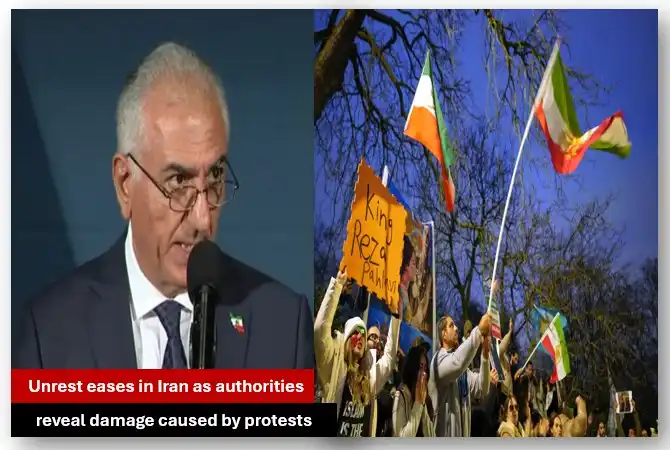
After nearly three weeks of among the most intense and bloodiest civil unrests in modern Iranian history, a dense, fragile hush has settled over the streets of Tehran and the other principal cities. As of Saturday January 17, 2026 witnesses and residents both local and international are noting a notable calming down in street battles. But this “calm” has been achieved not through discussion but military muscle, and a nearly full digital blackout that has cut off the nation’s nervous system.
Now, as the smoke clears, the Iranian government has changed gears from warfare to narrative. State media and local officials have started to release detailed accounts and images of the damage sustained during the protests — a move that human rights groups say is part of an orchestrated effort to pave the way for the extreme use of force that human left thousands dead.
The Anatomy of Aftermath: How Tehran Mayor Uncovered the City’s Destruction
The first official “audit” of the physical damage across the capital was provided by Tehran’s mayor, Alireza Zakani, in a televised address on Thursday. Over 61 mosques and religious sanctuaries were put to fire in Tehran alone due to the riot, said the Mayor. State news outlets have been crammed with images of scorched interiors, half-burned copies of the Quran and CCTV footage supposedly suggesting that “rioters” set fires.
The damage report goes beyond religious sites. Authorities claim that:
- PUBLIC WORKS The destruction and vandalization of hundreds of banks, municipal buildings and traffic signals.
- Security Dead: Based on government account, at least 121 members of the security forces including Basij and IRGC Ground Forces killed since protests intensified January 8.
- Narrative of “Terrorism”: The regime hopes to lay the framework for portraying the popular economic unrest as a “terrorist insurgency” led by foreign intelligence services, specifically citing the U.S. and Israel, by emphasizing attacks against holy places.
This pivot is a chapter from the standard pre-emptive counterterrorism playbook: By emphasizing the “chaos” and “sacrilege” of the protesters, the state tries to shore up its remaining center of support (including through further repression if necessary) and intimidate internal critics who recoiled at it in horror when confronted with such enormous loss of civilian life.
A Digital Iron Curtain: The Price the Internet Is Paying for Worldwide Blackouts
The streets may be calm, but the “digital darkness” is total. The nationwide internet blackout entered its second week on January 8, with no indication that services would be restored. A government spokesman, Fatemeh Mohajerani, recently suggested that domestic access to the international web may not be restored until the end of a 40-day mourning period for people killed in protests — a timescale which would leave Iran cut off to mid-February.
This blackening is of a twofold nature. For the government, it helps stymie the organization of new “flash protests” and slow down the stream of footage that could be deemed “incriminating” by those outside. It is an economic and psychological stranglehold on the citizens.
Economic Paralysis: With inflation already at nearly 60%, the shutdown has brought digital banking and e-commerce to a standstill, aggravating the economic grievances that set off Dec. 28 protests.
Information Void: Throughout Iran, there are families in suspended grief. No internet access means many find out about loved ones by going to overcrowded morgues in person.
Human Rights Watch recently geolocated and verified images of the Kahrizak Forensic Center south of Tehran, reporting “open-air morgues” where hundreds of bodies in civilian clothing were stacked on stretchers and the bare ground. A vast gulf is widening between the official “damage reports” that focus on buildings and the grim reality of the human toll.
U.S. President warns of 25% tariff on countries doing business with Iran
The Looming Shadow of February: Is the Calm Sustainable?
But despite the absence of violent uprisings at this point in time, analysts at the Institute for the Study of War (ISW) and other regional experts caution that diplomatic efforts are “unsustainable.” Against the street movement, the regime has poured in with security forces, including elite squads — Thar-Allah Headquarters and others — occupying almost every major intersection.
“The panic has taken over at the moment,” said a European diplomat in Tehran. “But the basic anger — at the currency disintegration and at how massively so many people were slaughtered — remains. The state has been suppressing the activity, but they are not suppressing the cause.
The world is watching the calendar nervously. In Shia Islam, the 40th day of death (Chehellum) is an important public mourning day. The date Feb. 17, 2026, for thousands of families who are currently gearing up for these rites could become the flash point. In the past, such ceremonies have become the biggest anti-government gatherings as a nation’s shared sense of grief is given voice.
Conclusion: A Crossroads Nation
With Iran entering a new era of what one expert called, “enforced stability,” the world is holding its breath. U.S. President Donald Trump has threatened to “interfere” if the “senseless killing” resumes, and the United Nations is calling for an independent inquiry into what some are already referring to as the “January Massacres.”
The euphoria of relief from the sound of gunfire offers a temporary breather; for Iranians in the street, however, as for all ordinary citizens here, the “normalcy” spreading through shops and bazaars is an illusion. Underneath, the break to the social contract between people and state probably lasts longer than a torched building or a smashed window.
