


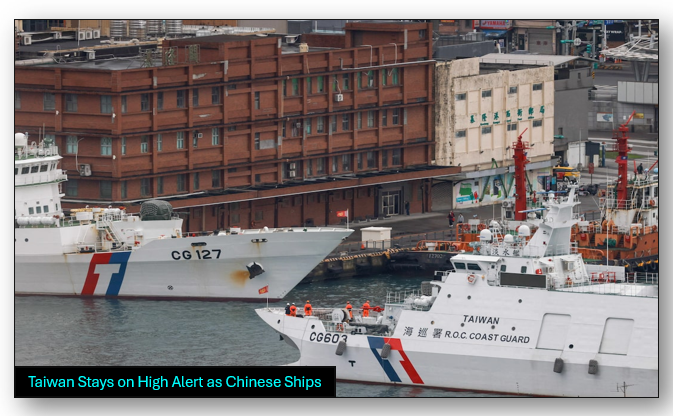
Even though the Chinese naval ships slowly pulled out of the waters around Taiwan on Wednesday, Taiwan was left on high military alert after one of the biggest and most intense military drills by the Chinese to date. The exercises held on a large scale were named as Justice Mission 2025. They involved the launch of rockets, combined naval operations, and mass aerial operations, raising serious concerns among Taipei and Western allies about rising tensions in the region.
China Showed Arsenal of Force Extensively
On Tuesday, the Chinese military launched what the authorities termed as massive war preparatory exercises, which included dozens of rockets launched in the direction of Taiwan as well as dozens of warships, coast guard ships, and military planes flying near the island. The exercises stretched through various areas surrounding Taiwan, such as north, south, east, and the Taiwan Strait, which represented what many analysts believed was a simulated encirclement strategy.
Beijing used the exercise as a caution to separatist groups in Taiwan and against what it termed as external interference, and meant the United States and its allies.
The Taiwan Affairs Office of China restated that the exercises were a reasonable and moral action that was necessary to protect national sovereignty and territorial integrity. State press Xinhua took this further and said that the exercise was a sign of the ability of China to seal internally and block externally, meaning that it was able to seal Taiwan militarily should the need arise.
Taipei Expresses Indignation over Incitement of Outright Provocation
The government of Taiwan attacked the manoeuvres with a lot of fierceness, terming it an extreme provocation that would jeopardize peace and stability in the Indo-Pacific. Authorities emphasised that Taiwan will not be threatened and will not concede the sovereignty of Beijing. Taiwan has argued that it is only its citizens who can determine the island’s future.
Taiwan responded to the exercises by cancelling dozens of domestic flights, mobilizing rapid-response teams, deploying naval forces, and putting air defence systems on high alert. Both the military and the coast guard had emergency response centres that were still operational to monitor the developments that were taking place.
The Ministry of National Defense of Taiwan reported that 77 Chinese military aircraft and 25 naval and coast guard ships were flying around the island in 24 hours. Out of the airplanes that were monitored, 35 of them flew above the median line of the sensitive Taiwan Strait a de facto demarcation that has long been followed by the two sides, although violated by Beijing in the last three years.
Chinese Ships Retreat, Tensions Are Still High
Late Tuesday, the chief of the Taiwan Ocean Affairs Council, Kuan Bi-ling, said that Chinese ships were gradually pulling out, but Beijing had not officially announced that the exercise was over. The Taiwan Coast Guard also clarified that all 11 previously existing Chinese coast guard boats were out of the waters, but sightseeing was still necessary.
The sea affair has been reduced, and ships and vessels are slowly leaving the sea. Nonetheless, since China has not officially declared the end of the military drills, the emergency response centre is on the go, as Kuan stated.
Local Response and Foreign Policy Undercurrents
The exercises went hand in hand with the diplomatic movements in Beijing. Representatives of the Quad countries, the United States, Japan, Australia, and India, convened at the U.S. embassy, an indication of the common worry over the stability of the Indo-Pacific. The U.S. Ambassador David Perdue has shared a picture of the meeting, claiming that the Quad is a force for good to keep the region free and open. The timing was rather somber; although no official words came after that, it is possible to stress that global powers think of Chinese military assertiveness rather seriously.
The activities were also in line with the announcement made by Washington earlier this month regarding an unprecedented 11.1billion arms sale to Taiwan, which Beijing adamantly objected to, and subsequently imposed sanctions on U.S. defence contractors. Most analysts feel that the exercises were a form of retaliation as well as an exercise in strategy.
Modeled Encirclement Strategy Alarms
As noted by military analysts, these war games were geographically broader than previous exercises in 2022 and 2023. They seem to demonstrate a developed Chinese military concept that emphasised cornerstone mobilisation, multi-service unification, port isolation strategies, and anti-access tactics meant to discourage U.S and Japanese interference.
The Taiwan defence ministry made it clear that its military was on maximum alert.
All members of our armed forces will be extremely alert and on high alert to take concrete measures to protect the ideals of democracy and freedom, an official statement said.
Foreign Stake and Future Threats
The international community is still seething with the apprehension that recurring military intimidation may habituate aggressive similes and increase chances of accidental war. The U.S and its allies have urged it to exercise restraint, and the stability of the Taiwan Strait is important to global trade, technology supply chains, and international security order.
In the meantime, China demands that Taiwan is under its sovereign territory and it is not prepared to eliminate force in ensuring that it reclaims the island. Taiwan denies China’s claims without no doubt and maintains its own views that its democratic system of government and independent state should be respected.
Hush, But Here and Now
In the meantime, the Taiwan coast guard and defence forces are on watch and keep a vigil on all the changes in air and sea traffic. Even though the threat has subsided with the withdrawal of Chinese vessels, suspicion remains, as Beijing has not officially ended the operation. Since no one wants to compromise, analysts caution that instances such as the one involving the Justice Mission 2025 might persist, strengthening a cycle of provocation and escalated preparedness in the area.
The leaders of Taiwan have echoed this: their strength, readiness, and global alliances have been the cornerstone of their efforts to maintain peace, even though there is a constant threat of conflict.
