


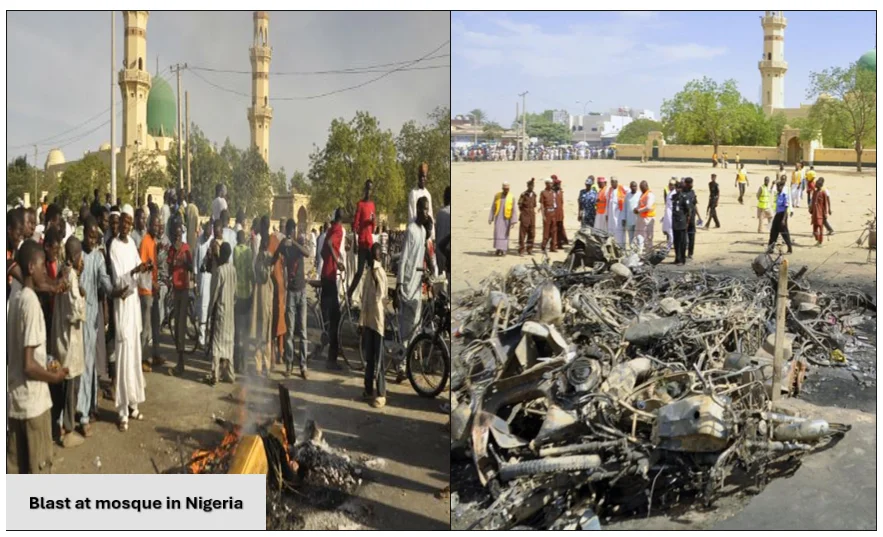
A bomb explosion ripped through the Al-Adum Juma’at Mosque in north-eastern Nigerian city, Maiduguri, Wednesday evening (Dec. 24, 2025). There were worshippers who observed the Maghrib-evening prayers when the blast occurred, catching the congregants inside the mosque completely off-guard.
Deadly Blast During Evening Prayers in Maiduguri Kills Scores
The explosion was confirmed to kill at least 5 people. 35 others were injured, many seriously, and were rushed to Maiduguri’s University of Maiduguri Teaching Hospital and the State Specialist Hospital for treatment.
Some witnesses and local sources reported higher tolls, with at least 7–8 fatalities claimed by mosque leaders and militia figures, though official counts remain at five.
The blast has reignited fears in a region long plagued by insurgent violence, despite a relative lull in major urban attacks in recent years.
read also:
- Afghanistan Hit by Early-Morning Earthquake
- Russia escalates attacks on key Ukrainian region of Odesa
- Explosion in Pakistan with heavy gunfire
Police and Military Response: Suspected Suicide Bombing
Such officials, in a buzz of comments, as the Borno State Police Command, have been quoted as saying this was a suicide bombing incident. Pieces of what resembled a suspected suicide vest were recovered at the mosque site while witness accounts tally with the theory that the bomber blew himself up amidst worshippers.
The Nigerian Army later confirmed that the blast was perpetrated by a Boko Haram suicide bomber. Preliminary findings had indicated that the attacker detonated an improvised device inside the mosque.
Security Operations
After the blast, security forces sealed off the area and began conducting sweeps for any secondary devices; patrols were increased around public places, markets, and places of worship as a way of deterring further attacks.
Reactions by Government and Official Agencies
Condemnation and Condolences
The Governor of Borno State, Babagana Zulum, who described the bombing as “barbaric and inhumane,” declared the attack as one against religious sanctity and urged increasing vigilance within communities.
Vice-President Kashim Shettima condemned the attack and warned that federal troops would scale up security operations to ensure justice is served on those responsible. He reiterated that Nigeria’s security forces were deploying additional tactical teams across vulnerable regions to forestall further insurgent violence.
Call for Restraint
They called on the citizens to be calm and abide by the control measures put in place by law enforcement agencies as they strive to bring the community to a state of normalcy, even during this holiday period.
Who might be behind it?
Though no group has so far claimed responsibility for the attack, analysts as well as Nigerian authorities put the blame for the causes on armed Islamist militant groups active in the region-essentially
- Boko Haram
- Its splinter group, Islamic State West Africa Province, commonly called ISWAP
The two have carried out insurgency operations for decades in northeastern Nigeria, usually with attacks on civilians, markets, mosques, and security installations. Traditionally, the groups use suicide bombing attacks and Improvised Explosive Devices to carry out their attacks.
Historical Background: Insurgency and Violence in Northeast Nigeria
The conflict has raged in the Maiduguri region and wider Borno State since 2009, with the Boko Haram/ISWAP insurgency responsible for:
- Tens of thousands of people were killed.
- Displaced millions
Infrastructure that has been destroyed, destabilized communities not only in northeastern Nigeria but also in the neighboring countries.
While joint military and local efforts have cut the rate of large-scale urban bombings from their height in the mid-2010s, the groups are still capable of carrying out deadly attacks, especially against crowded public areas and places of worship.
Previous acts of violence, including mosque bombings and suicide strikes in Maiduguri and its environs, reveal the lingering security nightmare that Nigeria’s northeast has struggled against.
What Happens Next? – Investigation Ongoing
Security agencies have continued forensic and intelligence investigations to:
- Identify the bomber
- Find possible network links
- Prevent any further coordinated attacks
They have been scanning CCTV footage, interviewing several eyewitnesses, and looking for accomplices.
Increased Security With the festive period at this time of year and social gatherings in open spaces, the police and other security agencies have increased patrol activities in Maiduguri and other northern areas prone to attacks, even in crowded places like markets and transportation centers. Impact and Wider Implications This blast is one of the stark reminders that regardless of military gains, Nigeria’s jihadist insurgency remains an active threat capable of inflicting casualties and undermining public confidence.
Beyond immediate loss of life and injuries, these kinds of attacks: Sow more fear among civilians Strain security infrastructures that are already fragile. Complicate reconciliation and economic recovery efforts in the concerned regions. As investigations proceed, the authorities are trying to strike a balance between reassuring the public and taking proactive security measures in protecting worshippers and the civilian population in general.
