


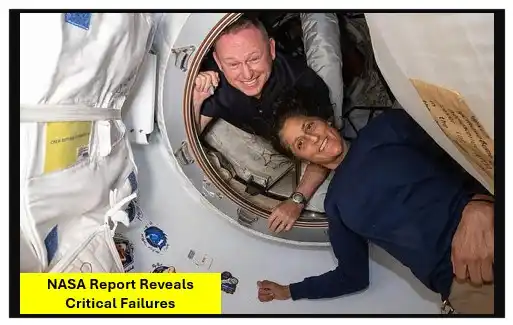
The NASA investigation has revealed a series of technical and management errors that kept humans in space for 9 months. The results have made people very worried about how the government oversees safety and makes decisions. Officials say the breakdown showed flaws that have been seen in other tragedies, like the terrible Space Shuttle Challenger accident.
NASA has finished investigating what went wrong with the 2024 Starliner and why two men were stuck in space for 9 months.
The space agency said on Thursday that the event was a Type A mishap, which is the worst kind of mission failure. The test flight of the Starliner is now in the same group as the Challenger and Columbia tragedies, which killed 14 people in total.
Technical Problems Were Ignored Before Launch
In July 2024, Sunita Williams and Butch Wilmore were sent to the International Space Station (ISS) with plans to stay for eight days. But the ship broke down, making it dangerous for people to move. NASA had to send it back to Earth, leaving the astronauts stuck on the ISS until March of last year.
Investigators say there were several red flags during pre launch tests. Engineers had found problems with the way key systems were working, but these were not seen as major threats but as acceptable risks. Over time, these small problems grew into big ones that made it hard to return safely and on time.
Soon after entering orbit, the spacecraft’s propulsion system began to malfunction. It turned out to be harder than imagined to try to fix the problem online. The backup systems didn’t work as planned, so mission managers had few options.
The study says that safety reviews did not fully think about what could go wrong. Risk assessments were mostly about meeting task deadlines, not so much about what might happen in the long run.
also read: Hydrogen leak delays NASA’s moon mission
Communication problems and pressure on the leader
The attitude toward internal communication is another major issue the results highlight. People who worked as engineers and raised concerns felt their messages were not taken seriously enough at higher levels.
Experts thought this pattern reminded them of what they learned from the Space Shuttle Challenger disaster, where technical problems that were not taken into account led to disaster. Even though no one was hurt in the latest event, the similarities have prompted people to discuss safety culture again.
The study also said that the way different sections worked together was not well organized. Teams shared information about weak spots in the system, but there was no single plan to address the growing dangers.
read more: NASA Crew-12 Soars as SpaceX Falcon 9 Roars
Astronauts Stay on Mission for Longer Time
The men who got stuck had to remain in space for much longer than planned.
There was a mindset where time was sometimes more important than safety. As decisions and stresses that happened before and during the flight.
After the mission, worries about the program’s image kept it from officially reporting a mistake at first and the program did its own study first.
Calls for Change and Responsibility
In response to the results, NASA’s leaders have promised major changes. The office wants to change how it reviews safety and strengthen independent control. Officials have promised that in future flights, engineers who disagree will be given more weight.
Analysts in the field say that the event should also serve as a warning for the growing business space sector. As more tasks are sent out, it will be very important to maintain very high safety standards.
The study concludes that strong leadership and clear communication are just as important for space research as new technologies. NASA now has to work on regaining the public’s trust while preparing for future trips beyond Earth orbit.
Though the 9 month experience did not end in tragedy, it is a strong warning that in space, even small risks can turn into major threats if not addressed quickly.
