


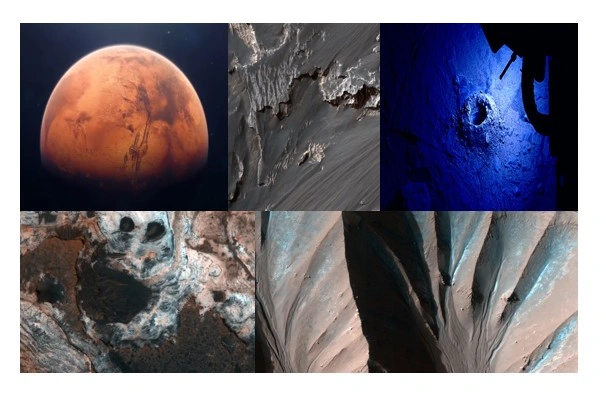
NASA provided the world with stunningly beautiful views of what Martian Evening is really like! The robotic spacecraft that have been exploring Mars revealed this to us and now show us a new side to Mars, one that is silent, darkened and shining through the universe with a faint, but certainly there, cosmic show.
NASA Brings the Wonders of Martian Nights
Mars has a very, very thin atmosphere, as well as there is not very much light produced by either of its two small moons, so at the time of Earth, Martian skies appear darker with less bright lights than those on Earth. As a result of this, stars show up with extreme clarity and are literally able to be seen from all of the different positions in the solar system.
NASA Reveals the Magic of Martian Nights- A Sky Unlike Earth’s!
When they look at the stars, you can see the Earth Constellations; however, the constellations show up at different angles depending upon your Position in the Solar system (there can be 3 different variations of each Constellation). In some of these photos, we can see some marginal amounts of what has been created by the Milky Way are being displayed, which is incredible for how different the surface of Mars is when compared to Earth.
Phobos and Deimos Glimmer in the Night
The two moons’ (Phobos and Deimos) role in what happens in the night on Mars is not great; they each produce some kind of light on the surface of Mars, but they do NOT completely illuminate the surface of Mars the same way our Earth’s Moon does.
Rather they are two very small, fast-moving, bright blobs in the sky creating their own shadows on the ground. Phobos is the more significant of the two, because it rises and sets faster than Deimos does and can cast extremely faint shadows on the surface of Mars, typically live for no more than 5 minutes.
Twilight Blues and Dusty Hues
Martian twilight is an extraordinary sight; sunrise and sunset on Mars have a bluish hue close to the Sun with a reddish hue farther away due to fine dust suspended in Mars’ atmosphere; at night, fine dust scatters light differently than it would produce a muted glow around the horizon instead of complete darkness.
Why Night Images Matter to Science?
The beauty of these images are also scientifically important to scientists studying the Martian atmosphere, dust movement, and weather. They also utilize star visibility to help them calibrate cameras on the rover and determine atmospheric clarity. Observing how temperatures drop after sunset helps researchers develop future missions, specifically for human exploration.
A Quiet, Lonely World
The most noticeable feature of NASA’s night images on Mars is the lack of noise; there are no city lights or clouds to distract from the scenery; all there is to see is rocks, dust, and a vast expanse of sky. They illustrate how remote Mars is from Earth and how rare the experience of being there would be as an astronaut on Mars.
A Glimpse Into Future Exploration
Astronauts can expect amazing, but challenging, experiences at night on Mars. The one-of-a-kind Martian night images will give astronauts an idea of what to expect as they view a planet in silence with thousands of stars and be reminded of how far away from home they are and how much they have left to explore.
Indian Origin NASA Astronaut Sunita Williams Retires After 27 Years
