


Rising conflict in the Middle East has shifted attention toward the response of businesses in their attempt to use the Strait of Hormuz as a passage for vessels moving between oil-producing countries in the Persian Gulf and importing nations throughout the world. The current state of affairs in the Middle East — particularly involving Iran’s ongoing war with the U.S. and Israel — has raised concerns surrounding the ability of vessels entering or leaving the Strait to do so without running the risk of being attacked by hostile elements.
As a maritime chokepoint, the Strait represents one of the world’s most strategically important waterways and is significant for trade between countries throughout Asia, Europe and North America. Approximately 20% of the total amount of oil produced globally on a daily basis flows through the Strait, making any interruption to ship traffic in this area potentially catastrophic for international markets and energy suppliers.
In light of increased caution by companies involved in international shipping, insurance, or commerce, hundreds of oil tankers have reportedly ceased operations or stationed themselves offshore in nearby bodies of water until the risk of travel along this waterway has been reduced.
Alternative Routes Proposed by Harsh Goenka
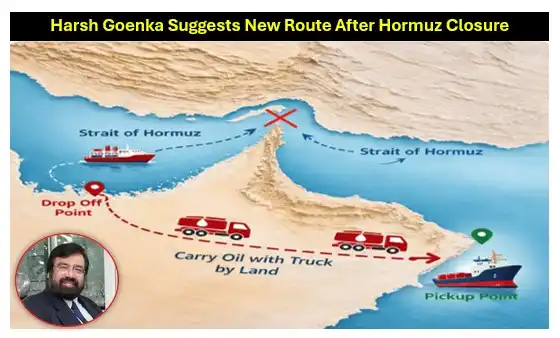
In an attempt to provide an alternative travel route, Indian businessman and entrepreneur, Harsh Goenka, has recently posted options for developing an alternative logistical route for transporting crude oil in place of transiting through the Strait of Hormuz.
As suggested in the proposed scheme, oil tankers will be able to offload shipments of crude oil in the Persian Gulf prior to being able to access the Strait. These shipments will then be transported by either trucks or other overland logistics systems, across Oman. Once transported to Oman’s coast on the Arabian Sea, they will be able to be reloaded onto another tanker and transported via the open Indian Ocean, avoiding this hazardous checkpoint.
Goenka posted the map with the question, “Could this be a solution?” The post gained significant traction online and sparked debates about how feasible this may be.
read also: Iran sent 11.7 million barrels of oil to China
Public reactions and online frenzy
Goenka’s suggestion has created a surge of reactions from social media users. Some have attempted to engage a serious conversation around the logistics of transporting oil overland through Oman, while others have engaged more creatively.
People are sharing many AI generated pictures and videos of how they can think of unimaginably transporting oil through Oman. Some of the pictures depict ships with wheels travelling on highways, some showed barrels on camels and others showed drones lifting entire ships.
Even with comedic commentary present in these discussions, there is an increasing level of concern on a global scale about the vulnerability of these major maritime chokepoints and the need for alternative supply routes to increase resiliency during geopolitical events.
read also: PNG and CNG Supply to Remain Stable IGL Reassures Consumers
Why the Strait of Hormuz Matters?
The Strait of Hormuz has historically been viewed as the most important transit point for oil globally. Millions of barrels of crude oil (and large quantities of LNG) move through the narrow strait on a daily basis, providing an important link to bring major producers in the Gulf Region into the world marketplace.
Saudi Arabia, Iraq, Kuwait, and the United Arab Emirates all rely heavily on the Strait of Hormuz for exporting their energy resources to customers in Asia, Europe, and elsewhere. The Strait of Hormuz is particularly important for energy importers (e.g., India) who receive a large percentage of the crude oil they import from West Asia via the Strait.
Analysts warn that even a temporary disruption of the transit of oil through the Strait of Hormuz could trigger increases in oil price, bottlenecks in the supply chain and uncertainty in global market.
As evidenced by the current crisis, increased oil prices have already been achieved as a result of the current geopolitical issues affecting the region, with the added possibility of future shortages if this situation fails to improve.
Debate Over Practicality of the Idea
Experts speculate that despite Goenka’s proposal being a very public idea, creating a large-scale “land transfer” system would be complicated and expensive. It would require significant investments to build adequate infrastructure, coordinate logistics across multiple locations, and provide adequate protection and security at multiple borders.
However, this concept highlights the need for governments and energy companies to investigate alternative routes and contingency plans for protecting global energy supplies. With ongoing tensions in the region, government and energy companies might look more often to diversify their transport options away from the single major checkpoint of the Strait of Hormuz.
