


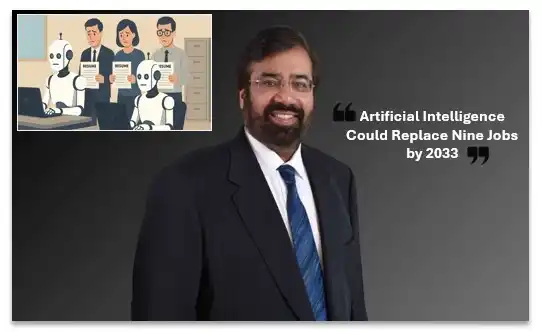
Harsh Goenka, an industrialist, has given a strong warning about the future of work. He says that rapid technological change and AI could eliminate nine major job roles within the next seven years. His post on the social media site X has sparked a lot of discussion about how AI could change jobs and what workers can do to prepare for the future.
People know Goenka as a leader in the Indian business world and for being active on social media. He said that AI is getting stronger and is already changing how many jobs work. He said that by 2033, some jobs that were once thought to be safe might no longer exist if technology and smart systems keep improving at the current rate.
AI is going to change the way people work
In his post, Goenka discussed how the world of work is about to undergo a period of rapid change. He said that AI is getting better so fast that it is beating standard job structures. This will have real effects on workers in many fields, he said. He gave a time frame for his prediction, saying that the next five to seven years will be very important in determining which jobs will change and which may go away due to automation.
Some people, businesses and politicians have been made aware of the importance of planning for the future because of the warning. Many experts think that AI will not only open up new opportunities but also drastically alter the nature of current jobs, causing changes in the skills needed and the way people work together.
you may also like:
Nine jobs with a lot of risk
Goenka named nine specific jobs he thinks AI systems will most likely replace or change significantly in the next few years. There are expert jobs, professional jobs, and even jobs that require you to be artistic and think critically. His prediction is that the following kinds of jobs may be very dangerous by 2033:
Jobs that involve writing code and making software
- Driving jobs
- Teaching roles
- Work in creative arts and design
- Medical professionals such as doctors
- Legal professionals such as lawyers
- Jobs in factories and manufacturing
- Surgeons
- Soldiers
Goenka’s list shows that AI is changing more than just simple, routine or physical work. It could soon change more complicated professional jobs that were once thought to be safe from automation. Different types of people in this wide range are worried about the changes that are coming and are asking how they can get ready for them.
What might happen to these jobs?
From Goenka’s point of view, these jobs are at risk because AI technologies are quickly learning to do tasks people used to do. For instance, AI powered writing tools can now write software code, fix bugs, and even suggest ways to make things better without any direct human input. Self driving cars are making quick progress in areas like driving and could take over a lot of work in operations and transportation.
Many people were surprised that doctors, surgeons, and troops were put on the list of people who are at risk because their jobs require a lot of judgment, decision making, and dealing with people. But Goenka isn’t saying that the whole job will go away. What he is saying is that adding AI tools could change how these jobs are done and reduce the number of people needed to do certain tasks.
Asks people to be ready and flexible
Because of Goenka’s advice, business leaders have told workers to prepare by learning new skills and improving at old ones. As AI becomes more common in everyday life, many experts say that the ability to adapt and learn new skills will become increasingly important. One way to do this is to learn to work with AI systems rather than be replaced by them.
A lot of attention is also paid to building skills that are inherently human, such as critical thinking, emotional intelligence, communication, imagination, and problem solving. These are places where AI doesn’t do as well right now and where humans might still have an advantage.
Goenka’s prediction has a bigger message: pros shouldn’t wait until changes can’t be stopped. He thinks the job market of the future will reward people who take the initiative to learn new skills and adapt to technological change rather than fight them.
