


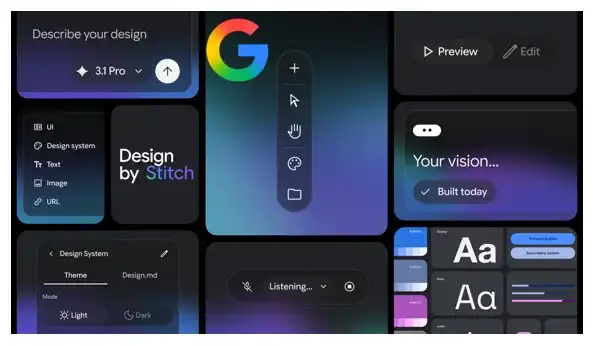
The blank page is the creator’s time-honored foe. Whatever your role, be it a designer or a coder or a strategist, that empty white void is an immense thing to fill. The experimental collaborative environment that is Google’s project Stitch has, for years now, been attempting to fill the void between a messy brainstorm and polished product. This week, Google unveiled its biggest revamp to the platform yet, transforming Stitch from a digital scrapbook to a living co-creator.
The update brings along three pillars: Voice-to-Canvas entry, an Infinite Spatial Canvas to work with and a powerful Design Agent that doesn’t just suggest color palettes but gets the intent behind your doodles.
From Typing to Talking: The Human Voice as a Paintbrush
The most direct adjustment is the way we relate to the interface. Previously, “voice input” in creative tools was like a glorified dictation service — clunky, literal and error prone. The new Stitch voice integration based on the latest Gemini multimodal architecture is different. It understands context.
Picture yourself in a studio, coffee at hand, staring at a fascicle. Instead of clicking through nested menus to change a font or move around a hero image, you just say things like “Can we make this section feel more ‘1970s brutalist’ but keep the typography modern?” The AI isn’t just looking for a “brutalist” tag, but studying the current layout and tweaking grid, shadows and spacing to fit in with the aesthetic vibe you’ve described. This also brings a human touch to the technology and keeps the user in a ‘flow state’. You are not just using software anymore; you are talking to your workspace.
you may also like:
- Google Chrome on Android gets desktop-style bookmarks bar
- Google adds feature to help Android users track lost luggage
The Infinite Canvas: Breaking out of the Box
Work nowadays is hard to be linear, yet most of our tools constrain us into the limits of an A4 page or a 16:9 slide. Google’s move to an Infinite Canvas in Stitch pays homage to the “war room” style of physical creation, where walls are plastered with sticky notes, drawings and reference photos.
This spatial architecture enables teams to zoom out for a bird’s-eye view of an entire multi-year project and then dive down into a single line of code or pixel-perfect icon.
Persistent Spatial Memory: the canvas “remembers” where you put things in relation to each other. Put a research PDF next to a mood board, the Design Agent knows they are talking about something similar.
Fluid Zooming: The interface employs a new vector-based rendering engine, which effectively means that whether you’re looking at a pocket-sized thumbnail or billboard-sized graphic, the clarity is tactile and razor.
Non-linear navigation: You can “jump” between groupings of ideas, allowing if and where astronauts (e.g., marketing, engineering) to function in the same “universe” without stepping over one another’s layers.
The Design Agent: Not an Assistant but a Peer
At the heart of this update is the Stitch Design Agent. In the old way, systems could suggest templates; the new Agent is like an active co-creator. It watches you work on the canvas, and then starts predicting your needs.
If you begin sketching an approximate wireframe for a mobile app, Agent doesn’t sit still waiting for instructions. It could seamlessly fill a sidebar with high-fidelity parts that are designed to fit your brand’s design system. If it detects a potential color contrast issue that would not pass accessibility standards, it gently nudges you with something like, “Hey, this could be hard to read for some users — how about we try a deeper navy?”
