


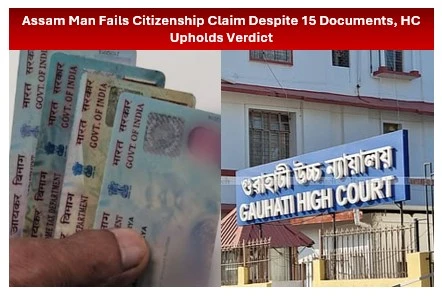
The Gauhati High Court has upheld a Foreigners Tribunal decision declaring an Assam resident a foreigner, despite the man submitting 15 documents and oral testimony in support of his claim to Indian citizenship. The court ruled that the evidence presented was either legally inadmissible or insufficient to establish his citizenship.
The petitioner, a daily-wage labourer residing in rented accommodation near Guwahati, had relied on documents including 1951 NRC records, voter lists, a school certificate, a land deed, a PAN card, and an Elector’s Photo Identity Card (EPIC). However, the court found that none of the evidence successfully proved his ancestry or citizenship.
High Court Upholds Foreigners Tribunal Decision
A Division Bench comprising Justices Kalyan Rai Surana and Shamima Jahan dismissed the petitioner’s writ petition on June 30, affirming the earlier opinion of the Foreigners Tribunal.
The Bench observed that the petitioner had failed to meet the burden of proof required under Section 9 of the Foreigners Act, 1946.
According to the judgment, the petitioner failed to:
“discharge his burden as required under Section 9 of the Foreigners Act, 1946 to prove that he is not a foreigner but an Indian Citizen”.
India Today Digital withheld the petitioner’s identity because he has not yet exhausted all available legal remedies.
Read more: PM Modi Urges Amarnath Yatra Pilgrims to Keep the Route Clean and Put Nation First
Documents Submitted to Establish Citizenship
The petitioner submitted 15 documents before the Foreigners Tribunal in an effort to establish his Indian citizenship.
The documents included:
- Computer-generated copies of the 1951 National Register of Citizens (NRC) containing the names of his father and grandparents.
- Certified copies of voter lists from 1996 to 2017 featuring family members’ names.
- A 1973 original land purchase deed executed by his grandfather.
- A 2017 school certificate issued by Hashdoba Anchalik High School.
- His PAN card.
- His Elector’s Photo Identity Card (EPIC).
The petitioner stated that he was born in 1988 and worked as a daily-wage labourer while living in rented accommodation in Borbori, Guwahati.
He also explained that repeated river erosion forced his family to relocate from Charai Khasara to Dhobakura, then to Ghugudoba, and later to Hashdoba, where he studied in Class 5 at Hashdoba Anchalik High School in 1999.
To support his case, both the petitioner and his father provided oral testimony before the Tribunal.
Read more: Bengaluru Daycare Abuse Case Five Caregivers Booked After Toddlers Allegedly Tortured
Why the 1951 NRC Records Were Rejected
Among the documents presented, the 1951 NRC records were considered central to the petitioner’s claim. However, both the Tribunal and the High Court ruled that they could not be accepted as evidence.
The High Court agreed with the Tribunal’s finding that:
“the NRC of 1951 were a photocopy/computer generated details, which was not proved in accordance with law”.
The judgment noted that the records were computer-generated documents carrying Image IDs and the notation “Generated by DLDD Version 6.0”.
The court further observed that the documents lacked the certificate required under Section 65B of the Evidence Act, 1872, corresponding to Section 63(4) of the Bharatiya Sakshya Adhiniyam, 2023, and therefore had no evidentiary value.
Additionally, citing Section 15 of the Census Act, 1948, the court held:
“NRC extract produced to prove domicile in India is inadmissible in evidence”.
The rejection of these records significantly weakened the petitioner’s effort to establish his ancestral linkage.
Read more: 11-Year-Old Canadian Boy Dies of Rabies After Bat Encounter
Other Documents Also Found Insufficient
The High Court also upheld the rejection of several other documents relied upon by the petitioner.
School Certificate
The 2017 school certificate was not accepted because the petitioner did not produce the headmaster who had issued it as a witness. The school admission register was also not presented to authenticate the entries.
Land Purchase Deed
The 1973 land deed executed by the petitioner’s grandfather was found inadequate due to the absence of evidence connecting the property to the petitioner’s family lineage.
The Tribunal also noted:
“no explanation that if the land existed, why the land did not devolve on the legal heirs of petitioner’s grandfather”.
No land revenue records were produced to establish how ownership of the property passed to subsequent generations or whether the petitioner’s father had relinquished any share.
PAN Card and EPIC
The High Court reiterated that both the PAN card and EPIC could not serve as proof of citizenship.
The judgment observed that it is already “well settled” that these documents are “not proof of citizenship”.
Court Identifies Inconsistencies in Voter Lists
The voter lists submitted by the petitioner also failed to satisfy the court due to multiple inconsistencies.
One discrepancy involved conflicting age records, with a family member listed as 25 years old in the 1979 voter list but 29 years old in the 1989 voter list.
The court also found that several names appearing in the voter lists were unsupported by pleadings or evidence linking them to the petitioner’s family.
Another significant issue involved the family’s presence across Dhobakura, Ghugudoba, and Hashdoba.
According to the court, the records from these three distinct places did not establish a continuous lineage extending back to the pre-1966 period, leading both the Tribunal and the High Court to reject the voter lists as reliable citizenship evidence.
Oral Testimony Alone Was Not Enough
The petitioner’s father also appeared as a witness to establish family lineage.
However, the High Court held that oral statements alone cannot establish citizenship.
The judgment emphasized:
“documentary evidence must be proved from record and not solely by oral testimony”.
The court also noted that the petitioner’s 1988 birth year, as recorded on his PAN card, was not confirmed by his father.
Further, during cross-examination, the father was found to be a different individual from the person whose name appeared on the 2015 voter list, despite his name appearing on the 1970 voter list.
Court Finds No Error in Tribunal’s Decision
After reviewing the evidence, the High Court concluded that the petitioner had failed to identify any legal flaw in the Tribunal’s findings.
The judgment stated:
“The petitioner has not been able to establish that the learned Tribunal had committed any patent error in appreciating the pleadings and evidence on record.”
It further observed:
“no material to hold that the opinion assailed in this writ petition is bad on facts or in law”.
The court also recorded that the petitioner’s counsel:
“could not show that the said opinion was perverse on any count whatsoever.”
Accordingly, the writ petition was dismissed, and the Foreigners Tribunal’s declaration that the petitioner is not an Indian citizen was upheld.
Conclusion
The Gauhati High Court’s decision underscores that submitting multiple documents alone is not sufficient to establish Indian citizenship if the evidence fails to satisfy legal standards. In this case, despite presenting 15 documents and oral testimony, the petitioner was unable to prove his claim, leading the court to uphold the Foreigners Tribunal’s decision declaring him a foreigner.
