


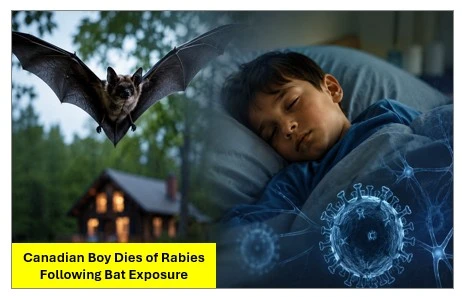
An 11-year-old boy in Canada has died after contracting rabies following direct contact with a bat during a family trip to a cottage in Ontario in 2024. The case, detailed in a report published Monday in the Canadian Medical Association Journal, highlights the importance of seeking immediate medical treatment after any direct interaction with a bat, even when no visible injuries are present.
Boy Developed Rabies After Bat Contact During Ontario Cottage Visit
According to the Canadian Medical Association Journal, the incident occurred while the boy and his family were staying at a cottage in Ontario in 2024.
The report states that the child woke to find a bat covering his nose and mouth. He immediately swatted the animal away, and his father later captured the bat in a pot before releasing it outside.
Because the boy showed no visible bite marks or scratches and the bat did not appear to behave unusually, his parents did not seek immediate medical care.
Read also: 11-Year-Old Dies After Tree Falls on School Bus in Mumbai, 5 Children Hospitalised
Symptoms Appeared Nearly Three Weeks Later
Nineteen days after the encounter, the boy began experiencing numbness and swelling on his face.
His family sought emergency medical attention over the following days as doctors at clinics and a hospital attempted to determine the cause of his symptoms.
Initially, clinicians believed he might have Bell’s palsy, a temporary paralysis affecting the muscles on one side of the face. He was prescribed antiviral medication commonly used to treat infections caused by herpes viruses.
Read also: Delhi-Mumbai Expressway Tragedy 7 Dead, 22 Injured After Sleeper Bus Hits Trailer
Multiple Hospital Visits Before Rabies Was Suspected
The boy later visited a hospital on consecutive days.
During the first visit, doctors suspected herpes gingivostomatitis, a viral infection affecting the mouth and gums. He returned the following day after weakness developed on the right side of his face.
While waiting to be admitted, his condition deteriorated rapidly. He developed a fever of 39C (102F), experienced difficulty swallowing, became confused, and suffered visual hallucinations.
Doctors subsequently intubated him and transferred him to the paediatric intensive care unit.
Laboratory Tests Confirmed Rabies Infection
Specialists from the University of Manitoba’s Department of Pediatrics and Child Health strongly suspected rabies based on his worsening neurological condition.
Several days later, laboratory testing confirmed the diagnosis. The Canadian Food Inspection Agency also identified a bat rabies virus variant.
The boy died 17 days after being admitted to hospital.
The medical report also noted that he had no history of allergies, sick contacts, tick bites, or recent travel outside Canada.
Rabies Remains Rare but Highly Fatal
Human rabies cases remain uncommon in Canada.
According to the Canadian Veterinary Medical Association, there have been 28 human deaths from rabies in Canada since 1924.
The association states:
“This low rate of rabies is due to widespread, ongoing vaccination programs, and failure to continue these programs can and will result in a return of disease.”
Medical experts emphasize that any direct human contact with a bat is considered an indication for rabies postexposure prophylaxis, which is preventive medical treatment administered immediately after a possible exposure to a rabid animal.
The report also notes that rabies infection is almost always fatal once symptoms develop.
Conclusion
The tragic death of the 11-year-old boy underscores the critical importance of seeking immediate medical evaluation after any direct contact with a bat, regardless of whether injuries are visible. Although rabies remains rare in Canada, prompt post-exposure treatment is considered essential because the disease is nearly always fatal after symptoms begin.
