


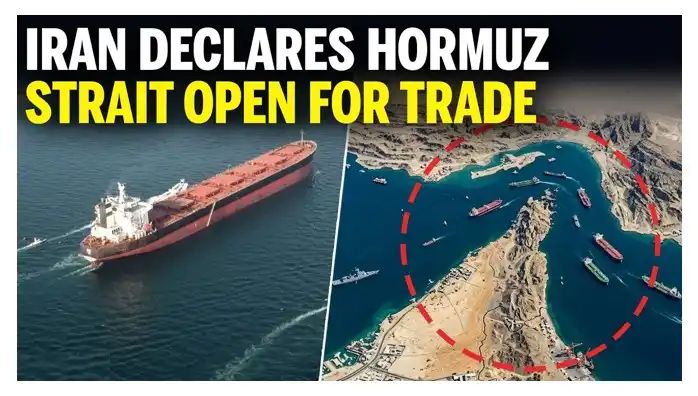
Iran issued a declaration that the Strait of Hormuz is open to be traversed by vessels from other nations without obstruction by the Iranian military. This statement served as an announcement of an upcoming change to how the Strait of Hormuz operates and could alter the strategic balance between nations with interests in the region.
The Strait of Hormuz is located within the waters adjacent to Oman and Iran and serves as a key shipping lane for oil and liquefied natural gas (LNG). Approximately 20% of all oil and LNG produced on earth is transported through the strait.
For most of the last year, access to the Strait of Hormuz had been effectively blocked due to hostilities between Iran and the U.S. as well as ongoing military operations between Israel and Lebanon. Because of this situation, oil prices around the world have risen sharply; there are increasing concerns regarding energy supply chain security.
Iran’s Statement: All Commercial Vessel Traffic Allowed
On April 17, 2026, Iran released a statement allowing all commercial vessels into the Strait of Hormuz. However, this statement includes numerous restrictions on the vessels that will be allowed into the strait. Iran has mandated that all vessels that are entering the strait must travel through designated shipping channels, and must follow any navigational or other instructions provided by the Iranian Government (e.g., use of IRGC vessels).
This is yet another example of Iran’s effort to synchronize its reopening of the Strait of Hormuz to its existing initiatives related to coordinating activity in other areas of conflict (e.g. ceasefire in Lebanon). This could mean that Iran is only granting provisional access to vessels for a very short time; however, it will need to establish some type of system to enforce compliance with this new mandate.
Iran has reiterated that if the United States continues its naval blockade on all of Iran’s ports, it will not hesitate to once again close the Strait of Hormuz, or if there are any violations related to the ceasefire.
read more
- US turns path waives sanctions on Russian oil sales
- LeT Co-founder Amir Hamza Shot in Pakistan Critical Condition
- China’s 4 point peace proposal to resolve Middle East war
Continued Uncertainty: “We Are Open But Not Fully Functional”
Currently, existing conditions are troubling to many, and continue ongoing; since the announcement of the reopening of the Strait of Hormuz, there have been very few new transits of vessels, with only a limited number of vessels transiting the strait at an average rate of approximately 100 per day before the announcement of the reopening of the Strait of Hormuz.
Some reasons why some vessels are returning to shore are:
- Potentially large numbers of sea mines in channels;
- “Uncertainty” regarding safety and
- No delineated channels and procedures for transiting through waterways.
Companies and organizations that rely on shipping for their business will not resume operations until they receive some form of guarantee of security and/or definitive guidelines for navigating through the area.
Global Marketplace Reaction
The financial markets reacted promptly and quickly to the announcement concerning the opening of the Well Path. The price of oil dropped drastically following this announcement. Brent Crude fell approximately 9%, while U.S. Crude fell more than 10%.
There was also an increase in stock prices on the assumption that the opening of the Well Path would stabilize energy supplies. There was positive activity on the financial markets; however, many analysts believe that such activity is likely to be premature. Actual stabilization of oil flow has not been confirmed at this time; however, logistical bottlenecks and ongoing uncertainty concerning security concerns and political tensions will continue to negatively affect oil supply as long as the Well Path is open.
International Organizations = Cautious Optimism
International organizations and world leaders have responded to this decision; however, their reactions have been measured. The UN has reaffirmed the need for freedom of navigation, while the European and regional leaders have called for a long-term solution that will address the real causes of the dispute.
In contrast, the United States continues to maintain its naval blockade of Iran, indicating that larger geopolitical disputes remain unresolved. Maritime organizations echoed the same caution expressed by the shipping lines, noting that operational decisions will be based on risk assessments rather than political announcements.
Strategic Implications
The reopening of the Strait of Hormuz emphasizes the importance of Iran’s strategic position with respect to global energy markets. Iran’s control of the Strait of Hormuz provides it with significant influence over the price of oil and global trade flows.
Even though the Strait of Hormuz is now “open,” Iran is still exercising tight control over the passage of vessels through the strait, requiring permission to transit and restricting transit routes. Therefore, to the extent that the Strait of Hormuz operates as a bargaining tool, it is more useful to Iran as a geopolitical leverage point than it is as an impassable neutral passageway.
What Lies Ahead?
The reopening of the Strait of Hormuz is a positive sign; however, it should be noted that the current situation is still very delicate and fragile. The ceasefire underlying the reopening is only temporary, while there will still be ongoing tensions between the United States and Iran.
Experts say
- It could be a while before shipping volumes are back up to previous levels.
- Insurance and security-related issues could delay the return of trade normalization.
- If diplomacy between Iran & the U.S.A fails, the opening of the Strait of Hormuz could quickly turn into its closure again.
Summary
While the Strait of Hormuz is currently open, that does not necessarily mean that it will remain open indefinitely.
Conclusion
The Iranian government’s reopening of the Strait of Hormuz gives the world market and supply chain participants temporary hope for some stability in the immediate future, although it has additional conditions and is reversible. The next few days are critical in deciding if the reopening will create longer-lasting stability in our global economy, or if it will be followed by more conflict due to an unpredictable global environment caused by ongoing tension, disappointment and distrust between the United States and Iran.
